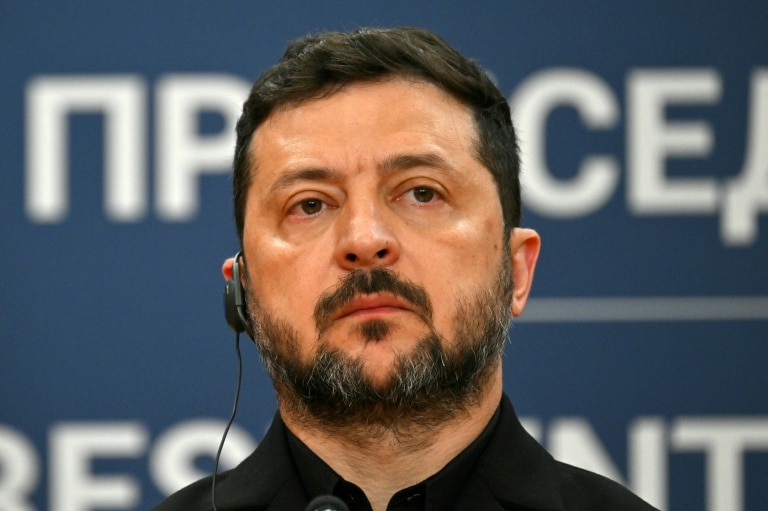
In a candid briefing with journalists held Saturday, comments on which were made public Sunday, Ukrainian President Volodymyr Zelensky firmly rejected calls to hold national elections during the ongoing full-scale Russian invasion, warning that a vote at this stage of the conflict would tear the country apart amid existential danger.
The announcement comes in the wake of a surprise call for elections from ousted former Defense Minister Mykhailo Fedorov, whose recent push for a wartime vote even split some of his own political backers, who have stepped back from the proposal. This latest political upheaval follows widespread public protests after Zelensky dismissed the popular defense minister last month, triggering a period of domestic unrest that has put the Ukrainian leadership’s unity under a spotlight.
Since Russia launched its full-scale invasion in February 2022, Ukraine has operated under martial law, which legally suspends all national electoral activity. This measure continues to hold broad popular support as the nation prioritizes fending off Russian territorial advances, according to public sentiment data. Recent polling from the Kyiv Institute of Sociology underscores this: only 15 percent of Ukrainian respondents back holding elections before hostilities come to an end.
Zelensky, who was first elected to office in 2019, framed the debate over wartime elections in stark terms during the briefing—the first he has held with international reporters including Agence France-Presse in months. “I believe that in a war like this, elections as such are a huge risk. Elections right now are a tsunami for the country that will split Ukraine,” he said. “If we want to destroy the country, then we can move in the direction of elections during these times of war.”
Beyond the risk of political division, independent policy experts have outlined a long list of practical barriers that make holding a free, fair election all but impossible during the current conflict. These include major questions around how to facilitate voting for frontline soldiers, more than 5 million Ukrainian refugees living abroad, and residents of Russian-occupied territories, along with the severe threat of Russian disinformation campaigns designed to manipulate the election outcome. Practically, the ongoing Russian missile and drone assault across Ukrainian cities also puts election workers and voters at grave risk of attack.
During the briefing, held ahead of Ukraine’s Independence Day celebrations Monday that will draw dozens of international leaders and new talks on bolstering Ukrainian air defenses, Zelensky did not hold back in criticizing his former defense minister’s call. “I believe he is going himself — or is being pushed — toward wrong things,” Zelensky said of Fedorov, who was a leading advocate for expanded drone warfare and military reform but repeatedly clashed with Ukraine’s top military command over its traditional, rigid approach to operations.
After Fedorov’s dismissal, much of the Ukrainian public initially rallied around the former minister, calling for the dismissal of Commander-in-Chief Oleksandr Syrsky. Zelensky acknowledged that Ukrainians retain the full right to peaceful protest, but pushed back against what he described as attempts to prioritize political positioning over the sacrifices of frontline troops. “Since when has marketing started to outweigh the people who are giving their lives?” he asked, adding that he sees ongoing efforts to pull the country into internal division as a dangerous development that threatens Ukraine’s war effort.
Positioning himself as a bulwark against domestic fragmentation, Zelensky emphasized that preserving unity between civilian society and the armed forces is a non-negotiable priority during the invasion. “I believe that society and soldiers must not be divided,” he said. “We must acknowledge that there is this risk — that there may be movement in that direction, toward dangerous developments.”