In a landmark first public address detailing his rift with ousted Defense Minister Mykhailo Fedorov, Ukrainian President Volodymyr Zelenskyy has laid bare a cascade of domestic political tensions, critical defense gaps, and incremental battlefield advances in a rare off-the-record meeting with reporters, whose full transcript was released publicly Sunday.
The two-hour briefing covered topics ranging from the fallout of Fedorov’s dismissal to shifting frontline dynamics, strained Western defense supplies, and ongoing budget and corruption challenges facing Kyiv amid its third year of full-scale war with Russia. Zelenskyy opened with measured remarks about his former minister, noting a long history of collaboration but confirming he viewed Fedorov’s actions—including his support for mass anti-government protests and public call for a wartime election—as fundamentally misplaced.
“I really had and still have a very positive attitude toward Mykhailo. We have been through a lot together. But I believe that he himself goes, or is pushed, into the wrong things,” Zelenskyy told reporters. He added that he had offered Fedorov four separate roles to remain in government, all of which were rejected.
Fedorov, a widely popular figure credited with revolutionizing Ukraine’s military through widespread adoption of drone technology and digital warfare modernization, was removed from his post last month following reported clashes with top Ukrainian military command. His dismissal sparked weeks of widespread public demonstrations across the country, though protests failed to reverse the decision. After his ouster, Fedorov publicly called for snap national elections—a demand Zelenskyy pushed back against forcefully in Sunday’s briefing, arguing that holding a vote amid active full-scale war poses an existential threat to Ukrainian unity.
“I believe elections during a war like this would generally pose enormous risks. Holding elections right now would be a tsunami for the state that would split Ukraine apart,” he said. Zelenskyy added that while international partners have previously pushed for wartime elections, no stakeholder has put forward a viable plan to conduct a poll that is safe, legitimate, and fully democratic amid ongoing active conflict.
Zelenskyy also alluded to problematic spending decisions by the Defense Ministry under Fedorov’s leadership, and linked inaccurate departmental intelligence to an awkward high-stakes encounter with former U.S. President Donald Trump over Starlink access for Ukrainian deep strikes into Russian territory. According to Zelenskyy, the Defense Ministry informed him earlier this year that SpaceX CEO Elon Musk had already approved Ukrainian use of Starlink over Russian-held territory for offensive operations, pending only U.S. political approval. Acting on that information, Zelenskyy raised the request directly with Trump, telling the U.S. president that Musk had confirmed the arrangement.
But when the White House sought direct confirmation from Musk, the SpaceX CEO rejected the proposal out of hand, warning the move constituted a dangerous escalation of the conflict. Zelenskyy said Trump subsequently accused him of misleading the U.S. government, a humiliating misstep that traces back to faulty information from Kyiv’s own Defense Ministry. While he stopped short of explicitly accusing Fedorov of deliberate deception, he confirmed the incident was a key factor behind the leadership changes at the defense department.
Zelenskyy also defended senior military leaders targeted by Fedorov-aligned protesters, including former army chief Gen. Oleksandr Syrskyi and current Defense Minister Maj. Gen. Yevgeny Khmara, saying demonstrators had crossed a line in their vilification of top commanders. “Maybe someone doesn’t like Syrskyi for one reason or another. But the slogans ‘Syrskyi is the devil, Khmara is the devil,’ […] this is too much. Do you understand? In principle, you can’t treat the military like this and tolerate it, especially when it was the military that made it possible for any peaceful protests to take place in the Ukrainian capital at all,” he said.
Beyond political turmoil, Zelenskyy outlined severe systemic pressures facing Ukraine’s defense apparatus, starting with a crippling $27 billion budget shortfall that emerged after early-year spending exhausted allocations earmarked for the second half of 2025. He also addressed a recent high-profile corruption inquiry that led to the firing of a senior presidential aide, noting that anti-corruption investigators have cleared him of any personal involvement in the alleged money laundering scheme. “The heads of anti-corruption agencies have zero questions for me. They understand perfectly well that I am not involved in anything like that. And this is important to me,” he said.
On the battlefield, Zelenskyy struck a markedly optimistic tone, confirming that Ukrainian forces have almost fully expelled Russian occupying troops from the Dnipropetrovsk region, with just 10 square kilometers (roughly 4 square miles) of territory remaining under Russian control. A second major offensive operation is currently underway elsewhere in the country, with preliminary results expected by the end of August, he added. The president projected that by the end of 2025, Ukraine will have retaken as much territory as Russia has seized since the start of the year: as of the briefing, Russia holds 990 square kilometers of territory captured in 2025, while Ukraine has already retaken 820 square kilometers.
Zelenskyy also warned of a growing and potentially catastrophic shortfall of Patriot air defense missiles, a critical capability for countering intensifying Russian ballistic missile strikes across Ukrainian population and infrastructure centers. He revealed that deliveries of Patriot interceptors from Western allies have dropped steadily over the past three years, falling from 675 missiles in 2023 to just 364 in 2024, with only 264 missiles expected to arrive this year. Ukraine is seeking 300 additional missiles to prepare for expected intensified Russian strikes this coming winter, while the Ukrainian air force has formally requested 360 interceptors to cover defense needs. The shortage is compounded by slow production expansion among U.S. and European manufacturers, Zelenskyy noted, adding that Ukraine is willing and able to purchase even a small share of U.S. reserve stockpiles to close the gap. He warned that Russia is ramping up its own ballistic missile production, with current capacity at 600 missiles per year and a projected peak output of up to 1,300 missiles annually.
In a nod to the Starlink controversy, Zelenskyy confirmed Ukraine is developing alternative satellite communications capabilities, including a European-led project, as Russia and China advance their own competing domestic satellite networks.
The briefing came amid ongoing cross-border drone strikes that have shifted the war into Russian territory. On Sunday, Russian local officials in Orenburg region reported that debris from a Ukrainian drone struck two industrial sites, including a warehouse owned by major Russian online retailer Ozon. Ukrainian long-range strikes have increasingly targeted Russian oil infrastructure, triggering widespread fuel shortages across the country, and have also hit retail warehouses operated by Russia’s largest e-commerce firm Wildberries and its competitors, unsettling Russian civilian populations. Separate Russian reports Sunday confirmed one person was killed and six wounded in Ukrainian drone attacks on the border region of Belgorod, while a woman died in a drone strike on Tula region. For its part, Ukraine reported Sunday that a Russian drone strike on an electric train in Kharkiv region killed two women and wounded five other people, according to the Ukrainian national police.
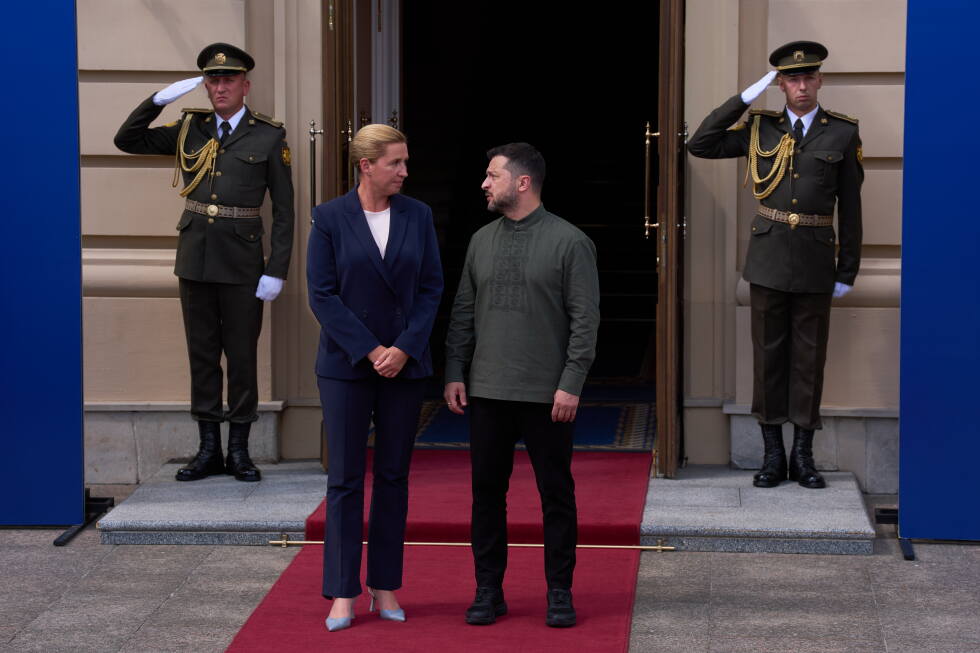
The developments coincided with a show of solidarity from key Ukrainian allies ahead of Ukraine’s Independence Day, with leaders from all Nordic and Baltic nations arriving in Kyiv Sunday for a series of bilateral and multilateral talks. The leaders of Denmark, Estonia, Finland, Latvia, Lithuania, and Norway took part in a flag-raising ceremony for Ukraine’s National Flag Day, ahead of a planned major “coalition of the willing” meeting focused on continued Western support for Kyiv. Ukrainian Foreign Minister Andrii Sybiha emphasized the importance of the visit in a post on X, writing “We feel we are not alone. Our allies are with us.”