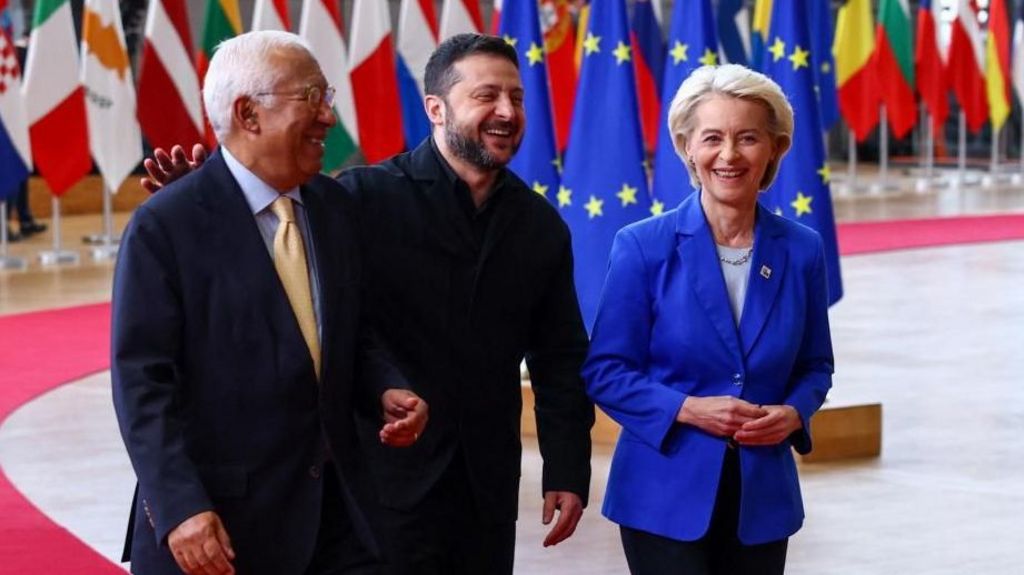
As Ukrainian President Volodymyr Zelensky arrived in Brussels Friday for a high-stakes summit with top European Union leaders, former U.S. President Donald Trump unleashed a fresh wave of sharp criticism against him, deepening tensions between the former American leader and the Ukrainian administration amid the ongoing full-scale Russian invasion.
In an interview with U.S. media outlet Newsmax Thursday evening, Trump compared Zelensky unfavorably to Russian President Vladimir Putin, claiming the Ukrainian leader is “more difficult to deal with” than his Russian counterpart. The former president also denounced Ukraine’s recent resumption of drone and missile strikes targeting Russian oil refineries as “a disgrace”, arguing that the attacks drive up global energy prices.
The breakdown of a brief, Trump-proposed ceasefire on energy infrastructure attacks explains the renewed hostilities. Zelensky had agreed to pause Ukrainian strikes on Russian energy facilities for three days at Trump’s request, but announced Thursday that strikes would resume immediately. The Ukrainian leader justified the reversal by noting that Russia never halted its own attacks on Ukrainian energy infrastructure, a violation of the informal ceasefire terms.
Overnight Thursday, that continuing Russian assault claimed new civilian casualties in northeastern Ukraine. Regional governor Oleg Synegubov confirmed via Telegram that a Russian drone strike on Kharkiv killed multiple civilians and left at least 14 others injured. As of Friday morning, Zelensky has not issued a public response to Trump’s latest critical remarks.
Top European leaders have publicly backed Zelensky’s position following the collapse of the energy ceasefire. European Commission President Ursula von der Leyen, who greeted Zelensky alongside European Council President António Costa at the Brussels summit, reaffirmed the EU’s unified stance against Russian aggression. “Of course we supported President Trump’s energy ceasefire but we’ve seen that Russia did not respect it, not a single minute,” von der Leyen told reporters on the ground. “Russia escalated and therefore we have to increase sanctions on Russia… We will not lift any sanctions unless Russia stops the war.”
Trump’s harsh comments signal a clear worsening of relations between the leading U.S. Republican presidential candidate and the Ukrainian government. The former U.S. president doubled down on his criticism, telling Newsmax: “Zelensky is not a good guy for us to deal with. He doesn’t want to settle. He says he wants to settle, but he doesn’t. I’m not a big fan of Zelenskyy.”
The dispute over energy strikes stems from competing U.S. and Ukrainian priorities. Trump’s frustration with Ukraine’s refinery strikes comes in the wake of a recent U.S. deal to import 300,000 tonnes of Russian diesel to the American market, a move designed to lower domestic fuel prices ahead of the 2024 U.S. presidential election. That agreement already drew fierce pushback from Zelensky, who publicly labeled it a “gift to Putin” earlier this week.
During his visit to Europe, Zelensky has maintained a packed schedule of diplomatic talks aimed at securing continued military and political support for Ukraine. Following a stop in London a day earlier, where he met with UK Prime Minister Keir Starmer (corrected from the original report’s misstatement of Andy Burnham), Zelensky met NATO Secretary General Mark Rutte and the heads of state of Poland, France, Denmark, and Belgium in Brussels on Thursday. Friday’s summit schedule includes additional meetings with European Council and Commission leadership, as well as the prime ministers of Hungary, Finland, and Sweden, as Ukraine pushes for continued progress toward EU and NATO membership.