Against a backdrop of persistent workplace anxiety and widespread age discrimination, a growing number of young Chinese professionals are turning to artificial intelligence to launch independent one-person companies, reshaping China’s startup landscape and offering a new path to address soaring youth unemployment.
The so-called “curse of 35” has long been a source of unease for Chinese workers: in competitive sectors ranging from tech to government roles, an unspoken “invisible line” at age 35 often leaves workers facing re-evaluation, layoffs, or stalled career growth. Compounding this anxiety is the rapid advancement of AI itself, which many young professionals fear will displace their traditional corporate roles. This confluence of pressures has pushed a new cohort to strike out on their own, leveraging AI to build viable solo ventures.
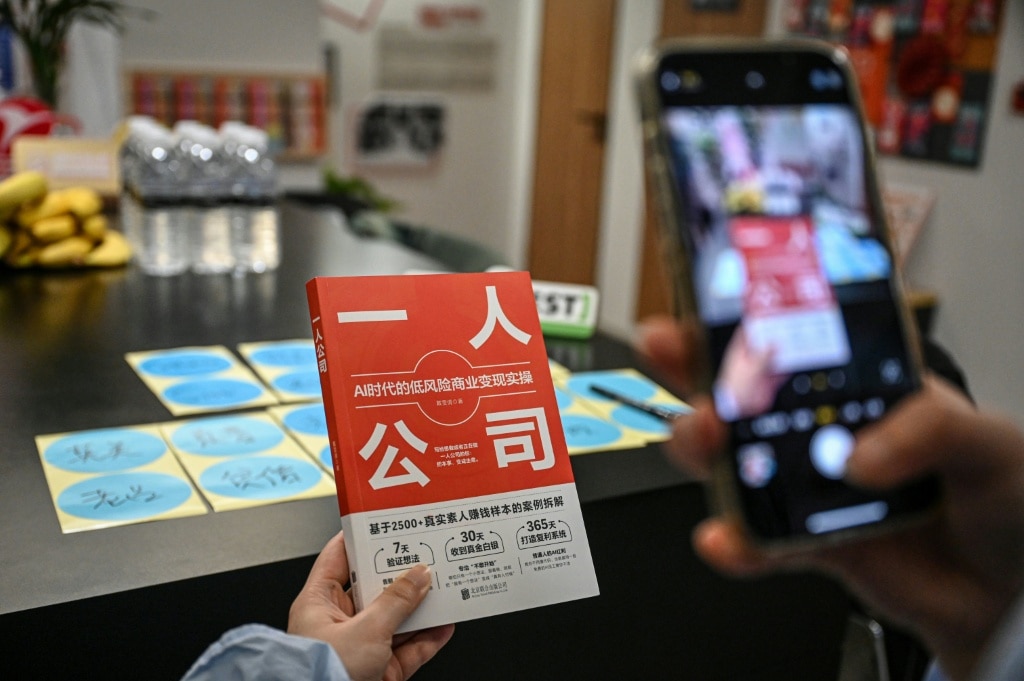
Karen Dai, founder of Shanghai-based entrepreneur community SoloNest and author of *One Person Company*, explains that AI has fundamentally lowered the barrier to entry for solo entrepreneurship. “In the past, it was nearly impossible to run an entire business alone,” she notes. “Now AI can handle a huge range of routine tasks, making the model not just feasible, but accessible.” Every weekend, Dai hosts sold-out idea-swapping events for aspiring solo founders; her most recent gathering drew nearly 20 attendees in their 20s and 30s, all eager to chart their own independent paths.
For many, the model is already delivering tangible results. Wang Tianyi, a 26-year-old who quit his corporate product manager role at a major Chinese internet firm last year, now earns up to 40,000 yuan ($5,800) per month creating AI-generated commercial advertisements for small and medium businesses. He frames the rise of one-person AI-powered companies as an inevitable shift, pointing to transformative efficiency gains from technological empowerment. “AI lets one person do the work that once required an entire team,” he says, predicting solo entrepreneurship will become a major trend in China’s economy in the coming years.
Wei Xin, a 34-year-old Shanghai resident who previously worked as a document reviewer at a foreign consulting firm, began preparing for her transition before AI displaced her role. After returning to China from completing a degree in the United States, she trained on Google’s Gemini AI model, experimented with building an AI-generated digital twin of herself, and ultimately launched a social media content creation business. “There is a bit of AI anxiety, but I see it as an opportunity,” she explains. “If I avoided learning and using it, I would be eliminated sooner or later.”
This grassroots shift has aligned neatly with both national policy goals and local government efforts to tackle youth unemployment. Beijing has prioritized advancing technological self-reliance, and local municipalities across China have rolled out targeted incentives to support these AI-powered ventures, officially dubbed “OPCs” (one-person companies) — a rare use of English initialism in official Chinese policy.
In November, Suzhou, a major manufacturing and tech hub in eastern China, announced plans to cultivate more than 10,000 OPC talents by 2028, with 700 million yuan ($100 million) in earmarked funding for AI robotics, healthcare, smart transportation, and other AI-focused sectors. Last month, Chengdu, the capital of southwestern Sichuan province, launched a subsidy program offering up to 20,000 yuan for new college graduates who launch AI-driven one-person firms.
Kyle Chan, a fellow at the Brookings Institution and an expert on China’s technology development, describes these incentives as “carrots to help these startups get off the ground and be successful.” For local governments, supporting OPCs is a low-cost strategy to address China’s persistent youth unemployment crisis, where roughly one in six people aged 16 to 24 remain out of work. “The cost of supporting an OPC for local governments is very low compared to attracting large corporate investments,” Chan notes, making the model an attractive policy option.
Still, challenges remain for these new solo ventures. Wang notes that while launching a business has become far easier with AI, many new founders struggle to commercialize their offerings and turn a consistent profit. “Getting started isn’t the hard part — the hard part is learning how to sell your work,” he says.
Despite these hurdles, for many young founders, the model offers something traditional corporate roles cannot: autonomy. “Young people are building backup plans, and asking themselves: can I, with my own two hands and the help of AI, explore the things I actually want to do?” Dai says. “This comes with a real sense of control, and of creativity that you can’t find in a traditional job.”
The trend mirrors a broader global shift: small, AI-powered solo startups have already grown popular in Silicon Valley and other global tech hubs, where AI is both a threat to traditional corporate jobs and a catalyst for a new wave of small-scale entrepreneurship. In China, the combination of grassroots anxiety, technological advancement, and government support has accelerated this shift, turning the one-person AI company from a niche experiment into a growing economic force.