On April 1 this year, China’s National Bureau of Statistics published updated provincial and municipal GDP rankings that paint a clear picture: while all major Chinese economic regions have recorded consistent growth, a profound geographic reordering of the country’s economic landscape is underway.
The most striking shift plays out at the provincial level, measured by GDP per capita. In the latest data, Jiangsu claims first place and Zhejiang takes third, leaving Guangdong in fourth position. Two decades ago, this ranking looked radically different: Guangdong held an unchallenged top spot, with Zhejiang and Jiangsu trailing far behind in third and fourth respectively.
This reordering is even more dramatic when examining city-level data. Back in 2005, nine Guangdong cities earned a spot in the country’s top 25 ranking for GDP per capita. By comparison, Jiangsu only had five cities in that group, and Zhejiang just two. Twenty years later, that balance has flipped completely: only three Guangdong cities remain in the top 25, while Jiangsu now has seven and Zhejiang has four.
None of this changes the fact that all three provinces remain among China’s most developed economic hubs. Since the launch of economic reforms in the late 1970s, China’s growth model centered on manufacturing and export-led development, which entrenched long-term regional inequality that heavily favored coastal eastern provinces. Guangdong was the original pioneer of this model.
Decades ago, Shenzhen and Zhuhai, two of China’s first special economic zones, leveraged their proximity to Hong Kong and Macao respectively to rocket up the rankings: Shenzhen held first place in 2005, and Zhuhai third. By 2025, Shenzhen has fallen to sixth and Zhuhai to 16th. Guangzhou, Guangdong’s capital and largest city, which ranked eighth in 2005, has dropped to 22nd, even as it built itself into a global manufacturing and trade hub. It is also worth noting that Guangdong remains home to some of China’s most globally successful innovative firms, from telecommunications giant Huawei and drone leader DJI to tech conglomerate Tencent and electric vehicle and battery manufacturer BYD. All these firms continue to expand their influence both domestically and internationally.
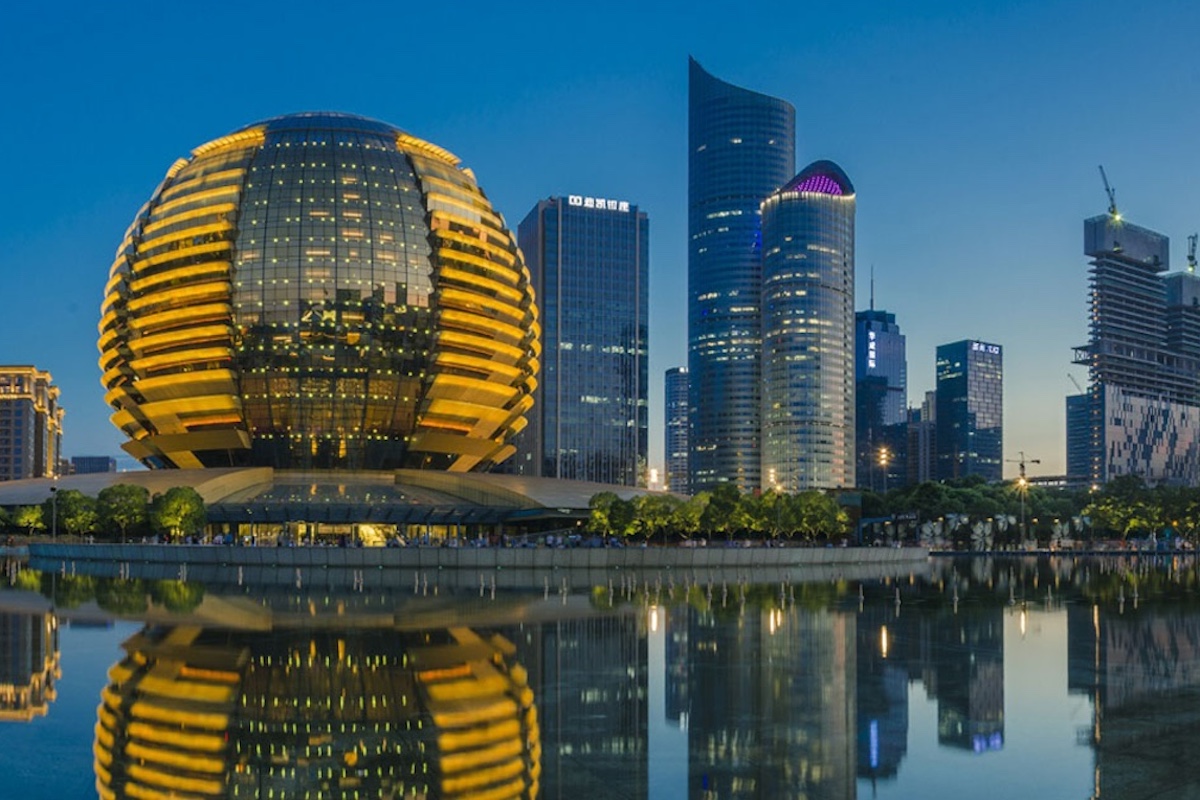
Even so, China’s cutting-edge startup ecosystem has gradually shifted northward, and the country’s latest five-year plan, released on March 12, makes this new geographic center of gravity explicit. In high-growth sectors like artificial intelligence and robotics, Hangzhou, the capital of Zhejiang, has emerged as a leading hub, home to prominent local players DeepSeek and Unitree, with backing from Hangzhou-based global tech giant Alibaba. In the fast-expanding biomanufacturing sector, national industry leader WuXi Biologics operates major facilities in Hangzhou, Suzhou (Jiangsu) and nearby Wuxi. Suzhou ranked 25th in 2005 and now sits at 7th, while Wuxi moved from 11th to 5th over the same period.
Analysts point to the strong advantage in higher education held by Jiangsu and Zhejiang as a key driver of this divergence. Last March, The Economist profiled Zhejiang University, concluding that the institution has played a transformative role in turning Hangzhou into a world-class startup hub, mirroring how Stanford University catalyzed the growth of Silicon Valley. Leading global and domestic university rankings consistently place both Zhejiang University and Nanjing University (Jiangsu’s capital Nanjing, which moved from 31st to 11th in city-level GDP per capita rankings over 20 years) among China’s top 10 higher education institutions, alongside leading schools in neighboring Shanghai and Anhui. Guangdong has no universities that hold a consistent spot in the national top 10.
This educational advantage that Jiangsu and Zhejiang hold is not a recent development: it stretches back centuries. The Jiangnan region, which covers the southern bank of the Yangtze River and spans most of modern Jiangsu and Zhejiang, has been China’s leading cultural and economic center since the Southern Song Dynasty. The region turned its historic strengths in agricultural productivity and trade into widespread artistic and intellectual achievement, laying the groundwork for a long-standing culture of academic excellence. In contrast, the Lingnan region that corresponds to modern Guangdong, while historically open to global seaborne trade, remained geographically and culturally separated from core regions of China for much of its history. Both regions carry deep commercial traditions, but Jiangnan’s centuries-old intellectual heritage gives it a unique edge in nurturing the skilled talent required to advance global technological frontiers.
This shift is not limited to economics: as Jiangsu and Zhejiang expand their economic lead, they are also reemerging as central players in China’s cultural landscape. In the 1980s and 1990s, Cantonese pop culture spread across the entire country, fueled by Hong Kong’s economic boom, giving the Cantonese language unprecedented cultural prestige across China. That prestige has declined sharply alongside Hong Kong’s relative economic slowdown. At the same time, Shanghai’s rise as a global economic powerhouse has elevated the profile of Jiangnan dialects, which are reasserting their presence in the public sphere even amid nationwide efforts to standardize Mandarin.
It is important to note that this ongoing economic and cultural shift from Guangdong to Jiangsu and Zhejiang is not a foregone conclusion. Future trajectories will depend heavily on the strategic choices and innovation success of individual entrepreneurs and firms across all regions. Global demand for Chinese goods and services is also subject to rapid shifts, shaped by ongoing trade restrictions on Chinese exports in major markets around the world. Regardless of how trends unfold in coming years, this regional reordering makes clear that China’s economic future is far from monolithic, with diverse regions competing and evolving along distinct paths.