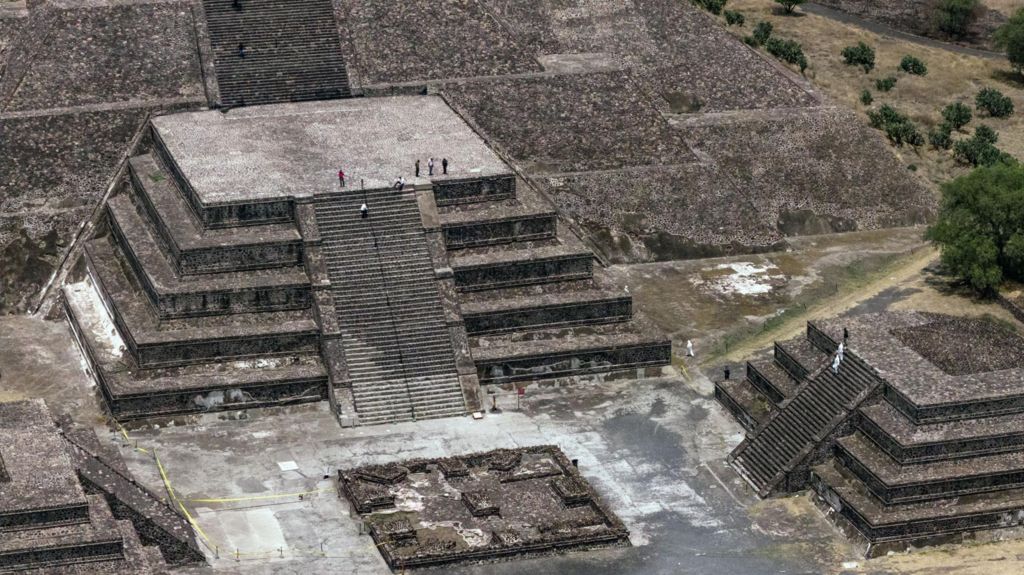
On April 21, 2026, a premeditated shooting at one of Mexico’s most iconic tourist landmarks, the ancient Pyramid of the Moon in the Teotihuacán archaeological complex, left one person dead and 13 others injured, prompting a swift response from national authorities who have moved to reassure the public ahead of this summer’s FIFA World Cup.
According to official details released by Mexican leadership at a Tuesday press briefing, the attacker was 27-year-old Mexican national Julio César Jasso Ramírez. When he carried out the attack, he brought a loaded handgun, dozens of extra ammunition cartridges, a knife, and printed materials referencing notorious violent incidents that have occurred around the world. Top law enforcement officials confirmed that Jasso Ramírez planned and executed the attack entirely on his own, with no connections to larger extremist groups or organized criminal networks. After a standoff with responding law enforcement, the attacker ultimately died by suicide on the site.
The dead victim of the attack was identified as a 32-year-old Canadian tourist. Thirteen other people ranging in age from 6 to 61 were injured in the shooting; seven of those injured suffered gunshot wounds, including two minor tourists from Colombia and Brazil. Responding officers included a member of Mexico’s National Guard and a local municipal police officer, who scaled the steep steps of the ancient pyramid to corner the attacker. The National Guard member shot Jasso Ramírez in the leg in an attempt to disable him before the attacker turned the gun on himself.
Mexican President Claudia Sheinbaum told reporters that preliminary investigations show the attacker displayed clear signs of unaddressed psychological distress and had been radicalized by prior high-profile mass shootings carried out abroad. State of Mexico Attorney General José Luis Cervantes Martínez confirmed that among the attacker’s belongings, investigators found documents, imagery and written materials referencing the 1999 Columbine High School massacre in the United States. One eyewitness tourist told Reuters that Jasso Ramírez explicitly referenced the Columbine attack during the shooting, which took place exactly 27 years to the day after the 1999 massacre.
Investigators added that the attack was far from impulsive. Jasso Ramírez had made repeated trips to the Teotihuacán complex, located roughly 50 kilometers (31 miles) northwest of Mexico City, in advance of the attack, and arrived at the site shortly before noon local time on Monday. Witness cell phone footage captured from the scene captured the chaos of the incident: visitors can be seen scrambling for cover as multiple gunshots ring out, while Jasso Ramírez can be heard making threats against crowds of tourists.
In the aftermath of the attack, the entire Teotihuacán archaeological site — a UNESCO World Heritage Site that draws roughly 1.8 million visitors annually — was closed to allow for forensic investigation and security adjustments. President Sheinbaum announced the site will reopen to visitors on Wednesday with newly implemented enhanced security protocols. The president also acknowledged that prior to the attack, most Mexican archaeological sites including Teotihuacán did not have entrance security checkpoints in place. In response, she has ordered immediate security upgrades at all tourist and archaeological sites across the country, including the installation of permanent metal detectors at Teotihuacán and other high-traffic landmarks.
With less than two months to go before the 2026 FIFA World Cup kicks off in Mexico City on June 11, President Sheinbaum moved quickly to reassure domestic and international audiences that security for the global tournament will be fully guaranteed. The president noted that she has already held in-depth talks with FIFA organizers to review logistics and security planning for the tournament. She emphasized that Mexico remains a safe destination for travelers, pointing to the 16 million international visitors that entered the country between January and February of 2026 as evidence of the country’s ongoing ability to welcome tourists safely.