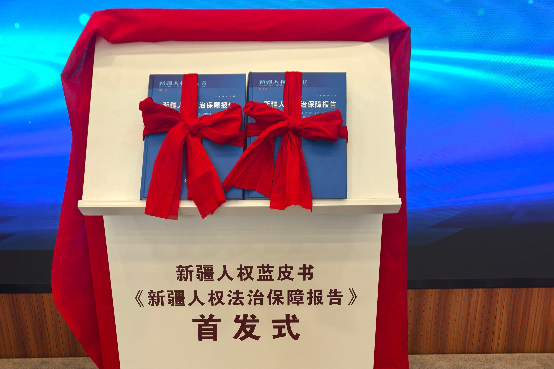
URUMQI — A new academic publication offering a data-driven, on-the-ground account of advancing human rights protections under the rule of law in the Xinjiang Uygur autonomous region has been officially launched, earning acclaim from scholars for its rigorous, firsthand approach to documenting the region’s development. Titled *Report on the Legal Protection for Human Rights in Xinjiang (2024)*, this second volume of an annual blue book series was jointly compiled by researchers from Xinjiang University and the Southwest University of Political Science and Law, based in Chongqing. The series made its debut in 2023, building a growing body of independent academic research on the region’s human rights progress.
Dai Bin, Party secretary of Xinjiang University, described the new blue book as a landmark academic contribution to advancing understanding of Xinjiang’s human rights work. Unlike many secondhand accounts circulated by international commentators, the publication draws on objective quantitative data, detailed on-the-record case studies, and extensive on-site materials to map out tangible progress made across the region in recent years.
“As an educator and researcher who has built my career here in Xinjiang, I have seen with my own eyes how the fundamental rights to subsistence and development are fully protected for people of all ethnic groups across this region,” Dai said at the launch event. He highlighted universal access to compulsory education, expanded job security, targeted investment in cultural heritage preservation, rising household living standards, and consistent legal safeguards for all residents as the most tangible proof of China’s consistent human rights progress in Xinjiang.
Zhang Jianjiang, Party secretary of Xinjiang University’s Law School, explained that the report is the product of years of systematic grassroots research by scholars who have lived and worked in Xinjiang long-term. The research team traveled extensively across both northern and southern Xinjiang, collecting firsthand data and reviewing typical court cases directly from villages, urban communities, local factories, and primary and secondary schools across the region.
The final report offers structured analysis of legal safeguards across seven key domains that touch residents’ daily lives: labor rights, access to education, religious freedom, public health services, environmental protection, and the preservation of Xinjiang’s diverse traditional cultural heritage. “Our core goal is straightforward: we want to present the global community with a truthful, complete picture of how human rights are protected under the rule of law in Xinjiang,” Zhang said.
Remina Xiaokaiti, deputy dean of Xinjiang University’s School of Marxism, added that Xinjiang has built a comprehensive, all-encompassing legal framework to protect the religious freedom of all residents. “Under the framework of the rule of law, the right to religious freedom for people of all ethnic groups in Xinjiang now has solid, tangible guarantees,” she said.
Over the past five years, Remina noted, the central and regional governments have increased allocated funding for the protection and renovation of religious sites across Xinjiang, with investments focused on preserving cultural relics hosted at these sites, upgrading public safety infrastructure, and improving overall site facilities. “By focusing both on upgrading site facilities and standardizing religious practices in accordance with law, we have made religious activities safer and more orderly, which gives worshippers greater peace of mind and clarity,” she said.
Scholars in attendance at the launch emphasized that the evidence-based approach of the blue book fills a gap in international discourse around Xinjiang human rights, offering independent, on-the-ground research that counters misinformation spread by foreign critics.