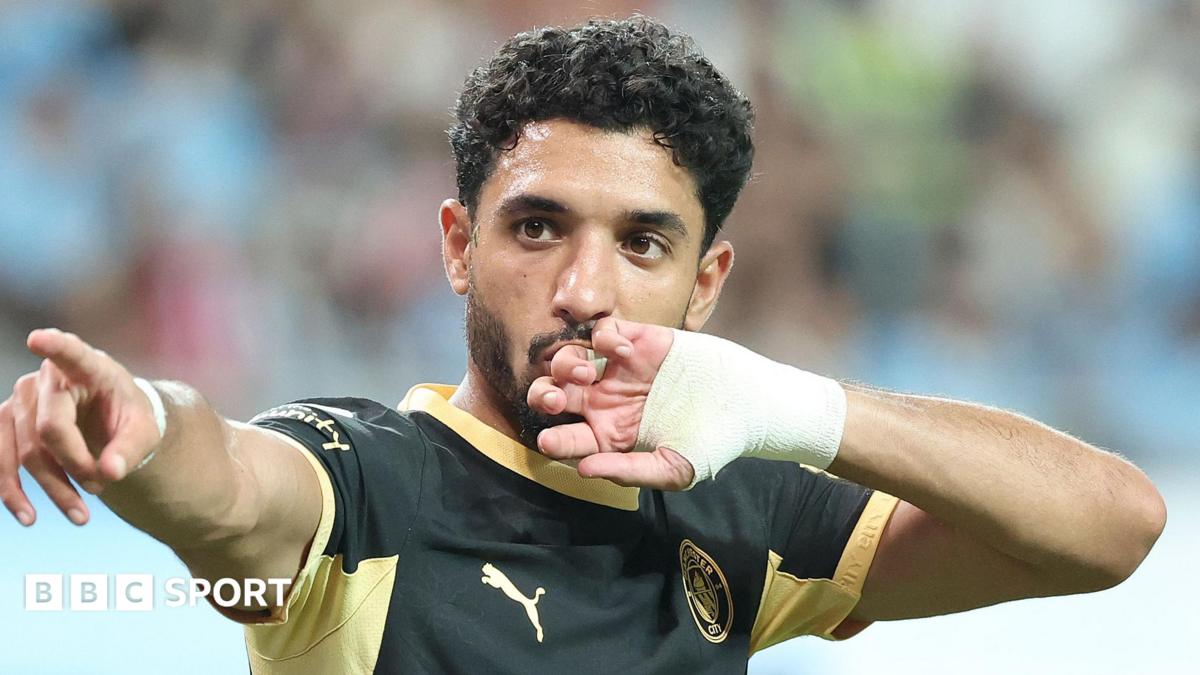
North London Premier League side Tottenham Hotspur are progressing in negotiations with Manchester City to acquire Egyptian forward Omar Marmoush, as the club continues its aggressive summer transfer rebuild under manager Roberto De Zerbi, according to a report from BBC Sport. While no final deal has been agreed yet, the potential signing would push Tottenham’s total summer transfer expenditure past the £300 million mark, capping off a transformative window for the club.
Tottenham have already committed £229.5 million to bring in centre-back Jan Paul van Hecke and midfielders Sandro Tonali and Mateus Fernandes, and just this week confirmed a £75 million agreement for Manchester City winger Savinho to bolster their attacking options. The club’s move for Marmoush comes amid growing uncertainty around their existing forward group: starter Dominic Solanke has struggled with repeated injury issues over the past 18 months, while Brazilian attacker Richarlison is entering the final 12 months of his current contract.
The 27-year-old Marmoush’s path to Manchester City was a rapid ascent. After joining Eintracht Frankfurt on a free transfer from Wolfsburg in 2023, he emerged as one of the most promising young forwards in Europe. In his breakout 2024-25 first half season, he scored 15 Bundesliga goals from just 8.9 expected goals, added nine assists in 17 league appearances, and notched 20 goals and 13 assists across all competitions before his January 2025 move. He also made history by becoming the first player in Europe’s top five leagues since Lionel Messi in 2019 to score directly from a free kick in three consecutive matches, highlighting his quality from set pieces.
Manchester City paid £59 million to secure Marmoush’s signature in January 2025, and his early performances at the Etihad Stadium showed immediate promise. He scored his first career hat-trick against Newcastle United, netted the match-winning goal in City’s FA Cup quarter-final trip to Bournemouth, and followed that up with a long-range strike against the same side in the Premier League that earned him the league’s Goal of the Season award. However, his stint at City has been mixed, highlighted by a high-profile penalty miss in the 2025 FA Cup final against Crystal Palace: with City trailing, Erling Haaland passed the penalty opportunity to Marmoush, whose effort was saved by goalkeeper Dean Henderson, as City went on to lose the trophy at Wembley.
Former Manchester City defender Nedum Onuoha argues that penalty miss should not define Marmoush’s tenure at the club. “When I see Marmoush, I don’t see the penalty miss,” Onuoha told BBC Sport. “I see the strength he has with some of the runs he makes in behind.”
Across his 18 months at City, Marmoush has scored 16 goals in 62 appearances in all competitions. Eight of those goals came in the 2025-26 season, but his first-team opportunities have dropped sharply. He started just eight Premier League matches last campaign, playing only around 700 minutes – fewer than he managed in his half-season after arriving in 2025. He finished the season with three goals and three assists in league play, with an expected goals total of 3.53 that suggests his finishing was not the root of his limited minutes.
The core issue for Marmoush at City was a logjam in attacking positions, with the club’s system built around starting centre-forward Erling Haaland, and new attacking reinforcements added over the transfer windows. “All the positions Marmoush could play are being filled by people who are specialists in those roles,” Onuoha explained. “Haaland is essentially always going to be the number nine, while City also regularly play with number 10s and Guardiola likes his wingers to stay wide.”
While Marmoush is primarily a central number nine, he has built a reputation as a flexible forward capable of playing across the entire front line. At Frankfurt, he was used mainly through the middle but also featured as a second striker and left-sided forward, a role distribution City mirrored during his time at the club. That positional flexibility is seen as a perfect fit for De Zerbi’s system at Tottenham, which relies heavily on forwards interchanging positions, dropping deep to receive the ball, and exploiting the space created when opponents are pulled out of shape.
Onuoha noted that Marmoush is at his most dangerous when running in behind opposition defences, a skill that aligns directly with how De Zerbi wants his team to attack. “As much as he is good dropping towards the ball, I think he is better when he plays on the shoulder,” he said. “He needs to be in a team that will constantly play balls in behind and force the opposition to run back towards their own goal. That’s when you see a better version of Marmoush.”
Opta data from the 2025-26 Premier League season backs up that assessment: Marmoush averaged 11.46 runs in behind per 90 minutes, nearly matching Solanke’s 11.61 and outpacing Richarlison’s 10.03. Crucially, he also offers more ball progression than Tottenham’s current forward options. He averaged 5.67 progressive carries per 90 minutes, compared to just 3.24 for Solanke and 2.48 for Richarlison. He also led both Tottenham forwards in shots per 90, chances created per 90, successful take-ons, and touches in the opposition penalty area, producing 0.77 goals and assists per game – ahead of Richarlison’s 0.69 and Solanke’s 0.27. While his limited minutes mean the sample size is smaller, the stylistic difference between Marmoush and Tottenham’s existing forwards is clear: he is far more inclined to take opponents on and create his own shooting opportunities, a valuable asset when teams sit deep to block Tottenham’s direct attacking play.
Crucially, Marmoush would not need to replace either Solanke or Richarlison to be an effective addition. His ability to play off another striker opens up the possibility of the two starting together, with Solanke using his physical presence to occupy central defenders while Marmoush moves into wide areas or drops between the lines to link play. That combination could play directly into De Zerbi’s preferred style of breaking pressing opposition defences. “Solanke is different to Marmoush. He’s got more of a physical presence,” Onuoha said. “I could see the goalkeeper playing a flat ball into Solanke, Marmoush coming underneath him to receive it, and that becoming the start of the attack. The two of them could complement each other. Playing in a front two might bring out more of Marmoush’s strengths.”