Global financial markets delivered a mixed performance across European and Asian trading sessions on Tuesday, rocked by conflicting signals: fresh U.S. military strikes inside southern Iran paired with ongoing optimism from former U.S. President Donald Trump about ongoing peace talks to end the regional conflict.
The U.S. military confirmed Monday that it had launched what it described as proportional self-defense strikes targeting Iranian missile launch facilities and watercraft reportedly used to lay naval mines. The operation was framed as a protective measure for U.S. military personnel facing imminent threats from Iranian forces, with officials noting they exercised restraint out of respect for an existing ceasefire between the two sides. As of Tuesday, Iran had not issued any official response to the strikes, and key details — including the full scope of the alleged threats that prompted the attack and the impact on diplomatic negotiations — remained undisclosed.
This military escalation comes even as Trump claimed via social media that talks to resolve the conflict are “proceeding nicely,” leaving investors caught between competing signals about the trajectory of regional tensions. Market analysts have highlighted the disconnect between investor pricing and on-the-ground diplomatic progress. “Markets are behaving as though a full Iran breakthrough already exists, even though the hardest parts of the negotiation remain unresolved,” noted Stephen Innes, a strategist at SPI Asset Management, pointing out that while Washington has publicly signaled optimism, Tehran has repeatedly pushed back against claims that a final deal is imminent.
Early trading in Europe reflected the uncertainty: Germany’s benchmark DAX index shed 0.7% to close at 25,214.08, while France’s CAC 40 dropped 0.9% to 8,187.07. Bucking the regional downward trend, London’s FTSE 100 gained 0.7% to reach 10,540.40. U.S. equity futures pointed to a positive open when Wall Street reopens Tuesday, with S&P 500 and Dow Jones Industrial Average futures both climbing 0.5%, following the Memorial Day holiday that closed U.S. markets Monday.
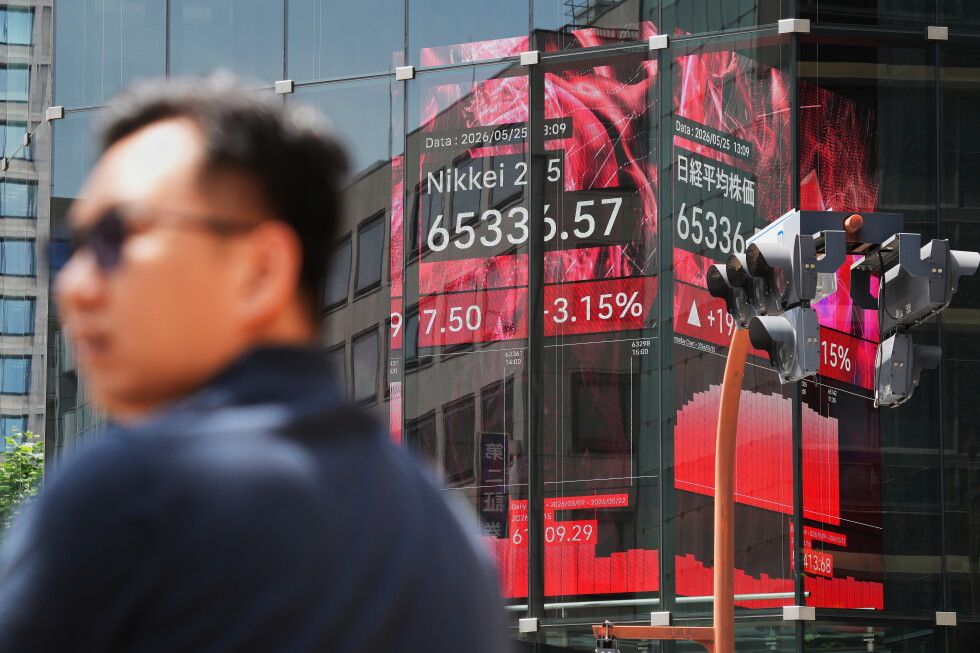
Across Asian trading sessions, performance was similarly uneven. Tokyo’s Nikkei 225 pulled back 0.3% to 64,996.09, retreating from the all-time closing high above 65,000 it set on Monday. China’s major indexes posted modest losses: the Shanghai Composite Index dipped 0.2% to 4,145.33, while Hong Kong’s Hang Seng Index remained nearly flat at 25,599.45. South Korea’s Kospi led regional gains, jumping 2.6% to 8,047.51 as markets rebounded from a Monday holiday closure. Australia’s S&P/ASX 200 edged down 0.4% to 8,657.80.
Energy markets also tracked the conflicting developments, with oil prices splitting gains and losses. International benchmark Brent crude climbed $3.03 to settle at $96.45 per barrel on Tuesday, recovering most of the nearly $5 drop it posted Monday, but still holding below the key $100 per barrel threshold. U.S. benchmark West Texas Intermediate crude fell $3.67 to $92.97 per barrel.
Currency trading saw minimal volatility: the U.S. dollar inched up slightly to 159.09 Japanese yen, up from 158.91 yen in the previous session, while the euro weakened marginally to $1.1636, down from $1.1645.
The current market volatility stems from shifting expectations around a potential peace deal between the U.S. and Iran. Just one day earlier, global markets rallied after regional Middle Eastern officials signaled Washington was close to finalizing an agreement that would end the ongoing conflict, reopen the critical Strait of Hormuz shipping lane, and require Iran to dismantle its stockpile of highly enriched uranium. To date, however, no timeline for finalizing the deal or implementing its key terms has been confirmed.
A finalized peace agreement would resolve widespread regional security concerns that have roiled energy markets after Iranian missiles and drone strikes targeted key Gulf economic hubs including the United Arab Emirates. It would also clear the way for the resumption of full global shipping through the Strait of Hormuz, which carries roughly 20% of the world’s daily oil supplies, and support the reconstruction of damaged energy infrastructure across the region.