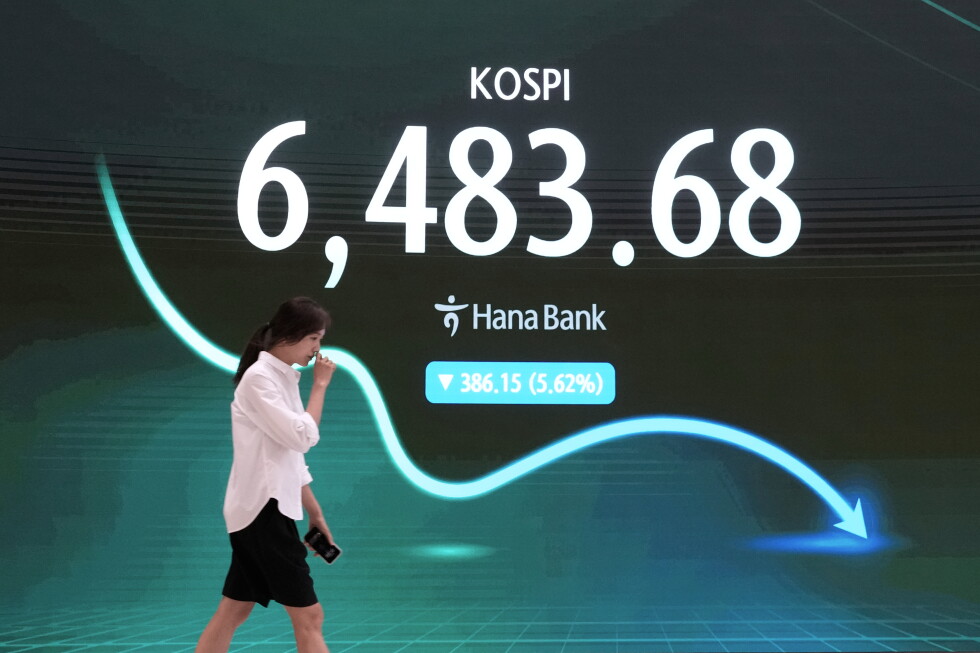
Global equity markets faced broad downward pressure on Wednesday, driven by a widespread selloff in artificial intelligence-linked stocks across Europe and Asia, as investors grew jittery over stretched valuations in the AI sector and layered macroeconomic risks.
In European trading, losses were mixed but largely negative: Germany’s benchmark DAX index dipped 0.2% to close at 26,085.69, London’s FTSE 100 shed 0.2% to end at 10,707.36, while Paris’s CAC 40 bucked the regional trend with a 0.3% gain to 8,532.16. Futures contracts tracking Wall Street’s S&P 500 and Dow Jones Industrial Average held near flat, pointing to limited opening movement after U.S. markets closed lower a day earlier.
Asian markets bore the brunt of the selling, with South Korea’s Kospi leading regional declines with a sharp 5.8% drop to 6,471.17. The two South Korean corporate giants that have reaped the biggest benefits from the AI boom followed steep losses from their U.S. tech and chipmaking peers: Samsung Electronics fell 7.8%, and leading memory chip manufacturer SK Hynix plummeted nearly 10% to end the session down 9.8%. Japan’s Nikkei 225 also tumbled 3.2% to 65,326.42, pulled lower by dual pressures of AI stock selling and growing market anxiety over rising government bond yields. The 10-year Japanese government bond yield has hovered near a 30-year high above 2.9%, as investors price in expectations that the Bank of Japan will soon lift its benchmark interest rate to tame persistent inflation.
Mainland China’s Shanghai Composite Index fell 2.4% to 3,894.42, though the session brought one standout outlier: domestic humanoid robot manufacturer Unitree notched a historic trading debut on the Shanghai Stock Exchange’s STAR Market, the country’s tech-focused board modeled on the Nasdaq. The firm’s shares initially surged nearly 630% in early trading after raising roughly $900 million through its initial public offering, and closed the session still up a staggering 460%. By contrast, UBTech, another major Chinese humanoid robot maker listed in Hong Kong, dropped 10.7% on the day. Hong Kong’s Hang Seng Index posted a modest 0.1% gain to 25,495.07, while Taiwan’s Taiex fell 1.3% and Australia’s S&P/ASX 200 slipped 0.2% to 9,053.80.
Multiple headwinds have combined to sour near-term market sentiment. First, investors have begun reassessing the sky-high valuations of AI-linked stocks, which have run up sharply over the past year amid the global AI boom. Market participants have grown increasingly concerned that projected demand for memory chips, processors and other core data center components could soften if the AI sector fails to deliver the outsized profits investors have already priced in. On Tuesday, that unease filtered through to Wall Street, pulling major indices further from their recent all-time highs: the S&P 500 lost 0.7% for its third consecutive modest loss, the Dow Jones Industrial Average dipped 0.2%, and the Nasdaq Composite sank 1.3%. Leading the U.S. selloff were the same big AI winners that have driven market gains for months: memory chip maker Micron Technology dropped 7% in the prior session, making it one of the heaviest drags on the S&P 500, while Nvidia fell 2.3% and Broadcom sank 3.2%.
A second key pressure comes from volatile and rising oil prices, which have added to global inflationary worries. Crude markets have swung sharply amid ongoing geopolitical uncertainty over whether the U.S. and Iran will reach an agreement to reopen the Persian Gulf for unobstructed oil tanker traffic. On Wednesday, international benchmark Brent crude added 0.8% to $91.78 per barrel, up sharply from $72.87 per barrel shortly before the latest Middle Eastern conflict began. U.S. benchmark West Texas Intermediate crude gained 1% to $84.86 per barrel.
Rising inflation expectations have in turn pushed government bond yields sharply higher, creating a third major headwind for equities. The 10-year U.S. Treasury yield edged down slightly to 4.70% on Wednesday from 4.72% late Monday, but it remains far above the 3.97% level recorded just before the outbreak of new hostilities in the Middle East. The 30-year U.S. Treasury yield also ticked slightly lower but still hovers near its highest level since 2007. High bond yields make investors less willing to pay premium prices for risk assets like stocks, particularly the richly valued tech and AI shares that have led market gains in recent years. They have also pushed the average long-term U.S. mortgage rate near its highest level in a year, crippling demand in the housing sector, and could slow Big Tech companies’ ability to borrow to fund new data center construction – a major engine of current U.S. economic growth.
In currency markets, the U.S. dollar weakened slightly against the Japanese yen, falling to 159.11 yen from 159.61 yen in prior trading. The euro ticked higher against the dollar, rising to $1.1607 from $1.1577.
Associated Press Business Writer Chan Ho-him in Hong Kong contributed reporting to this article.