BANGKOK – Global equity markets delivered a mixed performance on Friday, a day after modest pullbacks across major Wall Street indices, while international benchmark crude oil prices climbed more than 1% amid ongoing uncertainty over the future of the Strait of Hormuz, one of the world’s most critical energy shipping chokepoints.
Early trading in European markets showed mild upward momentum across major benchmarks. Germany’s DAX gained 0.4% to settle at 26,253.77, while France’s CAC 40 edged up 0.2% to 8,715.47. The UK’s FTSE 100 posted a modest 0.1% rise to 10,879.57. Futures for U.S. markets were also split: S&P 500 futures ticked up 0.1%, while Dow Jones Industrial Average futures slipped 0.1% heading into the New York trading open.
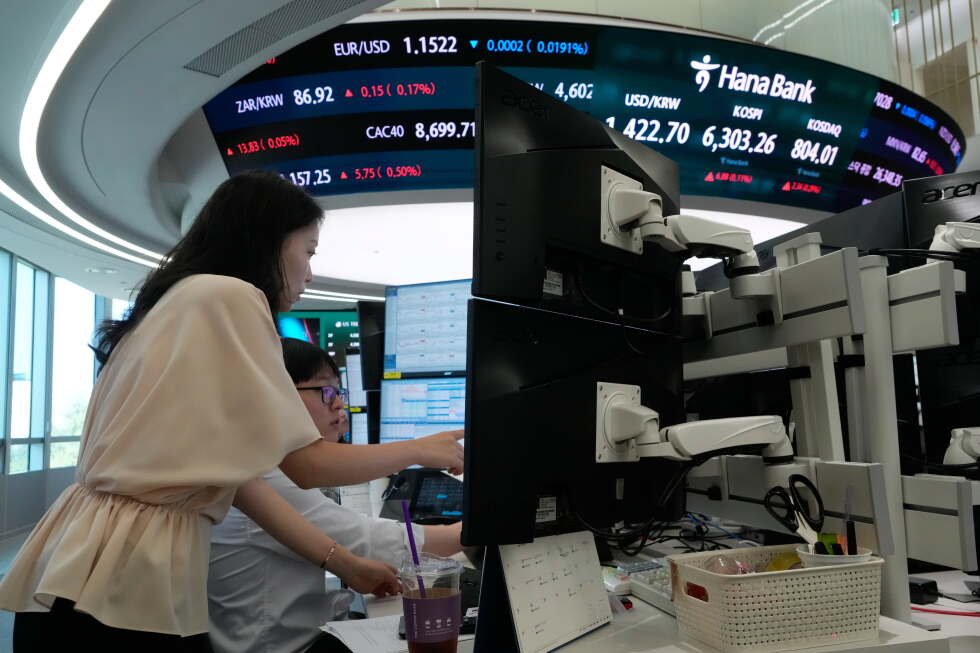
Across Asian markets, the recent sell-off in AI-linked tech and semiconductor stocks showed early signs of easing. Japan’s Nikkei 225, a market heavy with chipmaking and AI exposure, dipped only 0.1% to 65,606.71 following several days of broader losses for the sector. South Korea’s Kospi fell 0.6% to 6,258.77, and Taiwan’s Taiex declined 0.4%, while mainland China’s Shanghai Composite Index bucked the regional downtrend with a 1% rise to 3,940.04. The gain came after China released July trade data showing export growth slowed slightly but remained robust at roughly 24%, driven by sustained global demand for electronics and high-tech manufactured goods. The country’s overall trade surplus narrowed last month, and import growth also cooled, the data showed. Hong Kong’s Hang Seng Index added 0.5% to 25,668.03, while Australia’s S&P/ASX 200 slipped less than 0.1% to 9,263.60.
The mixed global performance followed a down day on Wall Street Thursday, when major indices pulled back as oil prices climbed and the latest wave of corporate earnings reports hit the market. The S&P 500 lost 0.2%, the Dow Jones Industrial Average fell 0.9%, and the Nasdaq Composite dipped 0.1%.
Oil prices extended gains into Friday after a nearly 4% jump Thursday, driven by persistent uncertainty over negotiations to reopen the Strait of Hormuz. The strait, which once carried roughly one-fifth of the world’s globally traded oil and natural gas, has been at the center of a months-long standoff that has disrupted global energy supplies. Iran says it is close to an agreement with Oman to reopen the strategic waterway, and former U.S. President Donald Trump has previously stated a deal is imminent, but negotiations have seen repeated stops and starts over the past five months.
Reaching a workable compromise has proven elusive: the Trump administration has ruled out allowing Iran to charge passage fees for ships, but Iran insists on retaining some level of control over the waterway, rejecting calls to return it to full international free passage status. As of early Friday, Brent crude rose 1% to $83.33 per barrel, while U.S. West Texas Intermediate crude advanced 0.7% to $77.79 per barrel. Spiking oil prices, which surged as high as $113 per barrel amid the ongoing conflict, have exacerbated global inflation by pushing up gasoline prices and increasing shipping costs for nearly all sectors of the global economy.
Against this backdrop, global markets remain caught between two competing forces: ongoing anxiety over geopolitical conflict, rising energy prices, and fears of a potential bubble in high-flying AI investments, are offset by stronger-than-expected corporate earnings that have eased concerns about overvalued U.S. equities. Roughly 85% of S&P 500 companies have released quarterly results, and aggregate earnings growth for the period is on track to hit its highest level since 2021.
In standalone tech news, SpaceX shares rose 6.1% on Thursday after a lockup period expired, allowing early investors and employees to sell more than 911 million shares for the first time since the company’s initial public offering. The volume of newly tradable shares is more than double the number of shares sold in SpaceX’s IPO. Elon Musk’s aerospace firm saw its share price jump as high as $225 shortly after its June public debut, but has since fallen below its $135 IPO price, and was trading around $115 ahead of Friday’s session.
All eyes are now turning to the U.S. Bureau of Labor Statistics’ July monthly jobs report, scheduled for release Friday. The U.S. labor market has remained resilient in recent months, but hiring growth has gradually slowed. A weekly jobless claims report released Thursday showed the number of first-time unemployment benefit applications rose last week, though layoffs still remain at historically low levels not seen since the post-pandemic recovery. Hiring slowed sharply in June, with employers adding just 57,000 new jobs, marking the weakest monthly gain in months.
In currency markets, the U.S. dollar edged up slightly against the Japanese yen, rising to 158.46 yen from 158.42 yen in previous trading. The euro ticked down fractionally to $1.1520 from $1.1524.