Along the sun-dappled southwestern Indian coast, in the historic port city of Kochi, two men carry the weight of an ancient community that has outlasted empires, religious persecution, and centuries of change. Today, they stand as the last stewards of Cochin Jewry — a distinct community that has called this region home for millennia, now fading into history as most of its members relocated to Israel decades ago.
At sunset on Shavuot, the Jewish holiday marking the gifting of the Torah to Moses, 70-something Keith Hallegua pulled on his gray kippah and made the quiet, solitary walk down the cobblestone lane of Kochi’s iconic Jew Town to the 458-year-old Paradesi Synagogue. For Hallegua, the last local Jew remaining in the neighborhood, this pilgrimage ended as it often does: praying alone, without the 10-person male quorum called a minyan required for formal Jewish communal worship.
Across the city at the 12th-century Kadavumbagam Synagogue, Elias “Babu” Josephai paused to remember the chukkunda — golden fried dough balls his grandmother once prepared for the Shavuot holiday. “It wasn’t much,” he said, wiping away tears. “But at that time, it was everything.”
The story of Cochin Jews stretches back more than 2,000 years, when the first Jewish traders are believed to have arrived on India’s Malabar Coast during the era of King Solomon. For centuries, the community lived in relative peace alongside Hindu, Muslim, and Christian neighbors, with no recorded history of systemic antisemitism — a rare stability that allowed their traditions to take deep root. In the 1950s, however, the vast majority of the community migrated to the newly formed state of Israel, leaving behind empty homes, silent synagogues, and generations of shared memory. Today, fewer than 5,000 Jews remain across all of India, the world’s most populous nation.
Hallegua and Josephai chose to stay, and each now tends to the legacy of their distinct branches of Cochin Jewry, even as they carry the grief of a community that is disappearing. Hallegua is a Paradesi Jew, descended from fair-skinned Sephardic Jews who fled the Spanish Inquisition in the 16th century and established dominance in Kochi’s Jewish community. For centuries, Paradesi Jews enforced rigid internal hierarchies: they brought enslaved people with them to India, and their freed descendants, called Meshuchrarim Jews, were confined to lower social standing and forced to fight for basic religious equality.
Josephai, meanwhile, is a Malabar Jew — part of the darker-skinned community that traces its roots to the earliest Jewish settlements on the Malabar Coast. Like the Meshuchrarim, Malabar Jews faced systemic discrimination from the Paradesi community for generations. While those caste and color-based divisions faded after most Cochin Jews relocated to Israel and abroad, their bitter echoes still linger in the community’s collective memory.
Though the two men rarely cross paths, both share a fierce, unshakable pride in their dual identity as Indians and Jews, and a relentless commitment to preserving what remains of their culture. Josephai spent years single-handedly resurrecting Kadavumbagam Synagogue after it was destroyed by vandals, tucking the restored house of worship behind the small aquarium shop he runs. Today, services are rare, and Josephai is almost always alone when he lights the lamps and leads prayers — a promise he made to his grandmother after his siblings moved to Israel in 1972. When he rebuilt the synagogue, neighbors of every faith stepped forward to help: a Muslim donor gifted the sanctuary lamps, a Christian neighbor gave a hand-carved Ten Commandments plaque, and a Hindu foundation covered the cost of the chandeliers.
An oil lamp burns constantly before the synagogue’s Torah ark, tended daily by Josephai. “Every Jew has a dream that his last breath should be in Israel,” he said. “I believe my last breath should be inside this synagogue.” Now 70, Josephai hopes a Jewish organization will one day take over the synagogue, library, and small museum he has built, acknowledging that once he is gone, no one will remain to carry the stories of his community. “But this is our fate and that’s how it is,” he said. Thapan Dubayehudi, a Malabari Jew who relocated to Vienna in 2022, calls Josephai “a one-man army” for his tireless work preserving Cochin Jewish history.
For Hallegua, staying in Jew Town was originally a matter of family responsibility: he remained to care for his ailing brother and aging parents, never imagining he would one day be the last local member of the Paradesi Synagogue. Today, the iconic 16th-century synagogue draws crowds of tourists every day, and relies on visiting Jewish travelers to form a minyan for rare communal services. On quiet days, when Hallegua walks the empty lanes to the sanctuary, he often questions God about his fate — though he has never received an answer.
His mind is crowded with fading memories: the unique blend of Sephardic chants and South Indian folk melodies that defined Paradesi Jewish worship, the smell of his mother’s famous chili chicken, his grandmother’s frantic pre-Passover cleaning, new clothes for the Rosh Hashanah holiday. “That’s never going to come back,” he said. Though the weight of being the last Jew of Jew Town leaves him broken some days, and he has often considered leaving, he remains rooted to his home. “I was born a Jew in India and I shall die in India, a Jew,” he said.
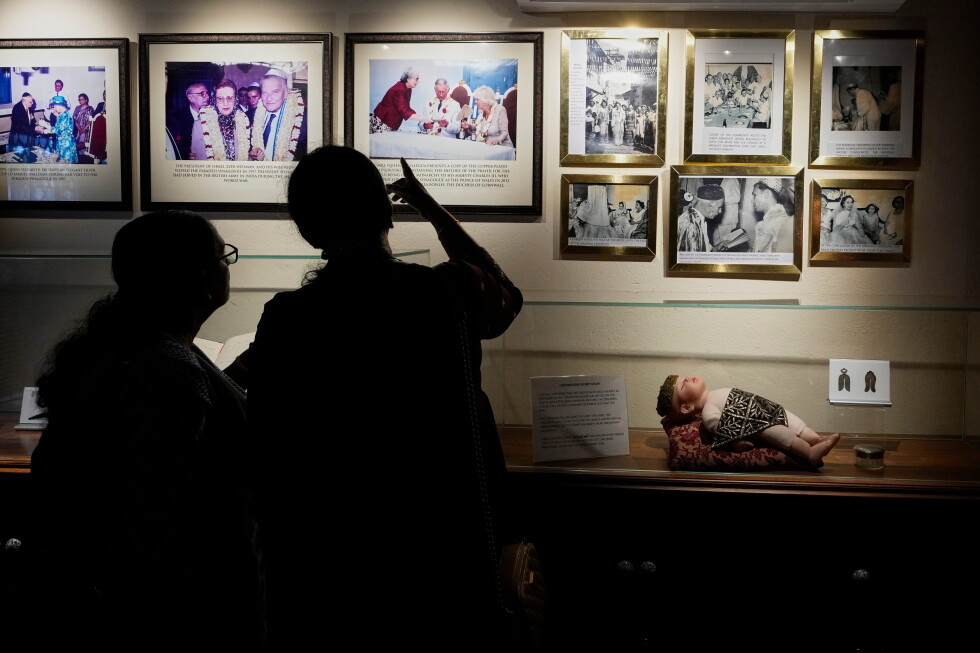
What makes the story of Cochin Jewish heritage preservation extraordinary is that it is not just the work of the few remaining Jewish community members. Across Jew Town, non-Jewish locals have dedicated themselves to protecting the neighborhood’s history and culture. M.C. Praveen, a Hindu who grew up in Jew Town playing cricket near the Paradesi Synagogue and eating Shabbat dinners with Hallegua’s family, now serves as a synagogue trustee and calls protecting Cochin Jewish history his life’s mission. He works closely with former Cochin Jews and their descendants scattered across the globe to ensure the community’s story is told accurately for future generations. Earlier this year, synagogue leaders opened a new museum showcasing the community’s history, centered on a 1,000-year-old charter etched into two copper plates granted by a local Hindu king that guaranteed the Jewish community full religious freedom — a document that speaks to the long history of tolerance in the region.
Shulamit Kotzer, a synagogue trustee who was born in Jew Town and moved to Israel at age 2, still considers Kochi her home, and dreams of opening a boutique hotel in the neighborhood to connect more visitors to its history. Down the street, Thaha Ibrahim, a Muslim craftsman, carries on the legacy of Sarah Cohen, the late Jewish matriarch who taught him the traditional craft of Cochin Jewish embroidery at her shop on Synagogue Lane. Ibrahim now runs the shop, teaches the craft to his son to carry on the legacy, lights Shabbat candles every Friday, and closes the shop on Saturdays in keeping with Jewish tradition. For Ibrahim, the work is not about religion — it is about human connection, even amid rising interreligious tensions in other parts of the world. “This is not about religion, it’s about human connection,” he said.
Today, the former Jewish homes of Jew Town now house spice warehouses and antique shops, a reminder of the community’s historic role as major players in Kochi’s world-famous spice trade, which for centuries shipped black pepper, cardamom, and nutmeg across the globe. But the legacy of Cochin Jewry endures, held together by two aging stewards and a multi-faith community committed to keeping their story alive.