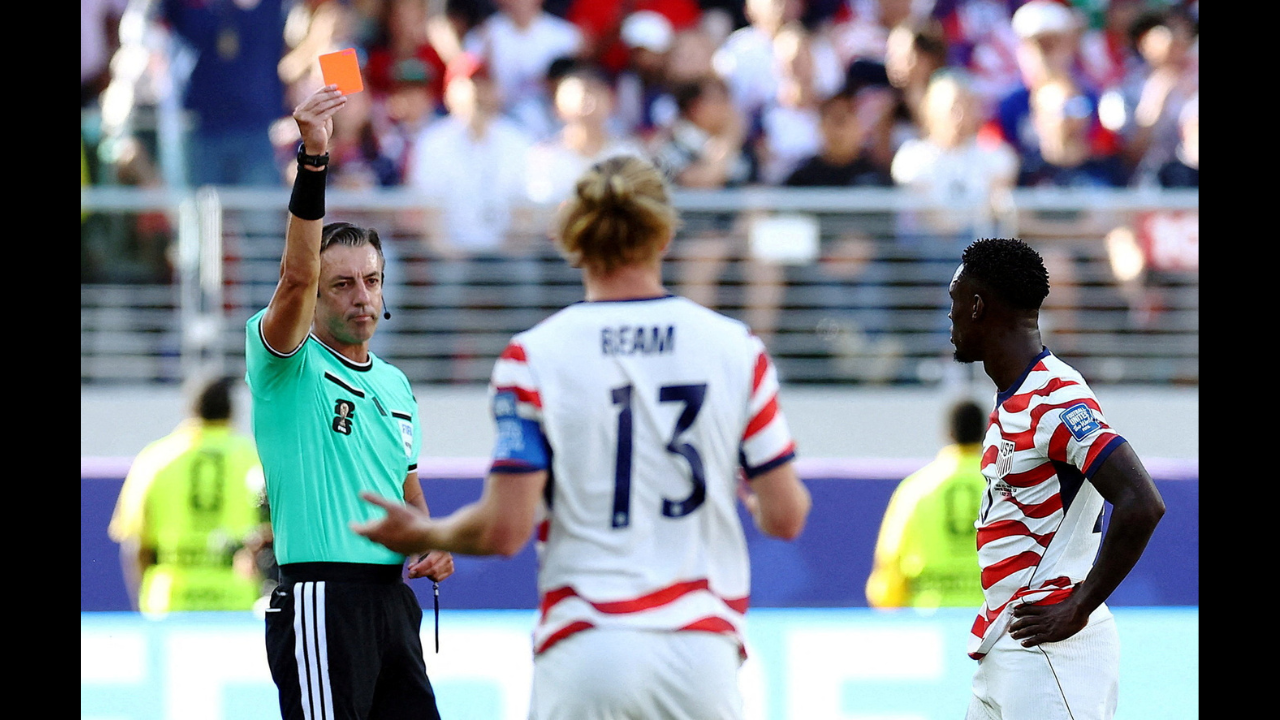
The global football community has been thrown into uproar after Fifa’s stunning weekend announcement that U.S. striker Folarin Balogun will be cleared to compete in the United States’ upcoming World Cup match against Belgium, defying the standard automatic one-match suspension that follows a straight red card. Balogun received his sending-off during the U.S.’s previous fixture against Bosnia and Herzegovina, a punishment that under normal tournament rules would automatically bench him for the next round.
Historically, overturning a straight red card suspension is almost unheard of: Fifa’s official disciplinary code explicitly prohibits appeals for immediate red card dismissals, and only one similar exception has ever been recorded, dating back to 1962 when automatic suspensions were not yet codified in tournament rules. This unprecedented decision comes after days of high-level lobbying from senior U.S. officials, according to reporting from American news outlet Politico. Within minutes of Balogun’s red card being issued, White House and U.S. soccer leadership launched a coordinated push to reverse the call: Andrew Giuliani, executive director of the White House Fifa World Cup Task Force, joined by U.S. Commerce Secretary Howard Lutnick and senior United States Soccer Federation officials, spent four days lobbying Fifa leadership to change the ruling. Multiple reports have also confirmed that former U.S. President Donald Trump made personal phone calls directly to Fifa President Gianni Infantino to press for the suspension to be lifted.
Fifa has defended its reversal by citing Article 27 of its disciplinary framework, a bylaw that grants the governing body broad authority to suspend any pre-existing disciplinary measures. But the move has drawn fierce condemnation from football governing bodies, current and former leaders, pundits and fans worldwide, who universally accuse Fifa of caving to political pressure and granting preferential treatment to the U.S. tournament host.
The Belgian Football Association, whose team stands to directly lose out from the decision, issued an official statement saying it was “astonished” by the ruling, noting that it directly contradicts core provisions of the World Cup’s disciplinary code that mandate automatic one-match suspensions for red card recipients. Though Belgium was granted the right to appeal the decision on Monday, it was given only a matter of hours on the same day to submit its challenge, a timeline critics have called intentionally restrictive.
European football governing body Uefa also released a scathing rebuke of the decision, saying Fifa had “crossed a red line.” In its official statement, Uefa emphasized that football’s integrity depends on consistent, enforceable rules, noting that the automatic one-match suspension for a red card is not a discretionary call: “When the certainty of rules is no longer guaranteed by its guardians, the integrity of the game is at stake and the credibility of a competition is undermined,” the statement read.
Criticism has also poured in from across the football and political spheres on social media, with many figures highlighting the glaring double standard of Fifa’s decision. Former Fifa President Sepp Blatter weighed in on X, writing, “Red cards are not overturned by political phone calls. They are overturned by rules, evidence and independent bodies… Football must never become a playground for political power.” Analysts and fans have also pointed out that Fifa has previously suspended entire national federations, including Nepal’s, for government interference in football operations — a policy that appears to have been set aside for the U.S. this time.
Many social media users have also called out perceived favoritism toward the host nation. A Reddit commentator noted that the rarity of red card reversals has long acted as a level playing field for all teams, so making an exception for the U.S. can only be interpreted as preferential treatment. Former professional footballer Yannick Bolasie drew attention to double standards across global confederations, writing, “All I’ll say is if this was AFCON and they let a man play after he got a red card, the nonsense being said would be crazy.”
Even some American commentators and fans have acknowledged the problematic nature of the decision. Political commentator and former Obama administration spokesperson Tommy Vietor noted, “As a fan, I am obviously overjoyed that Balogun will get to play,” but added that “it will make the rest of the world feel like the tournament was rigged.”
The controversy has also spilled over into broader political critiques of the Trump administration. One social media commentator highlighted that Trump recently attempted to eliminate birthright citizenship at the U.S. Supreme Court — the very policy that grants Balogun, born in the United States, his American citizenship and eligibility to play for the U.S. national team. Geopolitical analyst Bruno Macaes further connected the decision to broader questions of Fifa’s political ethics, referencing ongoing global criticism of Fifa’s decision to allow Israel’s football association to remain in international competition despite accusations of genocide in Gaza.
Trump, for his part, praised Fifa’s ruling in a post on his Truth Social platform. British media personality Piers Morgan has called the incident “the biggest story, and potential scandal, of the World Cup.” Middle East Eye has reached out to both the White House and Fifa for additional comment on the reports of political lobbying and the controversial reversal.