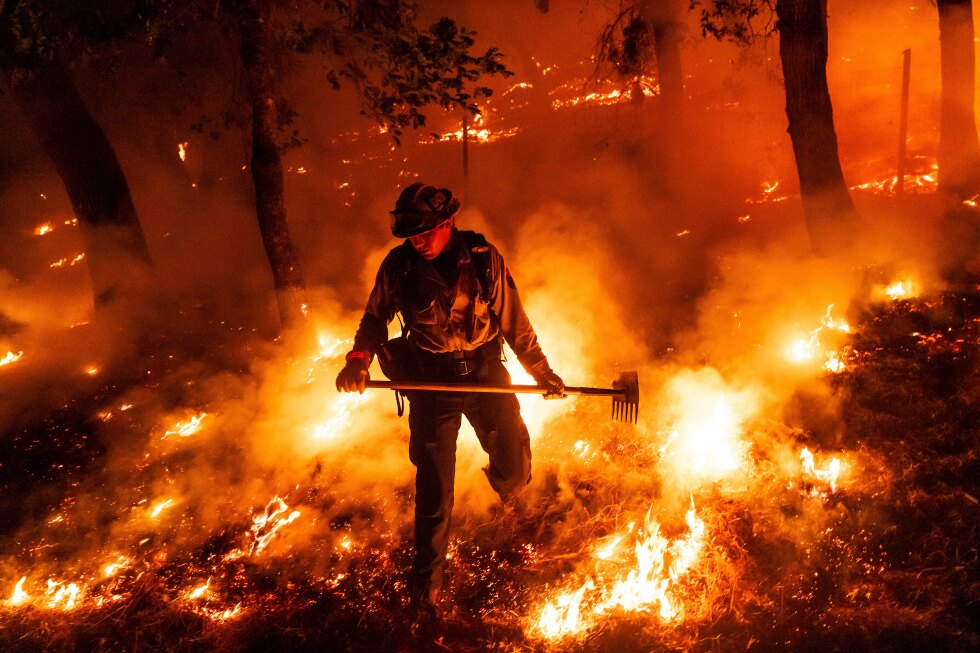
For decades, wildfires across North America followed a predictable rhythm: as temperatures dropped and nighttime humidity rose, flames would die down, giving crews a critical window to contain blazes before they spread further. But a landmark new study published in *Science Advances* confirms what firefighters and researchers have suspected for years: human-caused climate change has thrown that natural cycle off balance, extending wildfire-prone conditions deep into the night and pushing the start of dangerous fire weather earlier each season. The findings paint a stark picture of how rising global temperatures are escalating wildfire risk across the United States and Canada. The study, led by researchers from the Canadian Forest Service and University of Alberta, calculates that the total number of annual hours with weather conditions favorable to wildfire spread across North America has jumped 36% over the past 50 years. In some hard-hit regions, the increase is far more dramatic: parts of southwestern New Mexico and central Arizona now see more than 2,000 additional fire-prone hours each year compared to the mid-1970s, the highest increase recorded in the research. California, a state that has faced repeated catastrophic wildfire seasons in recent years, has gained 550 extra high-risk hours annually. Beyond extending daily burning windows, the research also found the overall wildfire season has grown 44% longer, adding 26 extra days of fire-prone conditions to the calendar over the past half century. Study authors note the shift is driven overwhelmingly by warmer, drier nighttime temperatures paired with slightly increased wind speeds. Unlike past decades when overnight humidity would restore moisture to vegetation and cool temperatures would slow flame spread, modern nights no longer deliver that relief. “Fires normally slow down during the night, or they just stop,” explained study co-author Xianli Wang, a fire scientist with the Canadian Forest Service. “But under extreme fire hazard conditions, fire actually burns through the night or later into the night.” Wang warned that ongoing atmospheric warming means this trend will only grow more severe in coming decades. Overnight-burning blazes are not just a statistical shift — they pose a direct, increased danger to communities and firefighters alike. Recent high-profile catastrophic fires have followed this dangerous new pattern: the 2023 Lahaina wildfire on Maui that killed more than 100 people ignited at 12:22 a.m., while the 2024 Jasper fire in Alberta and 2025 Los Angeles fires all raged uncontrolled through the night. Fires that do not die down overnight gain a critical head start the next day, making them far harder to extinguish, explained John Abatzoglou, a fire scientist at the University of California Merced who was not involved in the study. “Nights aren’t what they used to be — that is, more reliable breaks for wildfire,” Abatzoglou said in an email interview. “Widespread warming and lack of humidity is keeping fires up at night.” Wildland firefighters face unique hazards battling overnight blazes, from navigating dark, rough terrain to encountering nocturnal wildlife displaced by approaching flames. Nicholai Allen, a career wildland firefighter and founder of a home fire prevention company, noted a colleague of his was bitten by a bear fleeing a nighttime fire. “You have to deal with all the same hazards you face in the daytime: snakes, bears, mountain lions,” Allen explained. “But at night, those animals are disoriented and terrified, running straight away from the flames, putting them right in our path.” To reach their conclusions, the research team analyzed hourly atmospheric data — including temperature, humidity, wind, precipitation, and vegetation fuel moisture — from nearly 9,000 large wildfires recorded between 2017 and 2023, using data from weather satellites and ground monitoring stations. They built a statistical model linking weather conditions to fire activity, then applied that model to historical climate data stretching back to 1975 across the U.S. and Canada. The research aligns with longstanding climate science that shows nighttime temperatures are warming faster than daytime temperatures across most of the globe. The root cause is the accumulation of heat-trapping greenhouse gases from fossil fuel burning, which increase nighttime cloud cover that traps heat near the Earth’s surface, acting like a blanket to prevent cooling. Data from the U.S. National Oceanic and Atmospheric Administration confirms that since 1975, average summer overnight low temperatures in the contiguous United States have warmed by 2.6 degrees Fahrenheit (1.4 degrees Celsius), compared to a 2.2 degree Fahrenheit (1.2 degrees Celsius) increase in average daytime high temperatures. This rapid nighttime warming means overnight humidity no longer rebounds to the levels it reached in past decades after a day of hot, dry conditions, explained study lead author Kaiwei Luo, a fire science researcher at the University of Alberta. Drought conditions, which have become more frequent and severe across much of western North America due to climate change, amplify this effect: higher temperatures suck additional moisture out of soil and vegetation, turning trees and underbrush into highly flammable fuel for fires. When vegetation dries out, it can take weeks to regain enough moisture to become less fire-prone, Wang explained. Just as warm summer nights prevent human bodies from cooling off and recovering from heat stress, warmer nights prevent forest ecosystems and vegetation from recovering from daytime heat and dryness. “It’s just an added stress to the plants,” Wang said. “That also increases fuel flammability and makes fire spread more easily.” The trend of lengthened burning windows has already translated to far more area burned across the continent. Between 2016 and 2025, U.S. wildfires burned an average of 11,000 square miles (28,500 square kilometers) — an area roughly the size of Massachusetts — each year, according to the U.S. National Interagency Fire Center. That is 2.6 times the average annual burn area recorded in the 1980s. In Canada, the past decade has seen an average annual burn area 2.8 times higher than the 1980s average, per the Canadian Interagency Forest Fire Centre. Outside experts have called the study a rigorous, important confirmation of climate change’s growing impact on wildfire risk. Jacob Bendix, a fire scientist at Syracuse University who was not part of the research team, called the work “a sobering reminder of climate change’s role in driving increased fire potential across almost all of the fire-prone environments of North America.” This reporting on climate and the environment is supported by funding from multiple private foundations, with The Associated Press retaining full editorial control over all content.
Wildfires used to ‘go to sleep’ at night. Climate change has them burning overtime