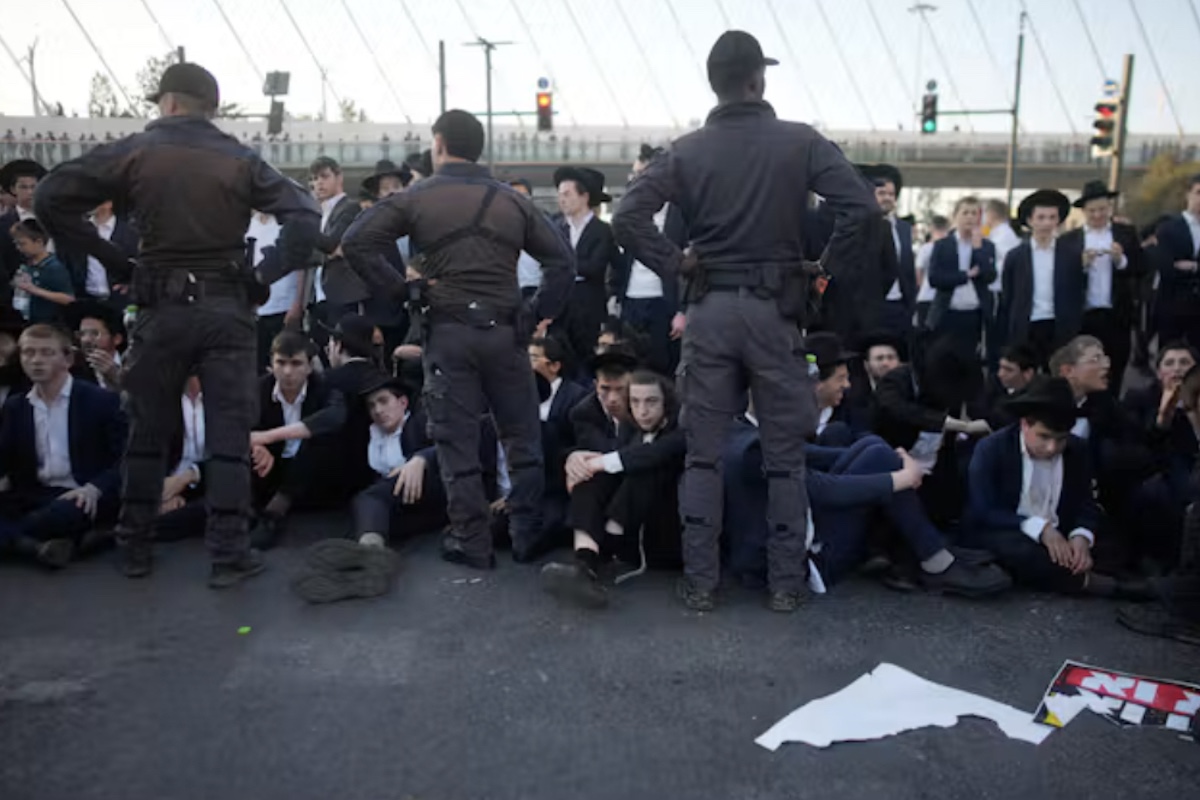
On October 20, 2026, just seven days before Israel’s scheduled parliamentary elections, law enforcement authorities detained dozens of young ultra-Orthodox (Haredi) men on suspicion of evading mandatory national military service – a move that drew immediate public condemnation from Prime Minister Benjamin Netanyahu, who labeled the arrests “unacceptable.” The incident has thrust a decades-long, highly charged national debate over equitable military burden-sharing back to the center of the election campaign, exposing deep rifts between competing political blocs, religious communities, and the broader Israeli public. For generations, Haredi men enrolled in full-time religious seminary programs have operated under de facto exemptions from the universal conscription rules that apply to nearly all other Jewish Israeli citizens, a status quo that was upended by a landmark 2024 Israeli Supreme Court ruling mandating that Haredi youth be drafted on the same terms as their non-Haredi Jewish peers. In the two years since that ruling, Netanyahu’s government has failed to broker a viable compromise: it has neither passed legislation to formalize a legal path for continued Haredi draft exemptions, nor fully enforced the court’s conscription order, even as Netanyahu has repeatedly stated that Haredi men not engaged in full-time religious study have a civic obligation to enlist. The unresolved policy impasse comes at a moment when the Israeli Defense Forces are deployed across multiple active conflict zones, including Gaza, southern Lebanon, the West Bank, and operations targeting Iran, making the unequal distribution of military service obligations increasingly unpopular among the general public. Polling data shows more than 70% of Jewish Israeli voters support requiring Haredi communities to share the national security burden. Despite this widespread public sentiment, Haredi political factions hold outsized strategic value for Netanyahu, who is fighting to retain his premiership amid growing challenges from rival right-wing and centrist contenders in the wake of the 2023 October 7 attacks and subsequent regional conflicts. The Haredi community, which strictly adheres to traditional Jewish religious law and largely rejects liberal secular interpretations of Jewish identity, currently makes up roughly 14% of Israel’s total population. Characterized by large average family sizes of six children per household, the community’s birth rate far outpaces that of non-Haredi Jewish Israelis: official projections from the Israeli Central Bureau of Statistics estimate Haredi residents will account for nearly 25% of the national population by 2050. Roughly half of all Haredi adult men pursue full-time religious study as their primary lifelong occupation, and the community’s 33% poverty rate is more than double that of non-Haredi Jewish households, leaving many families dependent on government welfare and seminary stipends for financial stability. Three distinct Haredi political parties are competing in the 2026 Knesset elections: the long-established United Torah Judaism (UTJ) representing Ashkenazi Haredi communities with ancestral roots in Eastern and Northern Europe, the Sephardi/Mizrachi-focused Shas party representing Haredi populations tracing their origins to the Iberian Peninsula and Middle East, and a new third faction, Haredi Public, founded in July 2026 to represent community members who feel underserved by the two older parties, with a platform focused on employment access, poverty reduction, affordable housing, and education reform – notably, it is the first major Haredi party to include women on its official candidate list. Under Israel’s proportional representation electoral system, any party clearing the 3.25% national vote threshold earns Knesset seats proportional to its total vote share, a structure that has ensured no single political party has ever won an absolute 50% majority to govern unilaterally. To maximize their combined seat count in 2026, Shas and UTJ have reached a formal agreement to transfer surplus votes to one another to avoid wasting support. For the past two decades, Netanyahu’s conservative Likud party has relied on Haredi factions as core coalition partners to secure a parliamentary majority, a dynamic that has granted Haredi parties disproportionate negotiating power to defend their longstanding priority of blanket draft exemptions. The 2024 Supreme Court ruling that struck down those exemptions as unlawful triggered a political crisis that saw Shas and UTJ exit Netanyahu’s governing coalition in 2025, prompting Likud to form a new parliamentary alliance with far-right nationalist factions including the Jewish Power party, a Kahanist faction once banned for racist advocacy that had long been considered a forbidden coalition partner for mainstream Israeli political leaders. The ideological rift between Netanyahu’s new far-right allies and the Haredi factions runs deep: while secular nationalist politicians frame military service as the ultimate demonstration of civic commitment to the Zionist state, most Haredi communities reject core tenets of Zionism, arguing that the modern state of Israel was established prematurely without divine mandate, and that their full-time religious study constitutes a critical form of service to the Jewish people that justifies exemption from armed service. Netanyahu’s public condemnation of the recent draft evasion arrests, paired with his support for a 2026 temporary law shielding Haredi draft evaders from arrest, signals he is actively positioning to bring Haredi parties back into a post-election governing coalition to shore up his political survival, even as leading rival candidates – former prime minister Naftali Bennett of the Together alliance, and centrist Yashar party leader Gadi Eisenkot – have laid out competing policies ranging from cutting Haredi community subsidies for draft evaders to a limited exemption policy that would allow only 3% of Haredi men to pursue full-time religious study. The ongoing tensions over conscription, electoral representation, and state subsidies are set to remain a defining structural political challenge for Israel for decades to come, as the fast-growing Haredi population moves toward proportional political influence that will force a long-overdue reckoning over the meaning of shared civic obligation in the Jewish state.