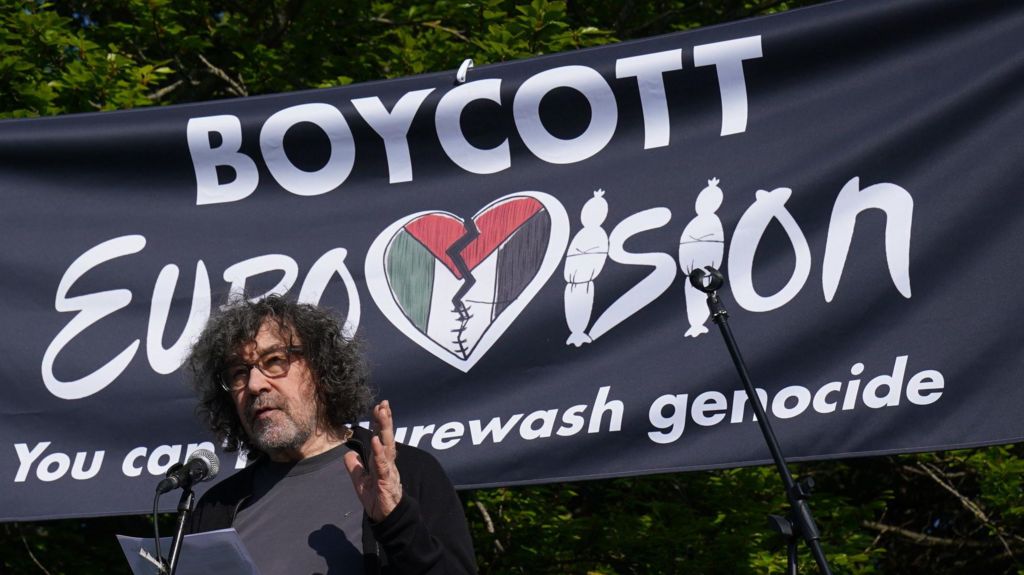
For decades, Ireland has stood as one of the most decorated competitors in the Eurovision Song Contest, sharing the record for the most tournament wins with neighboring Sweden and producing some of the competition’s most iconic moments from the 1980s through its dominant run in the early 1990s. In most years, the Irish public and national broadcaster RTÉ would join millions of viewers across the continent in counting down to the annual grand final. But 2025 marks a historic break from that tradition: Ireland is one of five European nations – joining Iceland, the Netherlands, Slovenia and Spain – that have withdrawn from the contest in protest of the European Broadcasting Union’s (EBU) decision to allow Israel to compete amid its ongoing military campaign in Gaza.
With no Irish entrant selected for this year’s competition hosted in Austria, RTÉ has opted to replace its traditional live grand final broadcast with a popular 1996 Eurovision-themed episode of the classic Irish sitcom *Father Ted*, a scheduling choice that has only amplified the fierce national debate around the boycott.
Controversy around Israel’s Eurovision participation has simmered since the country launched its Gaza offensive in October 2023, following a deadly attack by Hamas that Israeli authorities say killed roughly 1,200 people and took 251 hostages. The Hamas-run Ministry of Health in Gaza reports that Israeli military operations have killed more than 72,600 people in the territory to date, triggering widespread humanitarian catastrophe. In both the 2024 and 2025 contests, anti-Israel protests have been a consistent presence, and Israeli participants have required armed security for their appearances. Last year’s competition erupted in additional scandal after Israel’s entry unexpectedly finished first in the public vote, with multiple nations alleging that Israeli Prime Minister Benjamin Netanyahu’s government orchestrated a coordinated social media campaign to drive up votes for the entry. The EBU revised its voting and promotional rules in response to the outcry, but the reforms were not enough to prevent the 2025 boycott.
Shortly before this year’s contest, the EBU issued a formal warning to Israeli public broadcaster Kan after Israeli entrant Noam Bettan released social media videos urging fans to vote for Israel 10 times each. Bettan has said he was caught off guard by protests that interrupted his semi-final performance earlier this month.
In its official statement announcing the boycott, RTÉ argued that sending an Irish competitor and broadcasting the 2025 contest would be unconscionable given the massive loss of civilian life and unfolding humanitarian catastrophe in Gaza. The broadcaster also highlighted its deep concern over the targeted killing of journalists in Gaza and the ongoing Israeli ban on international media access to the enclave. Irish Taoiseach (Prime Minister) Micheál Martin framed the withdrawal as an act of solidarity with journalists killed in violation of international humanitarian law during the conflict.
But the decision has drawn sharp criticism from across the political and social spectrum in Ireland. Alan Shatter, a former Irish government minister and member of Ireland’s Jewish community, has accused RTÉ of moral bankruptcy, claiming the broadcaster acted solely to appease domestic political pressure. The controversy extended even to the replacement programming: Graham Linehan, co-creator of *Father Ted* and a prominent public supporter of Israel, issued a scathing rebuke of RTÉ’s choice to air the sitcom’s Eurovision episode during the grand final time slot. In a social media petition, Linehan called for the resignation of RTÉ Director General Kevin Bakhurst and labeled the broadcaster’s stance antisemitic. RTÉ has declined to issue a formal response to Linehan’s comments.
The Eurovision boycott is only the latest high-profile step in what has become one of Europe’s most unequivocally pro-Palestine national positions. In 2024, the Irish government formally recognized a Palestinian state, and it joined South Africa’s genocide case against Israel at the International Court of Justice (ICJ). Last December, Israel announced it would close its embassy in Dublin, citing what it called the Irish government’s extreme anti-Israel policies. Israeli Foreign Minister Gideon Sa’ar has even labeled Dublin “the capital of antisemitism.” A separate controversy unfolded last year over a local proposal to rename south Dublin’s Herzog Park, named for former Israeli president Chaim Herzog, who was born in Belfast and raised in Dublin; Martin called the proposal overtly divisive and wrong.
Public opinion on the boycott is deeply split across Ireland. Young people and visitors surveyed on the streets of Dublin overwhelmingly expressed support for the move. Two visitors from Manchester, Celine Flanagan and Niamh Worthington, said the United Kingdom should follow Ireland’s lead, arguing that participation in the contest amounts to tacit acceptance of Israel’s military actions. Two local students, Neha Anna Joseph and Nidhy Anna Abraham, said they supported the boycott even as they missed watching the contest amid their exam schedule, with Neha calling the move “great.” Brazilian visitors Aline Capucho and Augusto Neto also backed the boycott, saying nations linked to human rights crises should not be allowed to participate in the pan-European cultural event.
For Ireland’s small Jewish community, estimated at around 2,500 people, the boycott has sparked feelings of marginalization and anxiety. Oliver Sears, a 40-year resident of Ireland and founder of Holocaust Awareness Ireland, said he has long opposed cultural boycotts of Israel, arguing that the move amounts to collective punishment that will not save a single Palestinian life. “We have no power and we don’t really count in retail politics and don’t really count at all. That very much feeds into how we are feeling as a community, we feel dismissed, our concerns disbelieved and it’s been horribly isolating,” Sears told reporters. He added that Jewish residents in Ireland have faced a sharp rise in antisemitic language and incidents, fueled by widespread public confusion around Jewish identity, antisemitism and Zionism. “Those three words, Jews, antisemitism and Zionism have all been weaponized and distorted,” he said.
Israeli broadcaster Kan has characterized the boycott as an attack on creative freedom, describing the mass withdrawal as a cultural boycott that harms freedom of creation and freedom of expression.
Looking ahead, the controversy is set to spill over into Irish sports this fall, when the Republic of Ireland is scheduled to face Israel in UEFA Nations League matches. A group of Irish pro-Palestine activists, sports figures and musicians including former Irish national football manager Brian Kerr has published an open letter calling on the Football Association of Ireland (FAI) to boycott the fixtures. The FAI has confirmed it will go forward with the scheduled matches as planned.