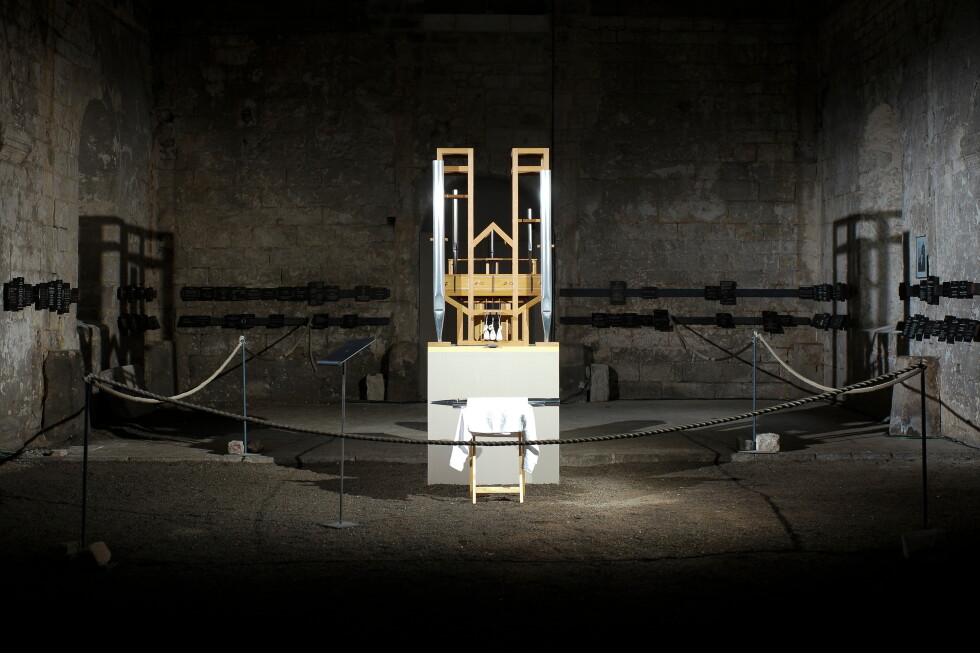
In the medieval ruins-turned-arts space of Burchardi Church in Halberstadt, eastern Germany, an extraordinary experimental art project that redefines the boundaries of musical performance continues its glacial journey. Nearly 25 years after the first note resonated through the stone walls, the world’s slowest ongoing concert has hit a rare milestone: a manual chord change that brings the 639-year performance to roughly 4% completion.
The ambitious initiative, known as the John Cage Organ Project Halberstadt, stages John Cage’s iconic experimental composition *ORGAN²/ASLSP (As SLow aS Possible)*, a work that demands the piece be played as slowly and softly as the interpreters choose. While project planning began in 2000, the performance officially launched on September 5, 2001, what would have been the avant-garde American composer’s 89th birthday, opening with a 17-month silent pause that stretched all the way to February 5, 2003, when the first chord finally echoed through the church. This week’s chord shift, which added an A4 pipe to expand the harmony from seven notes to eight, marks only the 17th sound adjustment in the work’s more than two-decade history. The next change is already scheduled for October 5, 2027, when an E4 pipe will be removed to alter the chord once again.
The 639-year timeline, set to conclude on September 4, 2640, was not chosen arbitrarily. According to Anneli Borgmann, chair of the project’s board of trustees, the duration was selected as a tribute to the world’s oldest playable historic organ, which was constructed in Halberstadt in 1361 — exactly 639 years before the project was first organized in 2000. The organ itself, powered by a continuous electric blower system to sustain unbroken sound, has been engineered for extreme longevity. Master organ builder Johannes Hüfken, who crafted the new A4 pipe installed this month, confirms that all components are built to survive at least another 500 years, ensuring the performance can outlive multiple generations of stewards.
What began as a radical experimental art concept has also reshaped the Burchardi Church itself. Before the project launched, the structure sat largely in ruins, but funds raised for the initiative paid for a new roof and critical structural repairs, saving the historic site for future generations. For visitors, the experience is unlike any traditional concert: the sustained chord resonates through the entire empty stone sanctuary, and shifting just a few feet dramatically alters how the sound is perceived, leading Jeffrey Lependorf, executive director of the New York-based John Cage Trust, to observe: “I think it really is the organ playing the church and not the other way around.” Lependorf, who has followed the project for years, says the deep, sustained vibrations of the organ are felt across the entire body, creating an immersive experience that cannot be replicated in modern performance settings.
Beyond its artistic innovation, the project acts as a provocative meditation on intergenerational responsibility and long-term thinking, a reminder to plan for futures far beyond any single person’s lifetime. “This John Cage project is a good example of thinking ahead for the next generation — thinking outside the box, beyond the completely normal and traditional,” Hüfken noted. Curators and stewards regularly grapple with questions that stretch centuries into the future: Will the church still stand when the final chord sounds in 2640? Will Halberstadt, a city that has already survived two world wars, endure the accelerating impacts of climate change? To lock in access for the final performance, the project has already begun selling inheritable “final tickets” for the 2640 closing event, priced at 2,640 euros (approximately $3,045) apiece, that can be passed down through families for more than six centuries.