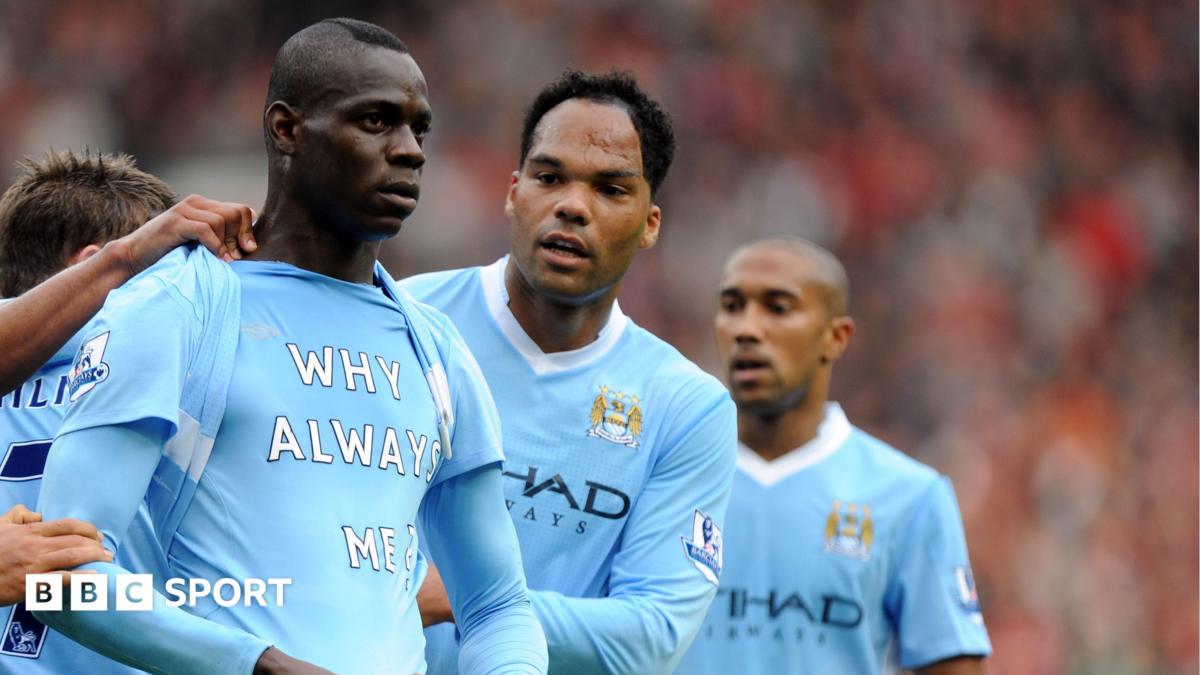
Seventeen years after he first burst onto top-flight football’s radar, and 15 years removed from that instantly recognizable Manchester derby T-shirt celebration, 36-year-old Italian striker Mario Balotelli continues to carve out a uniquely unorthodox career path, now plying his trade in the UAE First Division alongside his biological brother Enock Barwuah. Long labeled a maverick, loose cannon, and unmanageable talent by fans, pundits, and even some of his former managers, Balotelli’s story is one of unfulfilled elite potential, unforgettable on-field highlights, and a string of off-field anecdotes that have cemented his status as one of Premier League’s most cult-favorite figures.
Raised in foster care by the Balotelli family near Brescia after being placed in care as a three-year-old by his Ghanaian biological parents, Balotelli never came up through a top European academy system: he made his senior debut as a teen with Italian third-tier side Lumezzane, before a trial at Barcelona failed to land him a contract. It was Inter Milan that signed him in 2006, where he first crossed paths with the man who would become his lifelong paternal figure, Roberto Mancini. Under Mancini’s early guidance, a 17-year-old Balotelli shone, helping Inter claim the 2007-08 Serie A title and memorably scoring two goals against Juventus to send the club through to the Coppa Italia semi-finals. But the arrival of Jose Mourinho that summer sparked a notoriously fractious relationship: the Portuguese manager infamously branded Balotelli “unmanageable” and rated one of his performances close to zero, even as the striker picked up three more Serie A titles and a Champions League medal with the Nerazzurri.
In 2010, 20-year-old Balotelli reunited with Mancini at Manchester City, where the manager sought to harness his prodigious talent to lift the club out of its decades-long trophy drought. Balotelli’s time in England was defined by a chaotic mix of brilliance and controversy: he helped City end their 35-year wait for a major trophy with the 2011 FA Cup, but was also involved in a car crash with an Audi R8, threw a dart at a youth team player, and infamously caused a house fire when fireworks were set off in his Cheshire bathroom. Just days after that 2011 fire incident, he scored the opening goal in City’s iconic 6-1 derby demolition of Manchester United, lifting his jersey to reveal the hand-drawn “Why always me?” slogan that became one of the Premier League’s most enduring images. Most notably, his only assist of that 2011-12 season set up Sergio Aguero’s last-second title-winning strike against Queens Park Rangers, delivering City their first top-flight crown in 44 years.
Former teammates including Micah Richards and Nedum Onuoha pushed back against the public narrative of Balotelli as a reckless troublemaker, describing him as a kind, unarrogant figure whose off-field antics were rooted in genuine eccentricity rather than malice. But a final training ground bust-up with Mancini in January 2013 ended his City tenure, and he moved to AC Milan. His international career had peaked months earlier, at Euro 2012, where he became the first Black player to represent Italy at a major tournament, finishing as joint top scorer and hitting a memorable semi-final goal against Germany that sent the Azzurri to the final, celebrated by a shirtless muscle-flex that became a tournament icon. Throughout his career, Balotelli has been a vocal, uncompromising opponent of the persistent racist abuse he faced on pitches across Europe, drawing on his dual Ghanaian and Italian heritage to speak out against discrimination.
A disastrous, high-profile £16 million move to Liverpool in 2014, where he managed just one Premier League goal in 16 appearances, was later described by Balotelli as the worst mistake of his life. The subsequent years saw him bounce between 10 more clubs across six countries, including spells at Nice, Marseille, Brescia, Adana Demirspor, and Genoa, never staying more than a single season at most sides, and never recapturing the elite form he showed at his peak.
Now, at 36, Balotelli has found quiet contentment playing professional football alongside his brother in the UAE, far from the intense spotlight of top European leagues. Former teammate Onuoha notes that while the career never reached the Messi and Ronaldo-level heights a young, ambitious Balotelli once genuinely believed he could hit, the striker has earned the right to enjoy his final playing years on his own terms, far from the endless media scrutiny that followed him for most of his career.