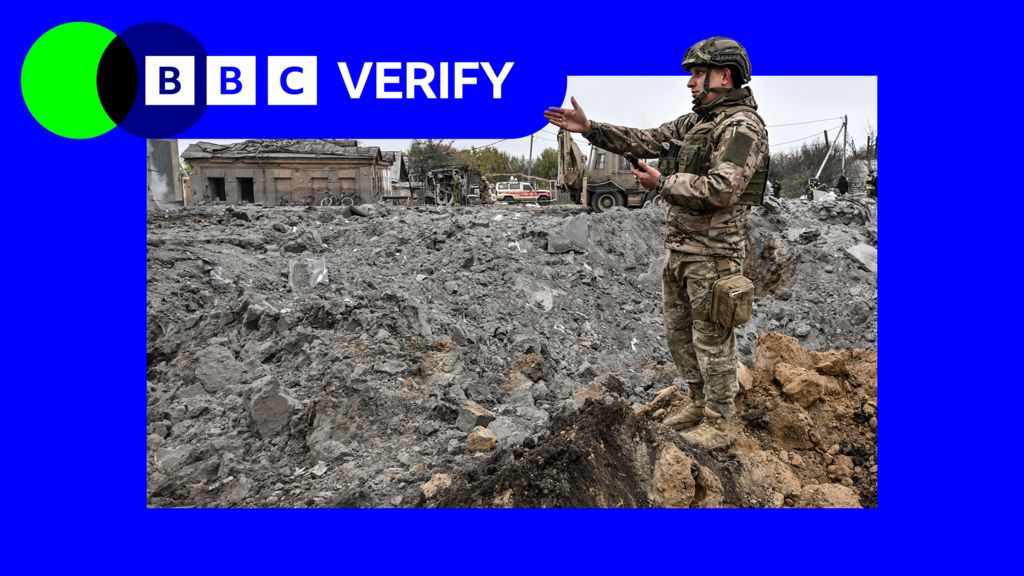
Two weeks after a devastating sequential aerial assault near Ukraine’s frontline settlement of Komyshuvakha left no fewer than 72 people dead, Ukrainian officials have formally accused Russian forces of intentionally targeting humanitarian rescue and recovery teams as they worked to pull survivors and recover remains from the rubble. The 2 November attacks unfolded at a designated aid distribution center in the small village, where local residents had gathered after a popular local Telegram group announced supplies would be handed out between 10 a.m. and noon local time. The first strike struck above-ground structures at 9:45 a.m., killing one civilian woman and prompting first responders, police, and volunteer aid workers to rush to the scene to launch search and rescue efforts. Roughly an hour later, a second, far more powerful 3,000-kilogram (6,600-pound) FAB-3000 aerial bomb, fitted with a precision glide guidance kit, detonated directly on the underground shelter where fleeing civilians and rescuers had taken cover to avoid further shelling. Documented, independently verified imagery shared in the days following the attack shows extensive damage to clearly marked emergency response vehicles, excavation machinery, and munition fragments consistent with the Russian heavy glide bomb. Ukraine’s State Emergency Service (DSNS) confirmed to BBC Verify that repeated Russian strikes continued to disrupt rescue operations long after the initial two blasts, leaving three police officers, four emergency service personnel, and two specialized search and rescue dogs injured, while destroying or damaging five dedicated response vehicles. Emergency crews have been forced to repeatedly pause their high-risk work and retreat to safe zones due to constant threats of renewed shelling, slowing recovery efforts even as scores of bodies remain trapped under debris. An SBU Ukrainian security service intelligence officer, who requested to be identified only by his first name Oleksiy, emphasized that all rescue vehicles operating at the site bore distinct, unmistakable humanitarian markings, framing the repeated targeting as a deliberate tactic to terrorize civilians. He noted that Russian forces have systematically targeted Komyshuvakha’s remaining civilian infrastructure, resident populations, and emergency response teams via drones and aerial bombardment, with the explicit goal of rendering daily life unlivable for anyone remaining in the frontline area. Independently verified bodycam footage released by Ukrainian police captures the chaos of the immediate aftermath: first responders can be heard shouting urgent warnings of incoming drone activity as they scramble for cover, while other clips capture attempts to free trapped civilians from rubble before the second massive detonation cuts the recording short, leaving the frame completely dark. Post-attack footage shows a massive crater where the underground shelter once stood, with twisted rebar and shattered structural debris scattered across the impact zone. Local communities have held nearly daily funerals for the victims, which include aid administrators, civilians who arrived to collect humanitarian supplies, and military personnel who deployed to the village to support initial rescue efforts. Two independent weapons and munitions experts, Trevor Ball of Armament Research Services and former UK National Crime Agency investigator Chris Proops, both confirmed that the size of the blast crater and recovered munition guidance kit fragments are fully consistent with a modified FAB-3000 heavy aerial bomb, a weapon designed to penetrate and destroy hardened underground structures. While Russian forces issued a general statement on 2 November claiming to have targeted Ukrainian military energy and transport infrastructure nationwide, no response has been provided to BBC Verify’s specific requests for comment on the Komyshuvakha attacks. No military or industrial facilities are documented within Komyshuvakha itself, though the village sits in proximity to a key logistics route used for Ukrainian troop movements, supply deliveries, and civilian evacuations, and was previously hit by Russian strikes on 28 October earlier that same week. Leading international humanitarian law experts have flagged the incident as a potential serious violation of global war crime statutes. University of Sydney international law professor Ben Saul noted that the attack “appears to be either a deliberate attack on civilians or civilian objects – a war crime – or an indiscriminate attack – also a war crime,” while Yale University’s Professor Samuel Moyn emphasized that intentionally targeting emergency rescuers and their dedicated equipment constitutes a gross, flagrant breach of established international humanitarian law, which requires all parties to a conflict to take every feasible precaution to avoid harming non-combatants and protected civilian personnel.
Ukraine accuses Russia of targeting rescue operation after ‘double-tap’ strike kills 72