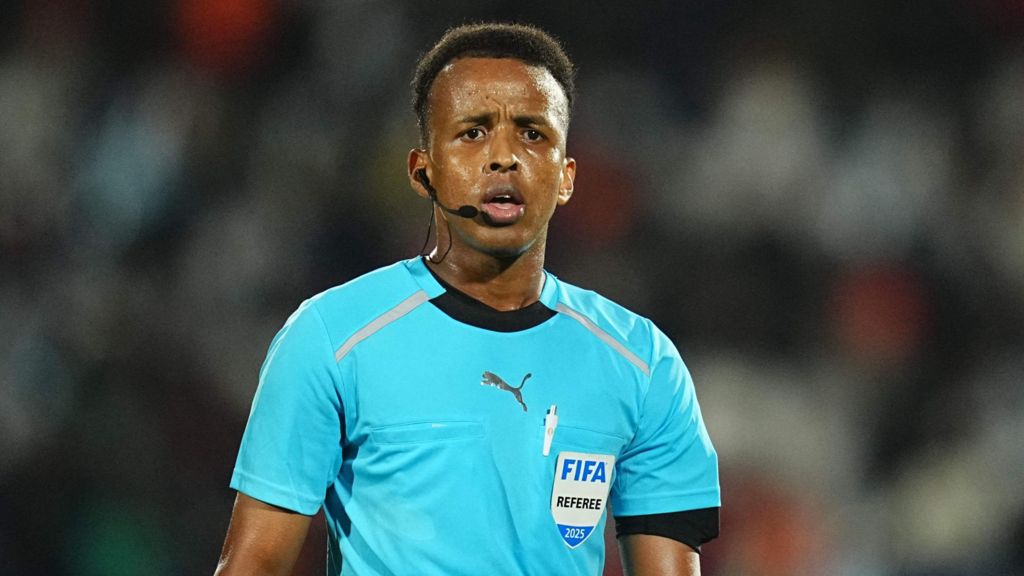
For Omar Artan, a Somali referee who climbed from war-battered local neighbourhood pitches to the cusp of football’s grandest stage, the 2026 FIFA World Cup was supposed to be the crowning achievement of a remarkable career. It was set to be a moment of national pride: Artan, 34, would become the first Somali to ever serve in an on-pitch role at the World Cup finals, a beacon of hope for a young generation in a country fractured by decades of conflict. But that dream has been shattered, after U.S. border officials denied Artan entry into the country despite him holding a valid diplomatic passport and approved single-entry visa.
Artan’s journey to the World Cup officiating panel is one of relentless grit against overwhelming odds. His playing career came to an early end following a leg injury, and he first picked up a referee’s whistle by accident: during a chaotic local match in Mogadishu, a dispute over the original official led both teams to ask Artan to step in. He accepted the role, and quickly carved out a space for himself in Somali football, honing his skills in informal and semi-organized fixtures at a time when the country’s football institutions operated with almost no structure or international support.
A formative figure in Artan’s early career was Osman Jama Dirac, the former head of refereeing in Somalia, who provided not just technical coaching but also personal support to up-and-coming officials. “He was like a father to us,” Artan recalled of Dirac, who was killed in 2017, just as Artan was on the cusp of breaking into international officiating. “He was preparing me to become an international [referee]. He would have been proud to see a Somali reaching this level.”
Artan earned his place on the FIFA listed referees roster in 2018, and steadily rose through the ranks of African continental football. In 2024, he made history as the first Somali to referee a match at the Africa Cup of Nations (Afcon), and by November of that year, the Confederation of African Football (CAF) named him the top male referee on the continent. He capped off this run by officiating the second leg of the 2025 African Champions League final, and in April 2026, FIFA included him in the 52-referee panel for the 2026 World Cup – a milestone celebrated by Somalia’s president Hassan Mohamud, who hailed Artan as “a symbol of inspiration for the new generation of Somalis.”
In the months leading up to the tournament, Artan threw himself into rigorous preparation, training daily to meet the physical, mental and technical standards required of a World Cup referee. “Preparation for the World Cup is not small work… physically, mentally, and in knowledge,” he explained before departing. “In World Cup football you are dealing with world-class referees at the highest level. You have to reach that standard and stay there.”
Artan traveled to the U.S. via Istanbul, Turkey, to attend the mandatory pre-tournament referee seminar hosted at FIFA’s Miami training hub – a requirement for all on-pitch officials, even those who would later officiate matches held in co-host nations Canada and Mexico. But upon his arrival in Miami, Artan ran into immigration barriers tied to a travel restriction policy first introduced by the Donald Trump administration, which lists Somalia as a restricted country.
Artan told the New York Times he was held for questioning by border officials for 11 hours, with much of the interrogation focused on the Somali militant group al-Shabab. Ultimately, he was denied entry over unspecified “vetting concerns” and placed on a flight back to Turkey, where he currently remains, and is expected to return to Mogadishu this Wednesday.
In a statement to the BBC, the U.S. State Department defended its process, noting it welcomes “legitimate travellers” to the World Cup and adjudicates each visa application individually “after rigorous review and thorough vetting,” with “national security and public safety” cited as core considerations.
FIFA has confirmed it is unable to intervene in the case, as immigration and visa decisions fall exclusively under the authority of host nation governments. “FIFA is not involved in host country immigration processes, including visa adjudications, and has been informed by authorities that Mr Artan’s status will not be changed at present,” the global governing body said in a Monday statement. “A host government ultimately determines who receives a visa and who is admitted into their country.”
The Somali government has launched diplomatic efforts to reverse the decision, but current indications suggest Artan will not take part in the 2026 tournament. Artan has responded to the setback with measured grace, expressing gratitude for the outpouring of support from the global football community and reaffirming his commitment to his refereeing career. “I would like to thank FIFA and CAF for all their support and I promise to keep my refereeing levels up as I concentrate on the future,” he told Reuters. “I wish my colleagues all the best success during the World Cup and I look forward to joining them again in future competitions.”
Six referees from Africa will still take part in the 2026 World Cup, which kicks off Thursday and runs through July 19, representing Algeria, Egypt, Gabon, Mauritania, Morocco and South Africa. But for Artan and Somalia, what was set to be a groundbreaking, hope-filled milestone has been cut short by U.S. immigration policy.