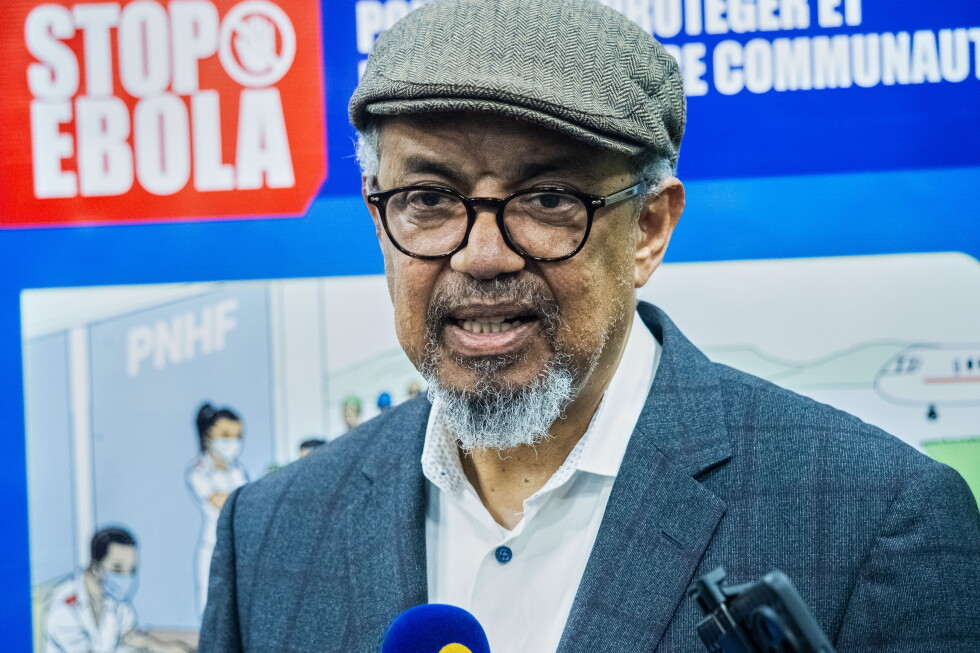
KINSHASA, Democratic Republic of Congo — As frontline medical teams grapple with cascading challenges ranging from critical equipment shortages to community distrust and active armed conflict, World Health Organization Director-General Tedros Adhanom Ghebreyesus touched down in Congo’s capital Kinshasa late Thursday to personally observe the response to a rare strain of Ebola outbreak.
In remarks to reporters gathered at Kinshasa’s airport, Tedros emphasized that his in-person visit was intended to send a clear message to affected communities: they are not facing this public health emergency alone. “Issuing directives from a comfortable office in Geneva is simple, but I am asking my staff to work side-by-side with local communities, and asking communities to take steps to protect themselves,” he explained. “My presence here reflects that shared commitment.”
The outbreak, caused by the Bundibugyo Ebola virus — a subtype with no currently approved vaccine or targeted treatment — has already spread across three northeastern Congolese provinces, centered on Ituri province. As of this week, WHO data records 1,077 suspected cases and 238 suspected deaths across the affected region.
Frontline response efforts have been severely undermined by a crippling lack of critical supplies. In multiple hard-hit areas, overstretched health workers have even been forced to rely on expired personal protective equipment, including medical masks, when interacting with suspected patients.
Community tensions have further complicated containment work. Stringent infection control protocols for handling Ebola victims’ bodies directly conflict with long-held local burial traditions, sparking anger among residents that has boiled over into at least three separate attacks on local health facilities. Tedros highlighted two other major barriers to stopping the outbreak’s spread: mass population displacement caused by decades of armed conflict in the region, and widespread acute food insecurity.
A day ahead of his arrival in Kinshasa, Tedros issued an urgent call for a ceasefire in the conflict-torn northeast, arguing that public health work cannot proceed amid ongoing violence. “We cannot build community trust or isolate infected patients while bombs are falling,” he said.
Ituri province, located in northeastern DRC near the Ugandan border, has been plagued by sustained violence from the Allied Democratic Force (ADF), a rebel faction linked to the Islamic State, alongside a coalition of ethnic militias. Just weeks ago, early May attacks by the ADF left at least 40 people dead and destroyed dozens of civilian homes in the province.
The outbreak has also been detected in North Kivu and South Kivu, provinces south of Ituri where the Rwanda-backed M23 rebel group holds control over major urban centers including Goma and Bukavu. Two cases of the virus have already been confirmed among rebel fighters in the region.
Goma’s main airport, a critical logistical hub that coordinates most humanitarian aid deliveries into northeastern DRC, has remained closed since M23 forces seized the city in January 2025. The ongoing conflict in eastern DRC has already spawned one of the world’s worst humanitarian catastrophes, forcing more than 7 million people from their homes across the region.
There was some positive development Thursday, however: a shipment of medical aid donated by the European Union arrived in Ituri, the epicenter of the outbreak. Hours earlier, the United States announced an additional $80 million in emergency assistance for the response, bringing Washington’s total commitment to the effort to more than $112 million.
During his Kinshasa press briefing, Tedros also pushed back against travel restrictions imposed by multiple countries in response to the outbreak, urging nations against implementing broad entry bans. “There are effective ways to manage risk and screen cases without imposing harsh, broad travel restrictions, and as an organization, we do not encourage that approach,” he stated.
The Trump administration recently drew criticism for its new restrictions: last week, it announced a temporary entry ban for non-US citizens and non-green card holders who have traveled to outbreak-affected nations including Congo, Uganda, and South Sudan within the previous 21 days. On Wednesday, the administration further announced that US citizens exposed to Ebola would be quarantined at a new facility in Kenya, rather than being repatriated to the United States for isolation. Congo’s neighboring countries, Uganda and Rwanda, have also recently closed their shared borders in response to the outbreak.
Reporting for this story was contributed by Banchereau from Dakar, Senegal.