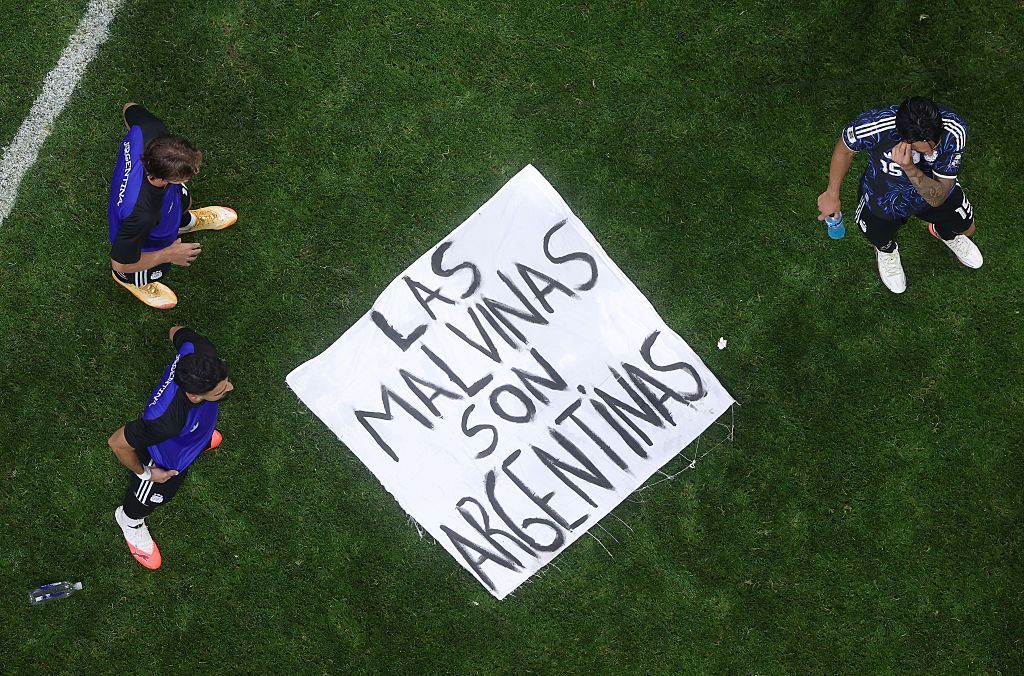
A diplomatic controversy has ignited following Argentina’s World Cup semi-final win over England, after the nation’s football team unfurled a banner asserting Argentina’s territorial claim to the Falkland Islands, a long-disputed South Atlantic territory controlled by the United Kingdom as an overseas territory.
The banner, which read “Las Malvinas son Argentinas” (translated to “The Falklands are Argentine”) was displayed in the immediate aftermath of Argentina’s 3-0 quarter-final victory over England on Wednesday, putting the team at risk of formal disciplinary measures from FIFA, international football’s governing body. FIFA’s rules prohibit political demonstrations and statements during official tournament matches, meaning the incident could lead to sanctions against the Argentine Football Association.
In a surprising intervention that has amplified tensions around the incident, a senior White House official has defended the Argentine squad’s right to make the political statement. Andrew Giuliani, head of the White House’s FIFA task force, told reporters Friday that the team retained the right to express such positions, aligning with U.S. free speech principles. “We believe in our First Amendment rights here in the United States of America,” Giuliani said, confirming the White House’s stance that players should have the opportunity to make those statements.
The United Kingdom has pushed back firmly against the White House’s comments, with Downing Street reiterating its unwavering sovereignty claim over the islands and backing growing calls for FIFA to launch a formal investigation. “The World Cup might not be ours, but the Falkland Islands definitely are. Our commitment to the Falklands will never waver,” a spokesperson for UK Prime Minister Rishi Sunak said Friday. While Number 10 noted that any disciplinary action falls under FIFA’s authority, it echoed calls from Business Secretary Peter Kyle for the governing body to probe the incident fully.
Officials from the Falkland Islands government said they were “disappointed but not surprised” by the team’s action, and urged FIFA to issue sanctions aligned with its existing rules against political displays. “We do not wish to see politics being brought into sport,” the government said in an official statement, adding “Nor do we wish the Islands and their people to be used as a political football in every conversation about England and Argentina.”
The sovereignty dispute between the UK and Argentina stretches back more than a century, and flared into open conflict in 1982, when Argentine military forces invaded the islands to assert Buenos Aires’ claim. A 74-day war led by a British military task force ended with Argentina’s defeat, leaving 255 British service members, three Falkland Island civilians, and 649 Argentine soldiers dead. In a 2013 referendum held by the Falkland Islands government, more than 90% of eligible voters turned out, and 99.7% voted to remain a British overseas territory.
Senior Argentine officials have echoed the team’s claim, with Vice President Victoria Villarruel writing on social platform X after the win that the match was “not just another match.” “The Falklands are Argentine,” she posted. “They banned bringing them to the stadium and forgot that we carry them in our blood and our hearts.” This is not the first instance of the Argentine squad raising the sovereignty issue during the 2022 World Cup: after the team’s dramatic 3-2 round of 16 win over Mexico, players sang chants referencing the Falklands, alongside tributes to Argentine legends Diego Maradona and Lionel Messi.