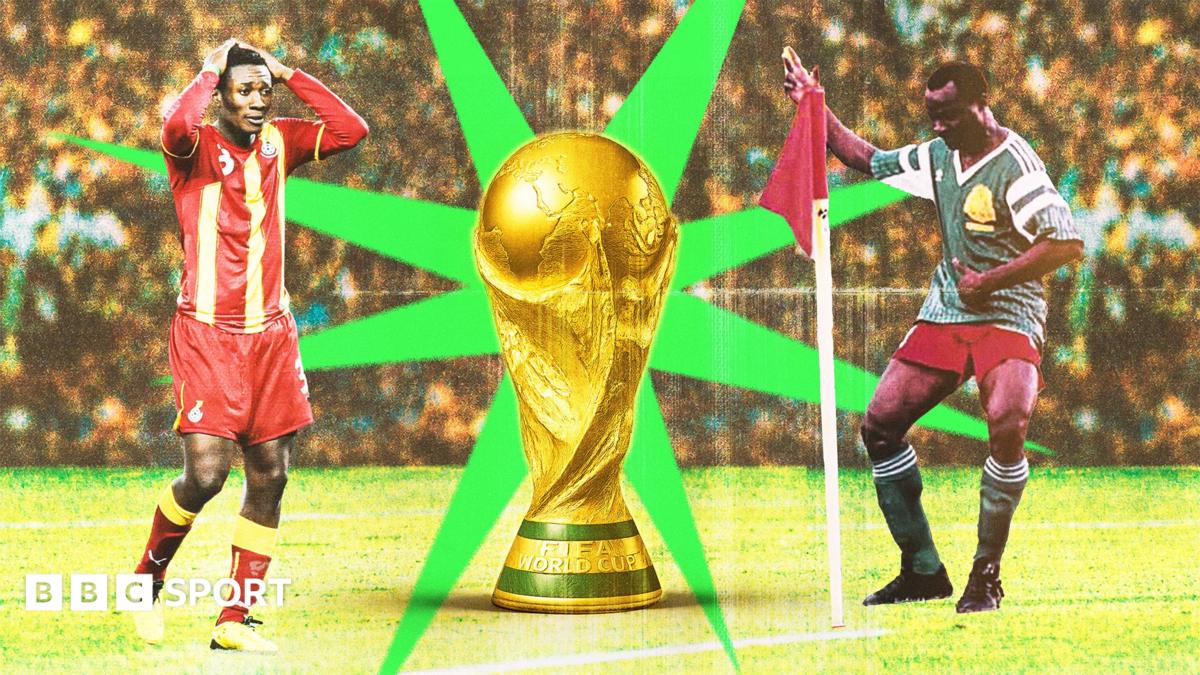
For decades, football fans across Africa have shared one enduring dream: to see a nation from the world’s second-largest continent lift the sport’s most prestigious prize, the FIFA World Cup. That dream remains unfulfilled decades after it was first predicted, but after historic breakthroughs and systematic investment across the continent, many believe the moment is closer than ever before.
Sunday Oliseh, a 51-year-old former player who helped Nigeria claim Africa’s first Olympic men’s football gold medal at Atlanta 1996, sums up the widespread continental longing. “If there’s something I want to see before God takes me to heaven or hell it would be great to see an African nation win [the World Cup], because this is a tournament that we all love passionately in Africa,” he says.
Since the first World Cup kicked off in 1930, 49 national teams from 13 African countries have taken part in 22 editions of the tournament. For decades, their progress was limited by systemic barriers rooted in colonialism, restricted allocation of tournament slots, and missed narrow opportunities. Before 2022, Africa had only ever produced three World Cup quarter-finalists: Cameroon’s Indomitable Lions in 1990, Senegal in 2002, and Ghana’s Black Stars in 2010. It was not until the 2022 Qatar World Cup that the continent made history, when Morocco’s Atlas Lions fought past heavyweights Belgium, Spain, and Portugal to become Africa’s first ever World Cup semi-finalists.
This landmark achievement came as no accident: it was built on more than a decade of targeted, long-term investment backed by King Mohammed VI of Morocco. The King Mohammed VI Football Academy opened in 2009, followed by a $65 million state-of-the-art training complex in 2019, creating a development pipeline that turned Morocco into Africa’s highest-ranked men’s national side.
William Troost-Ekong, a former Nigeria captain, says Morocco’s success created a replicable roadmap for other African nations. “Morocco has created a blueprint of how it can be done, which is years and years of investing in grassroots football and academies,” he told BBC Sport Africa. “It starts with structure, with planning. Investment [is] very, very important. It has to be something that comes from federations being supported from a governmental level. Morocco have invested not just money but also time and effort, with a clear idea of how they can progress. The facilities they have, the consistency throughout their age groups, I think that’s the only blueprint you can follow.”
Confederation of African Football (Caf) has also taken steps to strengthen the game across the continent, boosting prize money for the Africa Cup of Nations and top continental club competitions to increase federation and club revenue, while also investing in national schools championships. Caf president Patrice Motsepe reaffirmed the governing body’s commitment to developing the sport, predicting that “An African country will be champions of the world. That is what we are working towards, that’s what we are investing in and we are confident it will happen.”
Veteran manager Claude Le Roy, who led Cameroon at the 1998 World Cup and coached five other African national sides, echoes the focus on youth development as the foundation for long-term success. “If you want to permanently have high-level national teams in Africa, you need to work with youth categories,” the 78-year-old said. “That’s the base of everything.”
Structural changes to the World Cup itself have also opened new doors for African nations. For most of the tournament’s history, Africa was severely underrepresented: between 1930 and 1962, Egypt was the only African entrant in the first eight editions, and the continent boycotted the 1966 World Cup after FIFA refused to allocate it a direct qualifying spot. Through successive tournament expansions, the number of African slots grew from 1 in the 1970s to five from 1998 onward, and the 2026 expanded 48-team tournament hosted by Canada, Mexico and the United States will mark a new milestone: nine African teams qualify automatically, with DR Congo claiming an additional spot via inter-confederation play-offs to bring the total contingent to 10, the largest in African history.
South Africa captain Ronwen Williams, who will lead his nation in the tournament’s opening match in Mexico City, says the growth of African participation reflects broader progress across the continental game. “We’ve been on the rise – the leagues, Caf, the [African] Champions League, Afcon,” he told the BBC. “Everything has improved immensely. For so many countries to go out and compete at the highest level, it’s amazing.”
Williams and Troost-Ekong both argue that greater participation will directly improve performance, particularly under the new format that allows two-thirds of participating teams to advance past the group stage. “Making it more accessible is going to be the key factor in the long term for teams to be more competitive,” Troost-Ekong said. “You need that exposure for improvement. The more experience they get, the more capable they will be with handling pressure. Experience is invaluable.”
Another growing advantage for African nations is the ability to tap into talent from global African diasporas, reversing decades of talent drain that saw top players choose to represent European nations. Many diaspora players develop their skills in elite European club academies, and a growing number of African federations are now actively recruiting eligible players to represent their ancestral nations. Morocco was an early pioneer of this approach, convincing Canada-born goalkeeper Yassine Bounou and Spain-born stars Achraf Hakimi and Brahim Diaz to represent the Atlas Lions. More recently, 2026 debutants Cape Verde and DR Congo, returning to the finals for the first time since 1974, both relied heavily on diaspora talent: 18 of DR Congo’s 26-man squad were born in Europe, including defenders Aaron Wan-Bissaka and Axel Tuanzebe, who switched allegiance from England’s youth setup. Tuanzebe even scored the decisive qualification goal that sent DR Congo to the 2026 finals.
Gabriel Zakuani, a former DR Congo captain now working as a technical consultant identifying and recruiting eligible diaspora players, says outreach and persuasion are key to unlocking this talent pool. “Recruitment is massive,” he told the More Than The Score podcast. “You have to get players to believe in your vision. Potentially they can’t play for England, Belgium or France, but they can still get to the World Cup. The biggest example is Axel Tuanzebe. He’s gone through the system with England and then he scores the goal to gets us to the World Cup. That is the fairytale ending, and probably the story I’ll use for the next player I try and get into the country.”
Morocco’s 2022 semi-final run has also shifted the continental mindset, proving to a new generation of African players that a deep tournament run is achievable. “What Morocco did, that was the start for us as Africans to believe that we can [go far],” South Africa’s Ronwen Williams said. “It starts with that belief, and you need to go out and perform.”
Senegal forward Iliman Ndiaye says that belief has already translated to a winning mindset across the continent. “I wouldn’t even bother packing my suitcase and travelling to the World Cup if it’s not to win it,” he told BBC World Service’s Newsday. “I don’t play these tournaments to just be a tourist. What Morocco did at the last World Cup should give all African teams inspiration.”
Even with all this progress, African sides have faced heartbreaking near-misses in the past, and a title win will still require a measure of good fortune. Senegal were knocked out of the 2002 quarter-finals by a golden goal against Turkey, a rule that has since been scrapped. In 2010, Ghana’s Asamoah Gyan hit the crossbar with a last-minute extra-time penalty against Uruguay in the quarter-finals, and Ghana went on to lose the subsequent penalty shootout that would have sent them through to the semi-finals.
For 2026, the expanded format adds an extra knockout round, meaning managing injuries and suspensions will be even more critical than before. Former Ghana midfielder Michael Essien says luck is the missing ingredient for a title run. “There’s been a lot of progress,” he told BBC Sport Africa. “The only thing that’s missing is luck. We just have to keep believing and hopefully one day it will happen.”
Morocco (ranked 8th globally) and Senegal (ranked 14th) enter the 2026 tournament as Africa’s strongest contenders to break the title drought, though both face challenging group stage draws. Even if the continent falls short in 2026, Morocco will have home-field advantage in 2030, when it co-hosts the tournament alongside Spain and Portugal, with plans to host the final.
Today, the gap between African sides and the European and South American powerhouses that have dominated World Cup history is undeniably narrower. For millions across the continent and the global African diaspora, the moment when an African nation lifts the World Cup – and creates pan-African sporting legends – is steadily edging closer.