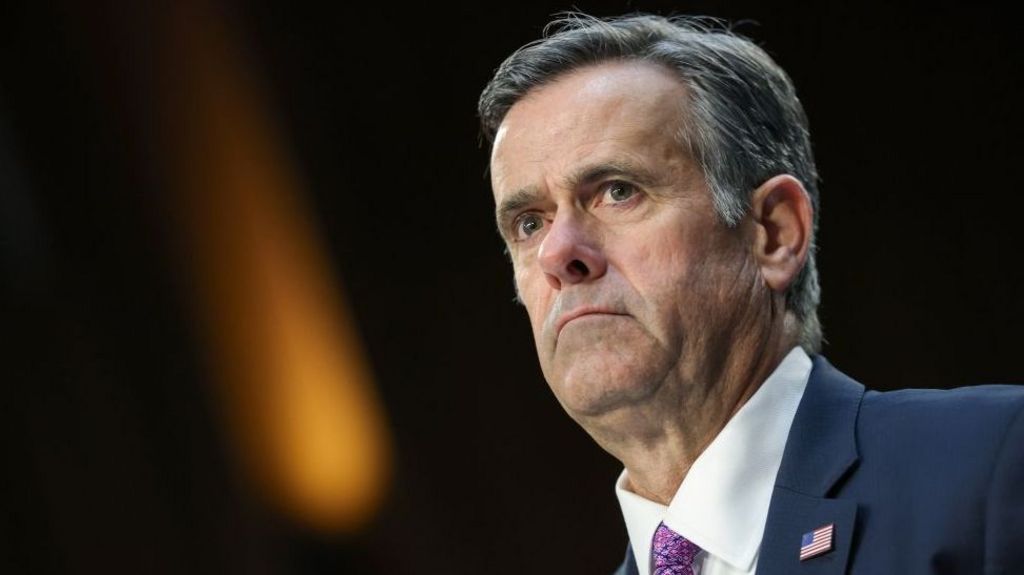
What U.S. President Donald Trump labeled a “semi-routine” trip belies the extraordinary nature of CIA Director John Ratcliffe’s secret 10,000-mile journey to the Russian capital Moscow last week. The Kremlin has since confirmed that Ratcliffe arrived in the city unannounced aboard a U.S. military aircraft, and held face-to-face talks on Tuesday with senior Russian intelligence leaders, including Sergei Naryshkin, director of Russia’s foreign intelligence service – Ratcliffe’s direct counterpart.
This meeting marks the first time a sitting CIA director has traveled to Moscow in nearly five years. The last visit, by then-director William Burns, came at an equally fraught moment: just months before Russia launched its full-scale invasion of Ukraine. That timeline alone signals the gravity of the current meeting, held at a time of rapidly escalating friction between Moscow and the Western alliance.
With no official statement from Washington explaining the purpose of Ratcliffe’s mission, open-source reporting and anonymous official briefings have pointed to one core objective: delivering a clear, direct warning to the Kremlin against stepping up aggressive actions amid the grinding war stalemate in Ukraine, particularly any moves that would directly target NATO member states. One senior U.S. official confirmed to Politico that the primary goal of the discussion was to caution Russia against initiating offensive operations against the three Baltic NATO members – Estonia, Latvia, and Lithuania.
Tensions have spiked sharply in recent weeks across the NATO-Russia border. On Thursday, a Russian foreign ministry spokesperson warned that Moscow could launch targeted strikes on British military installations in retaliation for Ukraine’s use of British-supplied long-range Storm Shadow missiles to attack targets inside Russian territory. Security analysts also assess that a recent explosive drone recovered at Leipzig Airport in Germany was most likely deployed by Russian actors, part of a growing pattern of unclaimed aggressive actions against NATO infrastructure.
These incidents come on the heels of U.S. intelligence assessments indicating that Russian President Vladimir Putin is actively considering a limited direct strike against a NATO ally, a development that would mark a dangerous new phase of the ongoing conflict. Even without top-secret NSA intelligence, it is clear that Putin faces growing domestic pressure to break the battlefield deadlock in Ukraine. Ukraine’s deep long-range drone strikes have repeatedly hit key Russian energy facilities, bringing the war’s impact directly to ordinary Russian citizens. Widespread fuel shortages and visible damage to critical oil infrastructure have laid bare the Kremlin’s earlier claims of military success, and the Russian leadership frames these strikes as evidence of a NATO proxy war against Russia.
Against this backdrop, a range of escalatory actions are on the table for Moscow, analysts say. The most immediate step would be an increase in the already heavy barrage of ballistic missile strikes against Ukrainian population centers, including central Kyiv. Ukrainian air defense forces are currently facing critical shortages of Patriot air defense interceptors, leaving them increasingly unable to stop these incoming attacks. Russia could also ramp up its undeclared hybrid war against NATO countries, expanding the cyberattacks, cross-border drone incursions, and sabotage attacks on weapons production facilities that intelligence agencies have already linked to Moscow.
At the more alarming end of potential scenarios, pushed by hardline domestic voices, are direct moves against NATO’s eastern flank. One widely discussed possibility is a limited incursion into a Baltic state, designed to distract from Russia’s stalled campaign in Ukraine and test the unity of the Western alliance. All three Baltic states were Soviet republics until 1991, and remain home to large Russian-speaking populations today. Putin, observers note, has likely calculated that Trump’s repeated public criticism of NATO commitments could mean a small-scale attack would not trigger the alliance’s Article 5 mutual defense clause, and that the U.S. would refrain from a military response. That context makes it highly likely that a core part of Ratcliffe’s mission was to reaffirm U.S. commitment to Article 5 and deter any such miscalculation.
Lithuania’s Suwalki Gap, a 60-mile stretch of border shared with Poland that separates Russia’s ally Belarus from its nuclear-armed exclave of Kaliningrad, is seen as a particularly high-risk flashpoint. Seizing the gap would cut off the three Baltic states from overland access to the rest of NATO, a strategic victory that would significantly weaken the alliance’s position in Eastern Europe.
Another major source of Western concern is the threat of Russian use of tactical nuclear weapons. Russian military doctrine has long integrated these smaller, high-yield weapons into conventional war planning. While the international community has repeatedly warned Moscow against breaking the 80-year taboo on the use of nuclear weapons in conflict, some analysts argue Putin could see a limited demonstration of nuclear capability as a way to force Ukraine into surrendering by escalating the conflict to the point of catastrophic threat – a strategy widely referred to as “escalate to de-escalate.”
Of course, without official on-the-record confirmation from the U.S. government, other motivations for the unexpected visit cannot be ruled out. Analysts have raised alternative possibilities, including efforts to convince Russia to end its military partnership with Iran, negotiations over new prisoner swaps, or discussions of Russian plans for a new mass troop mobilization. But regardless of the specific topics discussed, the unusual nature of the trip – coming at a moment of rapidly rising tension between Moscow and the West – makes clear that significant, high-stakes developments are unfolding behind closed doors.