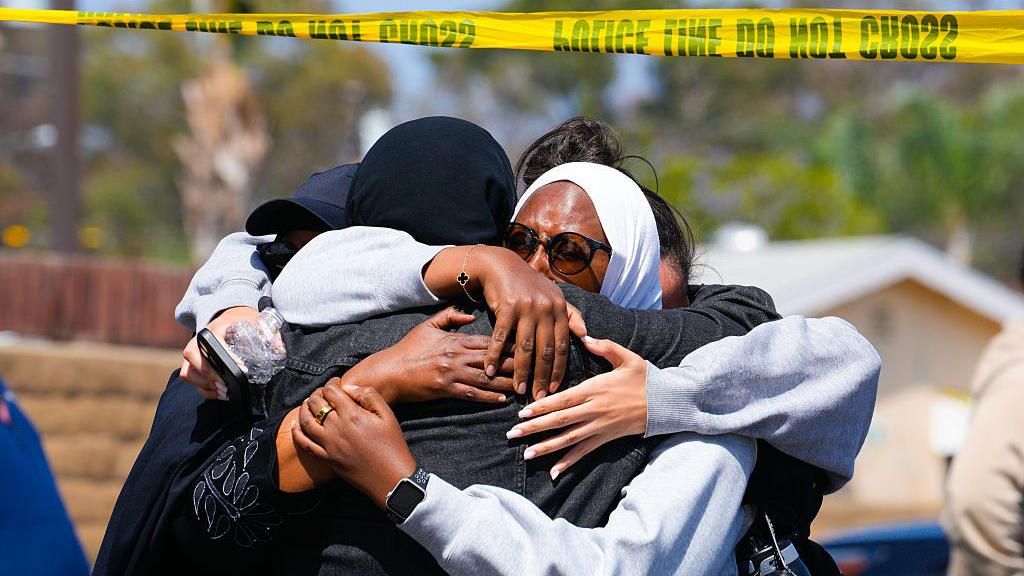
On a violent Monday that shattered the peace of a Southern California Muslim community, a shooting at the Islamic Center of San Diego left five people dead, including the two young suspects who died from self-inflicted wounds after the attack. Law enforcement officials have launched a full investigation into the assault, which they are treating as a likely hate crime rooted in targeted extremism, even as the full scope of the perpetrators’ planning and ideology remains under review.
San Diego Police Chief Scott Wahl has laid out a clear timeline of the tragedy that unfolded on the day of the attack. Roughly two hours before the first shots were fired at the mosque, at approximately 9:40 a.m. local time, the mother of one of the suspects contacted authorities to make an urgent report. She told police that her 17-year-old son had fled her home, stealing her firearms and her car, and warned that he was potentially suicidal and was accompanied by a friend. She also noted that he was wearing full camouflage clothing, a detail that could have allowed officers to locate the pair earlier if resources had been deployed immediately.
Just over two hours after that initial warning, at 11:43 a.m., local emergency dispatch received the first report of an active shooter at the mosque. Responding officers arrived on the scene within four minutes, a fast response that still came too late for three men who were already fatally shot outside the building. As first responders activated active shooter protocols to secure the area, they received a second report of shots fired from a vehicle nearby: the suspects had opened fire on a local landscaper, who escaped the attack without injury.
Less than a quarter of a mile from the mosque, officers located the suspects’ vehicle and found both young attackers — the 17-year-old and his 18-year-old accomplice — dead from self-inflicted gunshot wounds. Authorities have not officially released the suspects’ identities to the public, though multiple major U.S. media outlets have published their names unofficially.
The three victims of the attack, all regular community members tied to the mosque, have been formally identified by representatives of the Council on American-Islamic Relations San Diego (CAIR-SD). The first victim, Amin Abdullah, was a veteran security guard at the mosque and a father of eight children who had served the community for more than a decade. Chief Wahl confirmed that Abdullah’s quick, brave intervention stopped the attack from escalating into an even deadlier massacre, saying “It’s fair to say [Abdullah’s] actions were heroic. Undoubtedly, he saved lives today.”
CAIR-SD spokesperson Tazheen Nizam paid tribute to Abdullah, describing him as a beloved, constant presence at the mosque who greeted every visitor and child with a warm smile. “Amin was loved by everybody, he stood there day after day, always smiling, welcoming everybody, welcoming the kids who came to the school,” Nizam told the BBC. “He was a shining light. He is a true hero, a martyr.”
The two other victims were also deeply embedded in the mosque community. Nader Awad raised his children at the center, and his wife works as a teacher at the mosque’s on-site school. The third victim, Mansour Kaziha, supported the community by maintaining the mosque’s grounds and working in its on-site convenience store.
Investigators have uncovered early evidence pointing to the attack being ideologically motivated by hate. Multiple law enforcement sources, speaking on condition of anonymity to CNN, confirmed that hate speech was found scrawled on one of the weapons used in the attack. A suicide note left by the suspects also contained writings promoting racial supremacy, the outlet reported. Chief Wahl confirmed that investigators have identified hate rhetoric as a core component of the attackers’ motivation, cementing the decision to open a hate crime investigation.