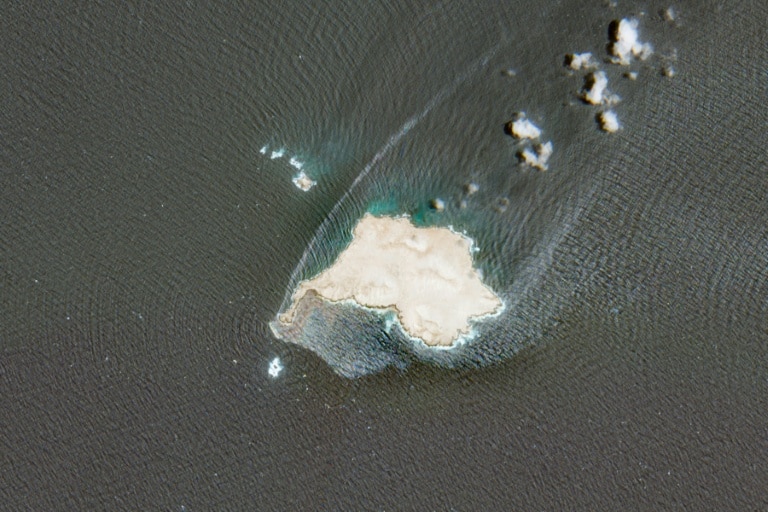
A growing oil spill from a stranded tanker linked to Russia’s shadow fleet has put a protected marine reserve off Oman’s southern Arabian Sea coast at risk of irreversible, long-term ecological damage, environmental advocacy groups and independent investigators have warned.
The vessel in question, identified as the *Caroline Bezengi*, is thought to be part of the loosely regulated network of aging, opaquely owned ships Russia has built up since its 2022 full-scale invasion of Ukraine to evade Western sanctions on its crude oil exports — a key source of revenue for Moscow’s economy. Maritime security firm Vanguard Tech told Agence France-Presse (AFP) that three explosions rocked the tanker on June 6, flooding critical compartments including the steering gear room and pump station. The blasts left the vessel’s main engine and steering systems completely inoperable, though all crew members were safely accounted for.
The cause of the explosions remains unconfirmed, with no definitive evidence to confirm whether the vessel was targeted in an attack. The tanker made its last known radio transmission off the coast of Yemen on June 11, and satellite data from the European Union’s Copernicus Earth observation programme confirms it ran aground off al-Qibliyyah island, part of the protected al-Hallaniyat island archipelago, between June 18 and 23. The stranded vessel’s dimensions, outline and deck markings match satellite records of the *Caroline Bezengi* before the ship deactivated its mandatory automatic identification system (AIS) tracking transponder, a common practice among shadow fleet vessels to avoid detection.
Kpler shipping data confirms the tanker loaded 1 million barrels of Russian crude at the Black Sea terminal of Sheskharis on May 11, and still held the full cargo when its last tracking signal was recorded a month later. The UK already sanctioned the *Caroline Bezengi* in February for its suspected role in violating Western price caps and sanctions on Russian oil exports.
Satellite imagery analyzed independently by Greenpeace and Dutch peace organization PAX shows the visible oil sheen leaking from the vessel has expanded dramatically in less than two weeks: from just 20 square kilometers on July 24 to an estimated 600 square kilometers by August 4. Unlike most high-profile tanker incidents in the Middle East that center on the Strait of Hormuz, this spill is unfolding far from the strategically critical chokepoint, in a remote protected area that Oman designated as a marine reserve just last year.
Environmental advocates warn the disaster is already unfolding, and the risk of a far larger catastrophe remains acute. “With oil apparently continuing to leak and the vessel stranded in a difficult location, the risk of an even larger environmental disaster remains serious,” Nina Noelle, Greenpeace’s spokesperson on the issue, told AFP. She emphasized that any full structural break-up of the tanker could release the entire 1 million barrel cargo into the protected ecosystem, causing consequences that would be “severe and long-lasting.”
The archipelago hosts one of the most biodiverse marine habitats in the Arabian Sea, supporting endangered species including nesting sea turtles, breeding migratory seabirds, the rare and endangered Arabian Sea humpback whale, fragile coral reef systems and seagrass meadows that form the base of the regional food web. Already, large stretches of al-Qibliyyah’s shoreline have been contaminated, with additional slicks spreading far out into open waters.
“Oil contamination in the Hallaniyat Islands threatens coral reefs, seagrass meadows and coastal habitats that support endangered sea turtles, migratory seabirds and marine mammals,” Noelle explained. “Even relatively small oil spills can persist in marine sediments for years, compromising the ecological resilience of this protected marine ecosystem.” Wim Zwijnenburg, an open-source environmental investigator with PAX, added that a full spill would also devastate local livelihoods: “A complete break of the ship can cause a regional environmental catastrophe, affecting both the lives of Omani fishing communities and the wider marine and island biodiversity.”
Both advocates agree that urgent action is critical to contain the damage. “Timely intervention and salvaging the oil tanker is of essence to prevent worse,” Zwijnenburg said. The International Maritime Organization has confirmed it is currently providing assistance to Omani authorities, but declined to share further details on the response effort. As of Tuesday, Oman had not responded to AFP’s requests for comment on the incident or the ongoing response.
Experts have long warned that Russia’s shadow fleet relies on aging, poorly maintained vessels that carry drastically higher environmental risk than standard commercial tankers. Noelle emphasized this incident is a predictable consequence of sanction evasion practices. “Sanctions are being circumvented using ageing and poorly maintained tankers, putting coastlines and marine ecosystems at risk,” she said.