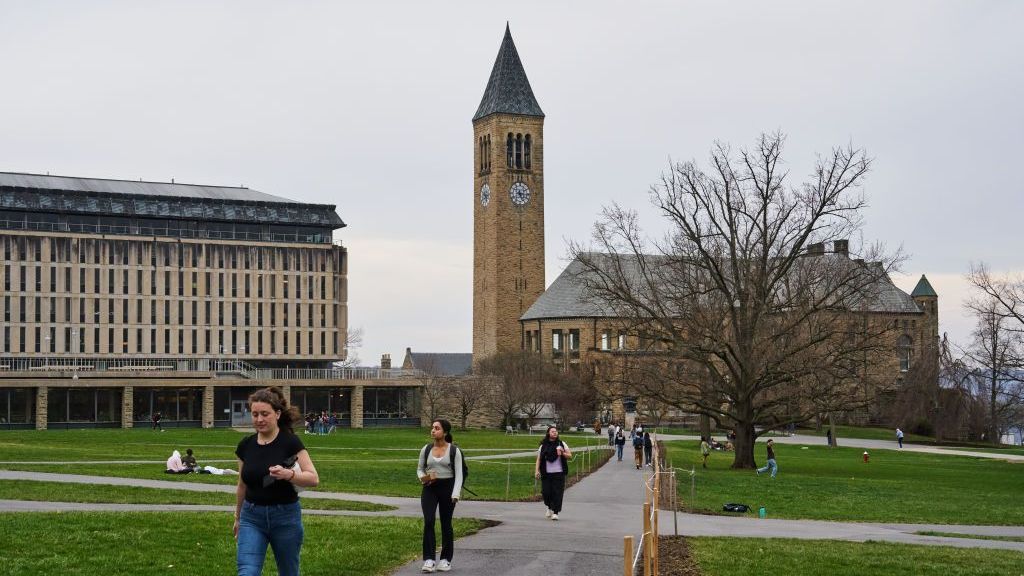
Nearly two years after an alleged sexual assault at an Ivy League campus, New York state prosecutors have relaunched a criminal inquiry into claims that seven Cornell University fraternity members gang-raped a drugged 20-year-old undergraduate in 2024. The case, which has ignited widespread public outrage over allegations the elite school failed to hold perpetrators accountable, is now set to move before a grand jury for formal consideration of criminal charges.
The accuser, identified only as Jane Doe in court documents, filed a 101-page civil lawsuit against Cornell, the local Chi Phi fraternity chapter and the seven accused men on September 16 this year. In her legal filing, Doe detailed the alleged October 19, 2024 attack: after leaving her sorority sisters to visit a friend at the Chi Phi house in Ithaca, New York, she became heavily intoxicated and was given the sedative drug ketamine without her consent. She says she was unable to give legal consent, and the seven men assaulted her over the course of several hours. The accused group has become widely known as the “Cornell Seven”.
Court documents include a screenshot of a group chat for active Chi Phi members, where members discussed the incident using vulgar language, referring to Doe as available for a “free” sexual encounter just before 2 a.m. local time on October 20. Two days after the alleged attack, CBS News New York obtained text messages from one of the accused men that appear to show him apologizing for how events unfolded. He wrote that his memory was “kinda fuzzy”, and that he and another defendant felt guilty for being too drunk to stop the assault before it escalated out of control. Doe replied that her memory was also clouded by alcohol, and she suggested meeting again without the additional men and ketamine, a message her legal team has framed as a trauma response rather than a reflection of consent. She officially reported the incident to Cornell University Police on November 8, 2024, more than two weeks after the attack.
The lawsuit sparked national anger after Doe alleged Cornell refused to properly investigate or punish the men involved, claiming the school allowed most perpetrators to avoid severe sanctions by only requiring them to submit essays about their conduct. Doe’s legal team confirmed two of the seven accused were ultimately expelled, but the lack of broader disciplinary action led the Cornell Daily Sun, the university’s independent student newspaper, to take the unprecedented step of publishing the full names of all seven defendants in a September 21 editorial titled “Cornell Won’t, We Will”. The move amplified widespread outcry across social media, putting increasing pressure on state and county authorities to revisit the criminal case.
Cornell has repeatedly pushed back against Doe’s claims that it failed to act. In multiple official statements, the university confirmed it immediately suspended the Chi Phi chapter and several students after the report, launched a Title IX civil rights inquiry and referred the case to a trained internal disciplinary panel that issued a range of sanctions, including expulsions and suspensions. The school did not deny that some students were required to write essays as part of their consequences, but emphasized that no defendant was allowed to use an essay as their sole punishment. “The events that took place on our campus in 2024 were appalling then and remain so now,” the university said in a recent statement, adding that it is committed to fostering a campus culture that does not tolerate sexual misconduct. The Chi Phi Xi chapter has remained closed and barred from campus since 2024. Cornell also confirmed that campus police turned over evidence, including the Snapchat group chat image, to prosecutors shortly after the incident was reported.
On September 29 this year, Tompkins County District Attorney Matthew Van Houten announced his office would reopen the dormant criminal investigation. When the incident was first reported in 2024, Van Houten said, prosecutors determined the initial evidence from Doe’s official statement did not meet the legal threshold to file criminal charges. Now, in light of the new allegations and evidence introduced in the civil lawsuit, the case will be presented to a grand jury, which will review all evidence and testimony to decide if criminal charges are warranted. Prosecutors have said they will pursue the case “in the most objective and impartial means possible.”
Van Houten also publicly noted a key discrepancy between Doe’s 2024 sworn statement to police and the allegations laid out in her recent civil suit. “Jane Doe’s sworn statement in November of 2024 did not allege that she was drugged against her will or gang raped,” he said. “On the contrary, Jane Doe’s statement described her participation in drug use and sexual conduct as voluntary, conscious, and consensual.” However, CBS News New York reports it has obtained a full transcript of Doe’s November 2024 interviews with campus police that contradicts this summary. In the transcript, Doe acknowledges she consented to an initial sexual encounter, but told investigators she can say “with 100% confidence I was raped” when the incident escalated beyond what she agreed to.
For anyone experiencing trauma or emotional distress related to sexual violence, support is available through global and national mental health organizations including Befrienders Worldwide.