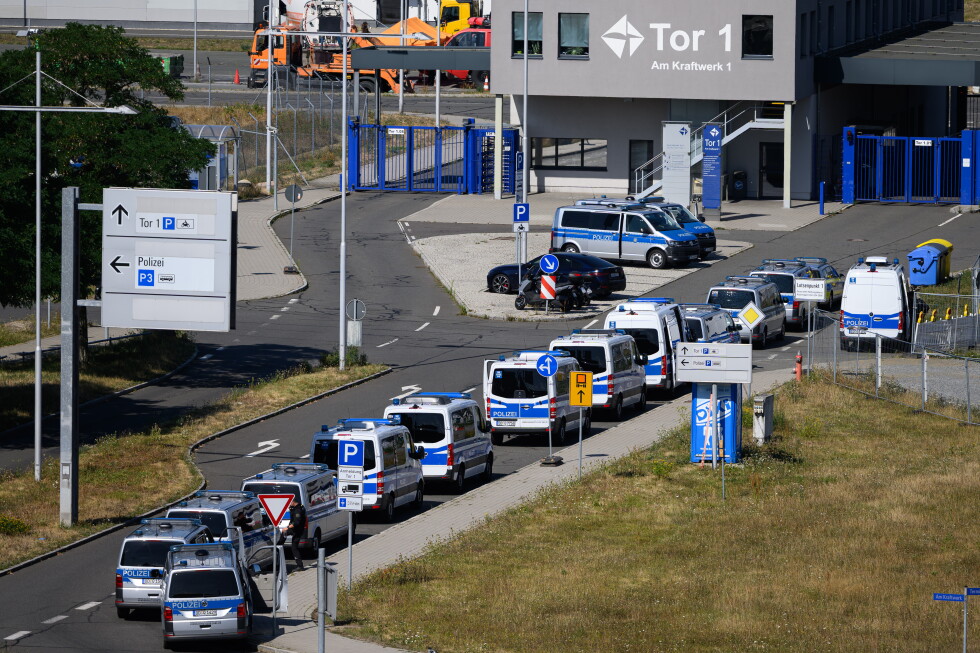
Germany’s Leipzig/Halle Airport, one of Europe’s most critical logistics and military support hubs, has narrowly escaped a second major potential security crisis in just over two years, after an explosive-laden drone was discovered on its grounds and a separate unidentified object collided with an incoming cargo plane this week.
The discovery of the drone was made Tuesday evening by a routine airport staff patrol near the facility’s southern runway, local law enforcement confirmed. The device was successfully defused shortly after recovery, and its detonator has been disabled ahead of forensic examination to uncover more details about its construction and origin. Investigations into the incident are currently ongoing.
In a separate, unconnected event occurring the same night, an unknown airborne object collided with a cargo jet that had aborted its landing at Leipzig/Halle after the runway was closed for the drone search. The aircraft diverted safely to Hannover Airport, roughly 200 kilometers northwest of Leipzig, where inspection teams found minor damage to the airframe. The plane remains in Hannover as inquiries continue, and Saxony State Criminal Police Office spokesperson Kay Anders told reporters Thursday that officers have launched a site-wide search around Leipzig/Halle to recover debris from the colliding object, declining to share further details on the extent of damage due to the active investigation.
Germany’s top domestic security official, Interior Minister Alexander Dobrindt, cut short a scheduled vacation to travel to the airport Wednesday for an emergency briefing with lead investigators. Speaking to reporters after the meeting, Dobrindt emphasized that while unauthorized drone incursions at German infrastructure have become a more common issue in recent years, the discovery of an explosive-packed drone at a major commercial airport marks an entirely unprecedented danger for the country.
“This is a new threat quality, a hybrid attack scenario that we have not faced before,” Dobrindt said, noting that all available evidence points to advanced, professional planning rather than amateur action. “For an operation like this, you need significant technical expertise, experience handling explosive materials, and careful coordination. None of the details we have seen so far point to amateur work.”
The minister also added that the drone was apparently designed specifically to evade existing airport drone defense systems, a revelation that confirms earlier warnings about evolving threats to German critical infrastructure. “Months ago, I publicly stated that we needed to upgrade our threat assessment, shifting from an abstract threat level to a confirmed high-level threat,” he said. “Today, that assessment has become reality.”
Leipzig/Halle Airport holds unique strategic significance beyond its role as a major international freight hub. As leading German terrorism expert Peter Neumann highlighted in a post on the social platform X, the facility serves as the operational base for Ukrainian Antonov Airlines, hosts NATO’s Strategic Airlift Interim Solution (SALIS) program, and is one of the primary European hubs for logistics support to Ukraine amid Russia’s ongoing full-scale invasion.
Neumann noted that suspicious drone activity targeting German infrastructure has risen sharply since Moscow launched its invasion in February 2022, with the vast majority of incidents targeting German military facilities, defense industry sites, and logistics hubs that support Ukraine. This is not the first major security incident at the airport linked to hostile activity: in 2024, an incendiary device detonated at an on-site logistics center, igniting a fire in a freight container that was bound for a flight bound out of the airport. Western security officials have publicly attributed that plot to Russian intelligence operatives, though no group has claimed responsibility for this week’s incidents.
As of Thursday, German security agencies have not named any potential suspects or confirmed a link to foreign actors, but the two back-to-back incidents have intensified scrutiny of Germany’s ability to defend critical infrastructure against evolving hybrid threats.