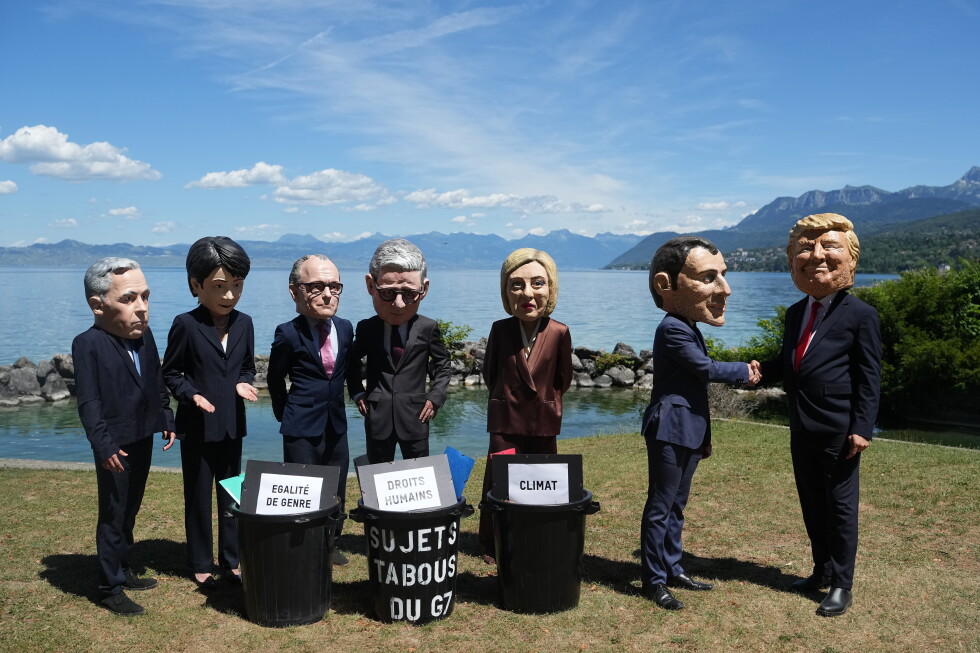
Fresh off celebrating his 80th birthday, U.S. President Donald Trump has traveled to the scenic Alpine spa town of Evian-les-Bains, France, for the annual summit of the G7 group of major world democracies, where simmering tensions with U.S. allies over conflicts, trade, and geopolitics are set to take center stage.
The entire narrative of the three-day gathering, running from Monday to Wednesday, shifted dramatically just hours before Trump departed Washington: he announced a landmark agreement to end the recent U.S.-Iran conflict, a development that has already altered expectations for negotiations between leaders. Only days earlier, the ceasefire between Washington and Tehran hung in the balance, with offensive military operations resuming after a brief pause, leading analysts to predict heated clashes and an early exit by Trump from the heavily secured summit zone. French President Emmanuel Macron, this year’s host, has sealed off the lakeside town to protect visiting leaders and invited guests, creating a tightly controlled security bubble for the talks.
The G7, founded in 1975 as a forum for leading industrialized democracies to coordinate responses to global economic crises, counts Canada, France, Germany, Italy, Japan, the United Kingdom, and the United States as its core members. Over its 50-plus year history, the bloc has maintained an unbroken record of full attendance by all sitting leaders, and has limited membership exclusively to democratic nations — a policy that allowed Russia to join as a G8 member in 1998 following the collapse of the Soviet Union, but resulted in Russia’s expulsion in 2014 after its illegal annexation of Ukraine’s Crimea peninsula, and has continued to exclude China, which is ruled by the Chinese Communist Party. France took over the rotating G7 presidency from Canada last year, and will hand the role to the United States in 2027.
Macron has structured the summit agenda to place the most divisive topics in the opening 24 hours, starting with the new Iran ceasefire deal and the ongoing war in Ukraine, which has slipped down the list of the Trump White House’s foreign policy priorities in recent months.
Ukrainian President Volodymyr Volodymyr Zelenskyy, an invited guest, will lead Tuesday morning’s dedicated session on Ukraine, where he will have a critical opportunity to lay out tangible progress made by Ukrainian forces against Russia’s full-scale invasion. Maria Snegovaya, a Russia expert at the Washington-based Center for Strategic and International Studies, notes that Zelenskyy comes into this meeting with a far stronger hand than he had during a tense Oval Office meeting with Trump and Vice President JD Vance last year. If Zelenskyy can successfully convince Trump that Russian President Vladimir Putin cannot secure a military victory in Ukraine, experts say he may be able to persuade the U.S. president to back pushing Putin into formal peace negotiations. Snegovaya adds that the Trump administration tends to view nations more favorably when they hold tangible leverage on the ground, a shift that works in Zelenskyy’s favor this time around.
Discussions over the new Iran agreement, set for a Tuesday lunch focused on Middle East policy, remain unpredictable. The formal ceasefire deal is scheduled to be signed this Friday, with 60 days of technical negotiations to work out core details. G7 allies that Trump criticized for refusing to join the U.S.-Israel offensive against Iran earlier this year are already breathing a sigh of relief: if the deal reopens the strategic Strait of Hormuz, the world’s most critical chokepoint for global energy exports, it will restore free flow of Persian Gulf oil and gas to global markets, easing pressure on already strained energy prices across Europe.
France and the United Kingdom have already prepared plans to clear potential mines from the Strait of Hormuz and provide escorted safe passage for commercial tankers, and are ready to launch the mission once a permanent ceasefire is confirmed. G7 leaders will also discuss expanding alternative energy export routes out of the Persian Gulf, including pathways through Egypt. The leaders of Egypt, Qatar, and the United Arab Emirates have been invited to join these talks, and Trump will hold separate one-on-one meetings with each of these regional leaders during the summit.
On Wednesday, the summit will shift to economic discussions, where China — though not a G7 member — is expected to be a top focus. G7 nations have grown increasingly concerned that China is flooding global export markets with heavily subsidized goods, undercutting domestic industries across the bloc and leading to widespread job losses. With an economy larger than all G7 members except the United States, China’s trade practices have emerged as a shared point of contention for the bloc in recent years.
Other items on the packed agenda include regulatory and policy talks on artificial intelligence, with a specific focus on protecting children and young people from online harms, as well as discussions over new economic development aid packages for low-income nations. Alongside Zelenskyy and the regional Middle Eastern leaders, Indian Prime Minister Narendra Modi, Brazilian President Luiz Inácio Lula da Silva, South Korean President Yoon Suk Yeol, and Kenyan President William Ruto will also take part in select portions of the summit.
John Kirton, a leading G7 scholar at the University of Toronto, explains that the informal, closed-door structure of G7 summits has long been key to their impact. “Many of the great G7 summit initiatives have come from leaders’ spontaneous collaboration, created by them on the spot, based on free, unrestricted dialogue about the values, shared memories and even common interests like sports that they share,” Kirton notes. But this year, long-running friction between Trump and key European allies has been amplified by Trump’s decision to launch the Iran offensive alongside Israel in February without any prior consultation with allies, making the tone of this first post-offensive gathering uncertain. Many analysts had predicted sharp confrontations ahead of the ceasefire announcement, but the last-minute deal has opened the door for a more cooperative tone — even as core disagreements on multiple critical issues remain.