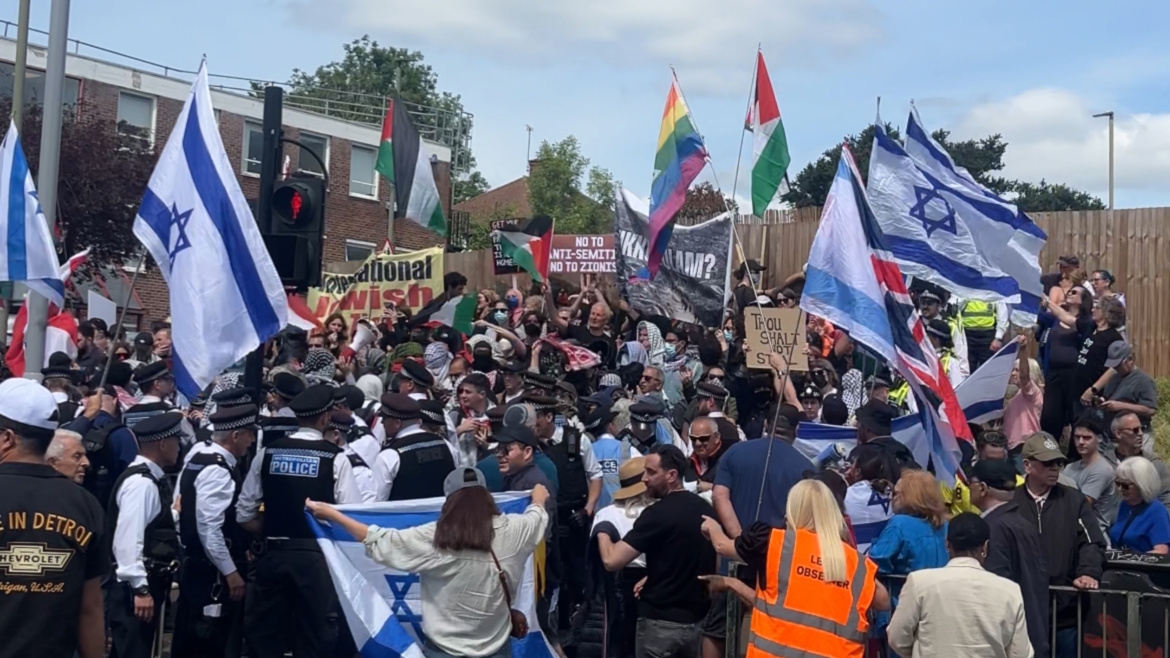
On a Sunday in West London, tensions over Israeli settlement expansion boiled over into violent clashes outside a real estate event marketing occupied Palestinian land, leaving multiple people arrested and drawing widespread condemnation of the gathering from political and human rights figures across the United Kingdom.
The controversial gathering, dubbed the ‘Great Israeli Real Estate Event’, was held inside Edgware United Synagogue and organized by Israeli real estate firm My Home in Israel. It was designed to promote the sale of residential and commercial properties located in illegal Israeli settlements built on the occupied West Bank, territory that Palestinians claim as the core of their future sovereign state. Under international law, all Israeli settlements established in the West Bank after the 1967 Six-Day War are classified as illegal, a position reaffirmed repeatedly by United Nations resolutions and global human rights bodies.
Hundreds of demonstrators from both pro-Palestine and pro-Israel factions gathered outside the venue to stake out opposing positions on the event. Reporters on the ground from Middle East Eye, the independent outlet that first broke detailed coverage of the clashes, documented at least one physical assault: a pro-Israel supporter was filmed throwing multiple punches at a pro-Palestine activist who stood behind a metal safety railing, before uniformed officers intervened and escorted the attacker away.
Heated rhetoric permeated the standoff. Pro-Israel counter-protesters were repeatedly recorded chanting the aggressive slogan ‘There is no Palestine, we flattened it’, and even young children in the pro-Israel crowd were heard hurling misogynistic slurs at pro-Palestine campaigners. Many pro-Palestine demonstrators, including Jewish anti-Zionist activists, framed the event as nothing less than state-sanctioned theft of Palestinian land.
Oscar Leyens, a long-time Jewish pro-Palestine activist and member of the International Jewish Anti-Zionist Network, called the gathering an affront to Jewish values of anti-oppression. ‘I’m a true practising and very proud Jew who sees what’s going on between Israel and the Palestinians as an abomination of Judaism,’ Leyens told Middle East Eye. ‘This event is land theft. They are trading land to explicitly only a Jewish population in order to organise settlers to move to their apartheid state. This is a disgrace to Jewish history of resistance against fascism and racism. They are the fascists, they are the racists, and we will not stand for a moment while they trade in Palestinian land.’
Andrey Khrzhanovskiy, a journalist who has spent years documenting Israeli settler violence against Palestinian communities in the West Bank, said the violent clashes outside the London synagogue mirrored the aggression he had witnessed firsthand in occupied Palestinian territory. ‘We are surrounded by a bunch of Zionists who are counter-protesting and attacking people. A bunch of Palestinian activists were attacked by the Zionists and then got arrested,’ he said. ‘This is very reminiscent of everything that I’ve seen in the West Bank… I feel like I’ve been here before.’
By the end of the day of demonstrations, London’s Metropolitan Police Service announced that 15 people had been taken into custody in connection with the unrest. Of those arrested, seven identified as pro-Israel supporters, six as pro-Palestine demonstrators, and the affiliation of two remaining detainees remained unclear as of initial police statements.
The event itself drew fierce political and legal pushback in the UK days before it even began. Just two days prior to the gathering, more than 100 British Members of Parliament signed an open letter to UK Foreign Secretary Yvette Cooper urging authorities to cancel the event entirely. The letter argued that allowing the promotion and sale of settlement property directly contradicted existing UK government guidance that warns businesses against engaging in any settlement-related economic activity, and would violate the UK’s own obligations under international law.
London Mayor Sadiq Khan also publicly came out against the gathering, confirming he had raised his concerns directly with Metropolitan Police leadership. ‘I share concerns about the Great Israeli Real Estate Event taking place in our city, which I oppose, and that’s why I’ve discussed this directly with the Met Police,’ Khan said. ‘I’m informed that any allegations of criminality relating to the potentially unlawful sale of property at the event would be assessed by the Met with a view to investigation.’
The list of participating organizations, released publicly on Facebook by Emanuel Vatari, CEO of event sponsor Emanuel Group, confirms that multiple Israeli firms with deep ties to settlement construction took part in the event. Among them were Harey Zahav, a development firm that openly lists properties for sale in Negohot, an illegal settlement in the southern Hebron Hills, and the Meshulam Levinstein Group, a diversified construction and real estate conglomerate that has built both residential and commercial projects in illegal settlements across the West Bank and occupied East Jerusalem, including a large housing and retail development in the East Jerusalem settlement neighborhood of Homat Shmuel. Additional participants included Tivuch Shelly, an agency that advertises homes in the large West Bank settlement of Ma’ale Adunim, and Africa Israel Residences, a subsidiary of the Africa Israel Group that has developed multiple settlement projects across occupied Palestinian territory.
The International Centre of Justice for Palestinians (ICJP), a UK-based legal advocacy organization, delivered a formal legal notice to Edgware United Synagogue on the day before the event, putting venue leadership on notice of significant legal and reputational risks for hosting the gathering. The ICJP letter, reviewed by Middle East Eye, noted that the event was explicitly marketed as a platform for the sale of property in the occupied Palestinian territories, and that UK government guidelines clearly warn businesses away from such activity due to its legal and ethical risks under international law.