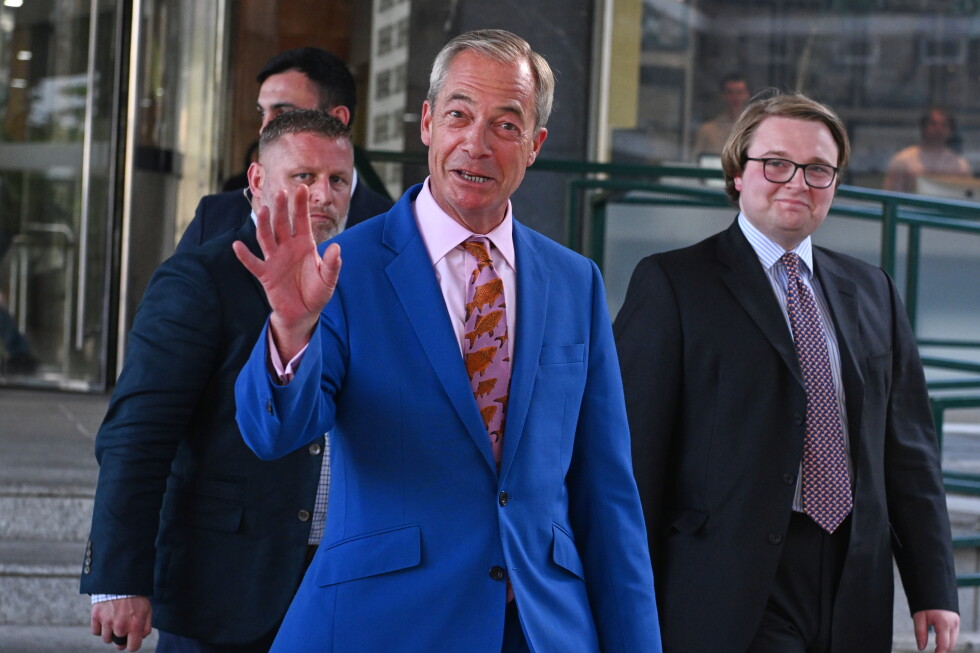
LONDON — For populist firebrand Nigel Farage, leader of Britain’s hard-right Reform UK party, the narrative is simple: he is an outsider fighting a corrupt political establishment that has colluded to end his career. But Farage’s latest attempt to prove that narrative has quickly unraveled, leaving the Brexit architect facing unexpected humiliation and fresh questions about his political future.
The chaos began when parliamentary officials launched a formal probe into potential violations of ethics rules tied to Farage’s personal finances, a controversy that has loomed over the two-year lawmaker for weeks. Rather than wait for the investigation to conclude— a process that could end in his suspension from Parliament and an involuntary special election for his Clacton constituency— Farage announced a dramatic gambit: he would resign his seat immediately and force an early by-election, framing the contest as a pitched battle of “the people versus the establishment.” Critics quickly denounced the move as a cynical stunt to dodge the ongoing standards inquiry and redirect public attention away from damaging financial allegations.
Farage’s plan relied on a simple premise: major rival parties would field candidates against him, allowing him to frame the race as a referendum on his agenda and his claim of establishment persecution. Instead, the United Kingdom’s biggest political parties — Labour, the Conservatives, the Liberal Democrats, and the Green Party — all refused to play his game, announcing they would not put forward candidates to oppose him. The only likely challenger to emerge so far is Count Binface, a veteran joke candidate who campaigns wearing a trash can as a helmet and has built a political brand out of offbeat, tongue-in-cheek policy proposals. For Farage, the outcome leaves him running almost unopposed, stripping his planned “against all odds” narrative of any real stakes.
The risk of further backlash remains high. Even if Farage wins the by-election as expected, parliamentary rules allow the standards investigation to resume once he returns to office. If the probe ultimately finds he violated ethics rules, he could still face suspension, triggering yet another special election for Clacton within months.
This high-stakes political drama comes at a defining moment for Reform UK and for British politics more broadly. Farage, who secured his first seat in Parliament just two years ago after seven failed attempts, has spent decades as one of the UK’s most influential and divisive political figures. His decade-long campaign to pull Britain out of the European Union transformed a fringe policy goal into the 2016 Brexit referendum result, reshaping British politics permanently. Today, he carries that same populist energy into new issues, stoking public anxiety over small-boat migration across the English Channel — which he has called an “invasion” — and echoing the populist rhetoric of his ally, former U.S. President Donald Trump, and far-right leaders across Europe.
Reform UK currently holds just 8 of the 650 seats in the House of Commons, but the party has surged in national opinion polls this year, scoring major gains in May’s local and regional elections that forced the ouster of Prime Minister Keir Starmer. Andy Burnham, the Labour candidate who won Reform’s most recent attempted by-election gain, is now widely expected to replace Starmer as prime minister within weeks. If Reform’s momentum holds, political analysts say Farage could have a realistic path to becoming prime minister after the next national election, scheduled for no later than 2029.
The current controversy centers on two key financial relationships under scrutiny by Parliament’s Independent Parliamentary Standards Authority. The first is a £5 million ($6.7 million) donation from Christopher Harborne, a Thailand-based cryptocurrency billionaire with a prior fraud conviction. Farage argues the sum was a personal gift he used to fund private security amid repeated threats against his life, and that the donation predated his election to Parliament, so it does not need to be disclosed under current rules. The second line of inquiry focuses on Farage’s business ties to George Cottrell, an aristocratic crypto and gambling entrepreneur who previously served a prison sentence in the U.S. for fraud.
Farage has repeatedly denied any wrongdoing, framing the investigation as a coordinated dirty tricks campaign by political enemies and a biased media that has spent years demonizing him. Beyond his parliamentary salary, Farage earns income from a wide range of ventures: he sells gold bullion, hosts a right-wing current affairs television show, gives paid public speeches, and records personalized video messages for fans on the Cameo platform.
Political analysts say Farage’s gambit was designed to turn adversity into advantage, even as it carries major risks. “Fighting and winning a by-election is perhaps his best hope of suggesting to people that he is still very much a man alone, fighting the establishment,” said Tim Bale, a professor of politics at Queen Mary University of London. But the refusal of major parties to contest the seat has undermined that narrative, leaving Farage open to criticism that he is a self-pitying populist chasing publicity to distract from awkward ethical questions.
Opponents have gone further, arguing the botched gambit is proof Farage and Reform UK are already on the ropes. The party has lost three consecutive by-elections it targeted as potential upset wins, leading some political observers to question whether its lead in national polls is starting to soften.
For now, the most high-profile challenger Farage faces is Count Binface, the alter ego of comedian Jon Harvey, who describes himself as a 5,000-year-old intergalactic space warrior and has run against a who’s who of British political leaders, including former prime ministers Boris Johnson and Rishi Sunak, London Mayor Sadiq Khan, and most recently Andy Burnham. While he is a joke candidate, Binface campaigns on a platform of quirky, voter-focused policies, from synchronizing traffic lights on congested local roads to moving a mispositioned hand dryer in a London pub and capping croissant prices at £1.10 ($1.47). When asked about the Clacton race, he told the BBC his main selling point to voters is simple: “I’m not Nigel Farage.”