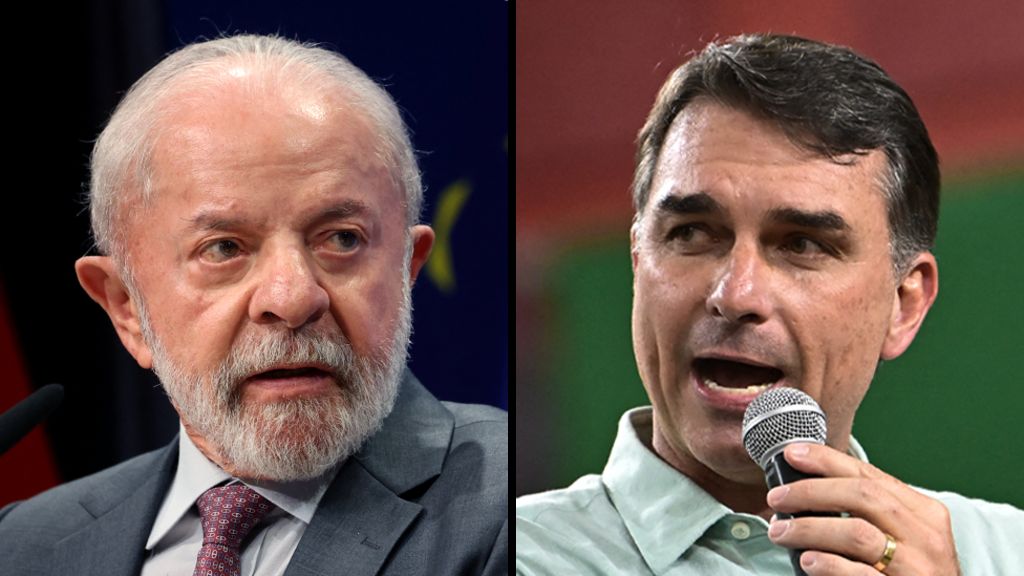
On Sunday, nearly 160 million eligible Brazilian voters headed to the polls for a general election shaped by lingering political turmoil, familiar partisan divisions, and unexpected new controversies that have upended the race. As opinion polling has consistently shown, the contest has narrowed to just two leading candidates: incumbent left-wing president Luíz Inácio Lula da Silva, and right-wing senator Flávio Bolsonaro, eldest son of former disgraced president Jair Bolsonaro.
The echoes of the 2022 election still reverberate across Brazil’s political landscape. Four years ago, Lula won a narrow 1.8 percentage point victory over Jair Bolsonaro, a result that sparked mass unrest when thousands of the former president’s supporters stormed the Brazilian Congress. Jair Bolsonaro was later convicted of coup plotting for his role in the insurrection, and is now serving a 27-year criminal sentence. Due to ongoing health issues, the 71-year-old former army captain is serving his term under house arrest, with a ban on public statements and social media activity. His conviction also bars him from running for public office indefinitely — a barrier that cleared the path for his son to carry the Bolsonaro political banner into the 2026 race.
Even from house arrest, Jair Bolsonaro has remained a central figure in the campaign. At Flávio Bolsonaro’s official campaign launch, an AI-generated deepfake avatar of the former president delivered a public endorsement of his son’s candidacy. While Jair Bolsonaro’s legal team later claimed he had not authorized the use of the image, political observers and Brazilian Supreme Court investigators have little doubt that the elder Bolsonaro remains the ideological backbone of his son’s campaign. Flávio Bolsonaro, a 45-year-old trained lawyer who has served as a senator since 2019, has centered his candidacy on continuing his father’s policy agenda, even as he adopts a slightly less confrontational political tone than his dad.
Running on the Liberal Party ticket, Flávio Bolsonaro has built his platform around hardline crime policies: he has pushed for longer prison sentences, looser gun ownership laws, and successfully lobbied for the U.S. to designate two major Brazilian criminal organizations as foreign terrorist groups — a move the Lula administration strongly opposed. He has also actively courted evangelical voters and the powerful agricultural lobby, promising to roll back environmental regulations he claims stifle farm production. On climate, he has walked back earlier claims that climate change does not exist, but still argues that recent extreme weather events are merely natural cyclical patterns, not human-driven. Flávio Bolsonaro has also positioned himself as a close ally to U.S. President Donald Trump, and has promised to join the Trump administration’s newly launched “Shield of the Americas” anti-crime alliance if he wins the presidency.
For the incumbent Lula, the 2026 race marks an unexpected fifth campaign for the presidency, and a bid for a fourth term. The 80-year-old former metalworker, who will turn 81 days after the first round of voting, first led Brazil from 2003 to 2010, where his signature Bolsa Família cash transfer program lifted more than 20 million Brazilians out of poverty and left him with record 80% approval ratings. After years of legal turmoil that saw his corruption convictions annulled in 2021, Lula reclaimed the presidency in 2022, and has positioned his third term as a return to democratic normality after Jair Bolsonaro’s tenure.
Lula’s presidency has drawn both praise and criticism on environmental policy. Supporters hail his administration’s success in cutting Amazon deforestation to its lowest level in a decade for the first half of 2026, cementing his reputation as a global leader on climate action. However, his decision to approve exploratory offshore oil drilling near the mouth of the Amazon has drawn sharp rebuke from some environmental activists, a criticism Lula has pushed back on by arguing that oil revenues are critical to funding Brazil’s long-term transition to renewable energy, and that he remains committed to phasing out fossil fuels over time. On the international stage, Lula has repeatedly pushed back against the Trump administration’s “Monroe Doctrine” security policy, asserting Brazilian sovereignty and rejecting the idea that the country should be treated as an American sphere of influence, while warning against foreign and domestic interference in the democratic election process.
Heading into election day, polling shows a razor-tight race: both leading candidates hover around 40% support in aggregated polling, with Lula holding a narrow single-digit lead over Flávio Bolsonaro. All other 10 candidates trail far behind, polling at 4% or less. Under Brazilian electoral rules, a candidate must win a majority of 50% of valid votes to win outright in the first round. Polling currently indicates a runoff between the top two contenders on October 25 is the most likely outcome, though around 9% of voters remain undecided or plan to spoil their ballots or abstain, leaving an outside chance of an upset first-round victory.
The final weeks of the campaign were upended by a major corruption scandal linked to imprisoned banker Daniel Vorcaro, who stands accused of orchestrating one of the largest financial frauds in Brazilian history. When voice recordings emerged showing Flávio Bolsonaro asking Vorcaro for 134 million reais (approximately $25.9 million) to fund a biographical film about Jair Bolsonaro, the senator admitted to the request, and Brazilian police launched a formal investigation into Flávio Bolsonaro on suspicion of corruption and money laundering. The scandal quickly expanded, however, when investigators uncovered alleged ties between Vorcaro and Supreme Court Justice Alexandre de Moraes, who presided over Jair Bolsonaro’s 2023 coup trial and oversaw the terms of his house arrest. Police reports show hundreds of communications between Vorcaro and a phone linked to Moraes, in which the banker requested help avoiding arrest. Moraes has repeatedly denied all wrongdoing, but Flávio Bolsonaro has seized on the revelations to attack Lula, claiming that a vote for the incumbent is a vote for the controversial justice, and framing the scandal as evidence of systemic corruption among the ruling left. Lula has attempted to distance himself from Moraes, affirming that “no one is above the law,” but polling suggests the scandal has dragged down support for both candidates in the final stretch of the campaign.
Brazil’s electoral rules require compulsory voting for all literate citizens between the ages of 18 and 70, with non-voters facing financial fines. While polling has consistently pointed to a close race between Lula and Flávio Bolsonaro, electoral observers note that pre-election surveys typically sample only thousands of voters from the 160 million-strong electorate, meaning the final result could diverge significantly from published polling numbers.