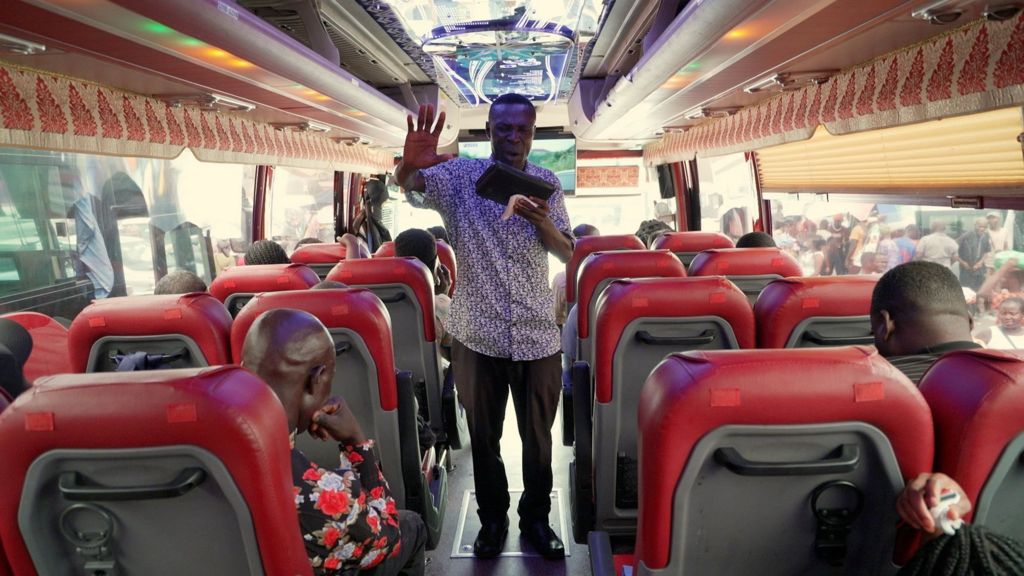
In the pre-dawn hush before Accra’s morning rush engulfs Neoplan bus station, the air shifts from the quiet rumble of idling engines to the rhythmic sound of drumming, singing, and prayer. Leading a small group of 13 worshippers – nine men and four women – 61-year-old pastor Boateng Bismark James lifts his voice in blessing for drivers and passengers bound for destinations across Ghana. For nearly three years, Boateng has led this ritual: gathering believers at the station, praying together, then boarding long-distance commercial buses to spread the Christian gospel to travelers who may never set foot in a traditional church on Sundays. But a newly enforced law is poised to bring this deeply ingrained cultural and religious practice to an abrupt end.
Ghana is a majority Christian nation, where public transport evangelism has been a common sight for decades. On cross-country bus routes, it is not unusual to see pastors standing in the stairwell beside the driver or pacing the aisle, reading from scripture and calling on passengers to repent, their voices carrying over the noise of the engine for hours on end. Many travelers offer voluntary donations to preachers, and for figures like Boateng, these gifts have become a critical source of income – enough to put his youngest child through university, he says. “Not everyone can get to church on Sunday,” Boateng explained to the BBC in an interview conducted before he boarded a bus bound for Kumasi, Ghana’s second-largest city. “There are many passengers who need this message of salvation. We have even prayed for the sick on buses, and people say they have felt healed.” As Boateng moves through the rows of idling buses, his clerical collar marking his calling, some passengers lean in to listen to his message, while others stare down at their phones or chat quietly with traveling companions. “Some people tell me they had never heard the gospel in a church, but through preaching on the bus, they have found it in the Bible,” he says.
The new regulation, passed by Ghana’s parliament in May and enforced in recent weeks, classifies preaching and hawking on moving public service vehicles as a public nuisance, citing risks to passenger safety and comfort. Anyone convicted of violating the ban now faces up to eight months in prison, a fine of nearly 50 dollars, or both. This is not the first time Ghana has restricted bus evangelism: a 2012 ban carried penalties of up to 30 days in prison, but weak enforcement allowed the practice to continue largely unchallenged. The updated law significantly strengthens penalties to crack down on the persistent activity. Notably, preachers who use megaphones in lorry parks and open-air markets are not targeted by the new rules, leaving that form of evangelism untouched.
The ban has deeply divided public opinion in one of the world’s most religious nations. Critics of bus evangelism, who support the new rules, argue that unregulated preaching is not just an annoyance but a genuine safety hazard, saying loud, mobile preachers can distract drivers and increase the risk of accidents. “I just want to travel in peace,” says Chery Lokko, a 30-something traveler who spoke to the BBC. “Some preachers spit without noticing when they’re shouting, especially if you’re sitting close to them. It’s a nuisance with the noise and the mess. I just want quiet when I’m on the bus.” This frustration has spilled into public view: a video recently went viral on Ghanaian social media showing a passenger angrily shouting down a pastor who tried to board a minibus, demanding he get off the vehicle before it departed.
But supporters of public transport evangelism say the ban infringes on constitutionally guaranteed religious freedom, and note that bus preaching reaches people who rarely attend traditional church services. Bernice Nartey, a passenger heading to Kumasi, says she believes preachers should be allowed to speak as long as passengers consent. “Sometimes the message helps people repent,” she says. “If someone is going through a really stressful time, a pastor’s word can give them new hope.” Boateng says he and his fellow preachers are shaken by the new rule, and are calling for a religious exemption that would allow them to preach before the bus departs Accra. “We are very worried because many pastors here depend on the gifts from passengers to support their families,” he says. For Boateng, this is not just a matter of religious calling: it is his livelihood.
Even within religious circles, opinions differ. The Christian Council of Ghana declined to comment on the new law, but Senior Pastor Enoch Paul Hayes of the prominent International Central Gospel Church says he does not believe the ban violates religious freedom. He has urged fellow preachers to abide by the law and adapt their methods, pointing to social media as an alternative platform that can reach thousands of people with the gospel message, far more than could ever fit on a single bus.
Ghana’s constitution does guarantee freedom of religion, but it also allows for restrictions on that freedom when public safety is at stake. For Boateng and hundreds of other bus preachers across the country, the new rules leave a difficult choice: find new ways to practice their ministry and give up a key source of income, or continue preaching and risk jail time and fines for breaking the law.