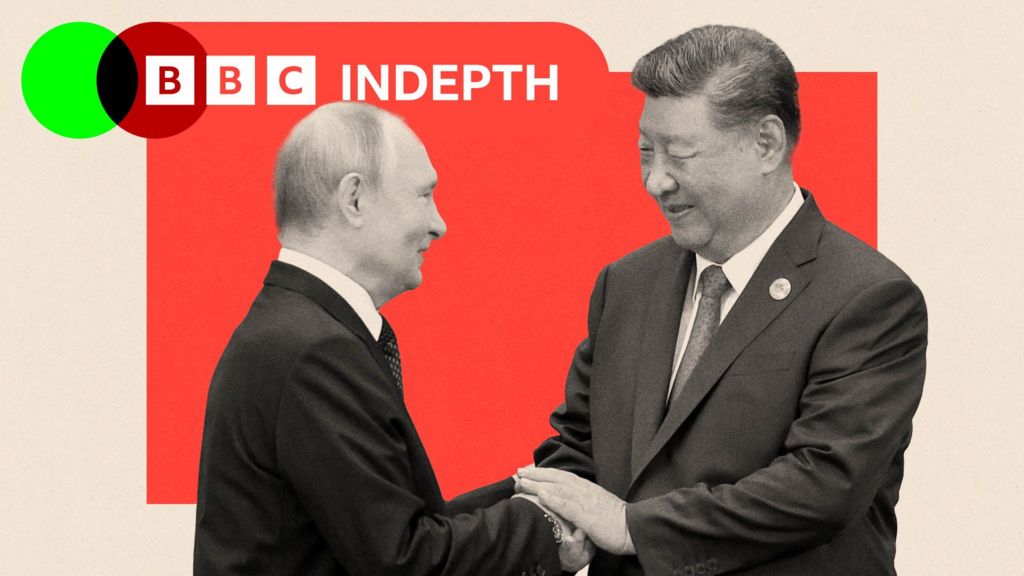
A candid off-script conversation caught on a hot microphone last September has offered a rare, unfiltered glimpse into the close personal and diplomatic bond between Chinese President Xi Jinping and Russian President Vladimir Putin, as the two leaders walked through Beijing’s iconic Tiananmen Square. In the casual exchange, Putin was heard musing on the possibility of extending human lifespan dramatically through sequential organ transplants, even joking about achieving immortality, to which Xi responded by noting expert projections that humans could reach a 150-year lifespan within the current century. For two long-ruling leaders who have publicly called each other their closest friend and have held power for a combined 39 years with no plans to step down, the lighthearted, off-the-record chat offered one of the few public insights into a partnership that has long been misunderstood and shrouded in secrecy. This week, that partnership is stepping back into the global spotlight, as Putin prepares to return to Beijing to mark the 25th anniversary of the landmark Treaty of Good-Neighbourliness and Friendly Cooperation between the two nations. The visit comes on the heels of U.S. President Donald Trump’s high-profile, extravagantly staged trip to meet Xi last week, which featured opulent banquets with gold tableware and a private tour of an ancient cultural site. In stark contrast, Putin’s visit has been deliberately low-key, with almost no advance details released to the public. The Kremlin has confirmed that one key goal of the trip is to hear a first-hand account of the discussions between Trump and Xi during the U.S. leader’s visit. It has also been reported that during Trump’s walk through Zhongnanhai — Beijing’s closed leadership compound, rarely accessed by foreign visitors — Xi casually referenced his long-time friend Putin, joking that the Russian leader had previously toured the restricted political space. While some in Washington have held out hope that Trump could persuade Beijing to distance itself from Moscow, analysts broadly agree that those hopes are little more than unfounded wishful thinking. In recent years, the two countries have formally described their bilateral connection as a “friendship with no limits”, but the reality of the partnership is far more nuanced than the slogan suggests. The dynamic between the two nations is deeply asymmetric, with any bilateral agreements overwhelmingly favoring Chinese terms, according to Alexander Gabuev, director of the Carnegie Russia Eurasia Center. “Russia is fully in China’s pocket, and China can dictate the terms,” Gabuev explains. This power imbalance is most visible in the economic sphere: China holds the position of Russia’s largest single trading partner, while Russia accounts for just 4% of China’s total global trade. China’s overall economy is many times larger than Russia’s, and it dominates exports to the Russian market. Years of sweeping Western sanctions imposed on Russia following its 2022 full-scale invasion of Ukraine have gradually pushed Moscow deeper into economic and diplomatic alignment with Beijing, creating new opportunities for Chinese firms to fill gaps left by departing Western companies. A prime example is Chinese tech giant Huawei, which has been targeted by U.S. sanctions and forced out of the United Kingdom’s 5G network. The company has capitalized on the exit of Western competitors to become a central foundational player in Russia’s telecommunications industry. As Russia’s economic and technological links to the West have fractured, China has become the primary source of expertise for Russia across technology, science, and industrial sectors. Most critically for Moscow’s foreign policy goals, Russia has grown increasingly dependent on Chinese components to sustain its war machine in Ukraine. A recent analysis from Bloomberg found that more than 90% of the technology restricted by Western sanctions that Russia imports now comes from China, representing a 10% increase from the previous year. Russian leadership is acutely aware of the risks that come with this lopsided dependence. In a recent commentary titled “We bow to no one”, Dmitry Trenin, president of the Moscow-based Russian International Affairs Council think tank, emphasized that Russia has no desire to become a vassal state of Beijing. “It’s absolutely essential for us to maintain an equal footing in our relations and to remember that Russia is a great power which cannot be a junior partner,” Trenin wrote. Yet for Moscow, there are few viable alternative partners to replace Beijing. China offers a scale of market demand for Russia’s core exports that no other country can match, a role that has become integral to Russia’s economic stability amid its break with the West. If China were to reduce its trade volumes with Russia, it would severely undermine Moscow’s ability to pursue its core foreign policy and military objectives. Despite the imbalance, Russia retains key buffers that prevent Beijing from exerting unchecked dominance over the relationship, analysts note. Marcin Kaczmarski, a security studies lecturer at the University of Glasgow, explains that Chinese policy makers are fully aware of the severity of the power asymmetry, and have deliberately adopted a policy of self-restraint to avoid a backlash among Russian political elites. “I would say that a summary of Chinese policy towards Russia is one of self-restraint. China is not pushing Russia around,” Kaczmarski says. This cautious approach stems in large part from recognition that while Russia is the junior partner, it remains a proud major power that is unlikely to acquiesce to external pressure. Gabuev points to a notable example from 2023, when Xi Jinping visited Moscow and was widely reported to have urged Putin to refrain from using nuclear weapons in Ukraine. Just days after the meeting, Russia announced it would station tactical nuclear weapons in neighboring Belarus, a move widely interpreted as a deliberate show of resistance to external pressure and a reminder of Russia’s independent strategic posture. While Russia’s protracted war in Ukraine creates certain liabilities for China, it also brings tangible strategic benefits for Beijing as it navigates its own regional tensions, particularly surrounding Taiwan. “Russia brings a lot to the table in terms of some military technologies such as niche equipment that it can still sell, and testing some Chinese equipment or components,” Gabuev says. Beyond military technology, Russia’s vast reserves of oil and natural gas hold huge strategic importance for China, which has been seeking to diversify its energy supplies to reduce geopolitical risk. In a May press conference, Putin noted that the two sides were close to achieving a “highly significant step forward in oil and gas cooperation”, a comment widely interpreted as referring to the long-stalled Power of Siberia 2 pipeline project. After years of slow negotiations, Russian energy giant Gazprom and China National Petroleum Corporation have reportedly signed a preliminary agreement for the pipeline, which will deliver 50 billion cubic meters of Russian natural gas to China each year via Mongolia. If completed, the project will be a transformative development for China’s energy security, particularly as tensions escalate in the strategic Strait of Hormuz. For Beijing, the shift toward increased reliance on Russian energy is not just a matter of pricing; it is a critical investment in long-term energy security amid growing global geopolitical instability. Unlike formal military alliances that require rigid coordination and shared commitments, the China-Russia partnership is defined by its deliberate strategic flexibility, a feature that analysts say gives it surprising resilience. “It is not an alliance, but a flexible strategic partnership,” explains Bobo Lo, former deputy head of mission at the Australian Embassy in Moscow, a partnership that has defied repeated Western predictions of imminent collapse. Western analysts have typically framed the Sino-Russian relationship in one of two extreme narratives: either as a unified “axis of authoritarianism” bound together by a shared goal of undermining the U.S.-led global order, or as a brittle, untrustworthy brotherhood on the brink of collapse. Neither narrative captures the nuanced reality of a deeply integrated partnership that two neighboring countries have built around shared core interests, despite their significant power asymmetry and occasional divergent priorities. Lo notes that even if both countries were to improve their relations with the West, they would still retain strong incentives to maintain close cooperation. The foundational shared interests are clear: first, they share a 4,300-kilometer border that was once a source of constant tension and insecurity, but is now a peaceful frontier that supports cross-border trade and cooperation. Second, their economies are deeply complementary: Russia is a leading exporter of energy and raw materials, while China’s massive industrial economy provides a ready, large-scale market for those exports. Third, both countries share a core opposition to the existing U.S.-led international order. A further unifying feature is the mutual non-interference stance the two countries adopt toward each other’s internal affairs. Unlike Western nations, which often condition engagement on shared values and human rights standards, Moscow and Beijing do not publicly criticize each other for controversial domestic policies. Western nations have raised repeated concerns over alleged large-scale human rights abuses in China’s Xinjiang region, which China denies, and over the death of Russian opposition leader Alexei Navalny, but neither Russia nor China has commented on these issues in the other’s case. “They don’t criticise each other over Xinjiang, the poisoning of Russian Navalny and so on. And they look eye-to-eye on a lot of issues of local governments in the UN… that creates an organic symbiotic relationship,” Gabuev says. This pragmatic approach to bilateral relations has deep historical roots that stretch back through the final years of the Soviet Union and into the post-Soviet era, he adds. On the question of whether the partnership will remain durable over the long term, one anonymous Chinese analyst acknowledged that the public framing of the relationship as an inseparable “boundless friendship” is partially performative, designed to project an image of unity and stability to the world. In practice, the public display of unity acts as a useful political tool to smooth over occasional differences in national priorities. While both countries oppose what they frame as “Western hegemony”, their strategic approaches to challenging that order differ significantly. The analyst noted that Russia favors building a new global order that completely bypasses the United States, while China adopts a far more cautious and pragmatic stance, prioritizing gradual, long-term gains over open confrontation and avoiding rash, high-stakes decisions. A clear example of this divergence came in China’s measured response to U.S. actions in Iran in the lead-up to Trump’s visit: Beijing refused to abandon its planned summit preparations, a choice that “clearly shows Beijing’s willingness not to provoke and not to close doors,” the analyst said. China has prioritized keeping communication channels open with Washington and avoiding unnecessary provocation, a markedly different approach from Russia’s more confrontational stance. Beyond high geopolitics, the depth of the Sino-Russian partnership is also being shaped by growing people-to-people ties, a factor that is often overlooked in mainstream analysis. From the top down, Xi and Putin have worked to cultivate an image of close personal friendship that sets the tone for broader bilateral connections. This visit will mark Putin’s 25th trip to China, and Russian bureaucratic officials interact with their Chinese counterparts more frequently than with officials from any other country. Not all analysts are convinced that popular cultural affinity between the two publics runs deep. Charles Parton, a former British diplomat to China, argues that ordinary citizens of both countries still prioritize the West when it comes to travel, study, and investment. “Do Chinese want to study in Moscow and settle in Moscow and buy flats in Moscow? No,” Parton says, noting that when given the choice, Russians prefer to invest and settle in Western cities like Paris, London, and Cyprus rather than Beijing. But Gabuev pushes back on that claim, arguing that people-to-people connections have grown rapidly in recent years, driven largely by Western sanctions and tighter European visa policies that have pushed ordinary Russians to turn toward China. A mutual visa-free travel regime between the two countries means Russians can easily travel to major Chinese cities, with multiple daily direct flights from Moscow. Russians are also increasingly adopting Chinese consumer technology and automobiles, a trend that has accelerated following Western sanctions that cut off access to many European and American brands. “So the interconnectedness, visa-free travel and ease of payment and navigation makes China much closer than it used to be. And then all of the exchange programmes, scholarships, joint research programmes bring the two societies closer,” Gabuev says. While the growing power imbalance between Moscow and Beijing remains a long-term structural weakness for the partnership, most analysts agree that predictions of an imminent collapse are unfounded, at least in the near term. Despite their differences and divergent priorities, Lo says, “The Sino-Russian partnership remains resilient. Both sides recognise that it is too important to fail, especially given there are no viable alternatives to continuing cooperation.”