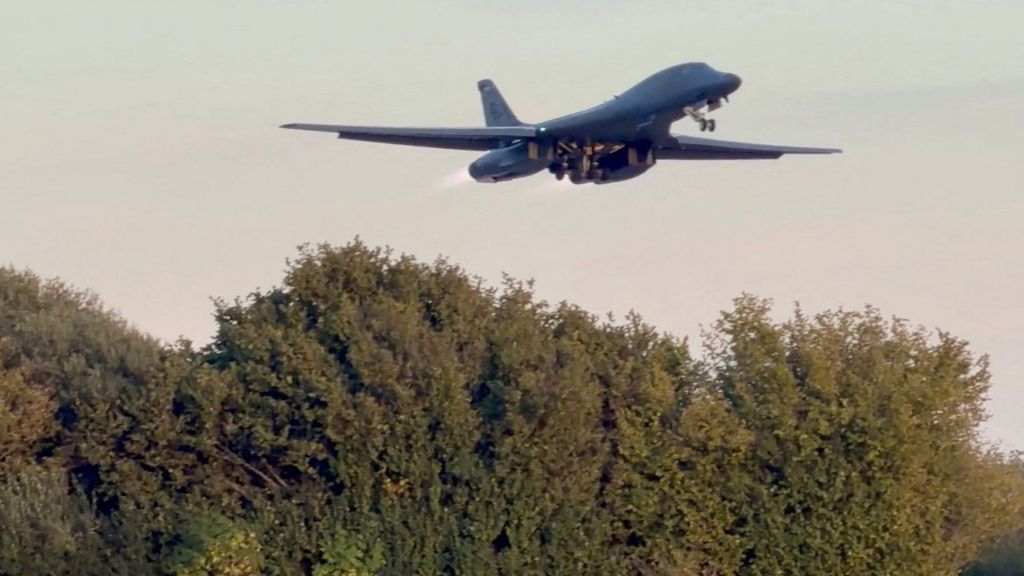
On a surprising Sunday, the United States ordered the abrupt mass evacuation of its fleet of B-1 Lancer heavy bombers from RAF Fairford in the United Kingdom, a move that has left defense analysts and global observers scrambling to unpack the multiple overlapping factors behind the urgent decision.
US Vice President JD Vance framed the withdrawal as an act of “abundance of caution,” attributing the move to long-standing Iranian patterns of behavior that Washington has consistently condemned. Vance noted that Iran has engaged in alleged terrorist actions against the US and other nations for 49 years, justifying the precautionary shift of the strategic bomber fleet. Critics, however, have characterized the rushed departure not as caution, but as a clear sign of widespread panic in US defense circles over an imminent, unconfirmed threat.
For seven months prior to the withdrawal, the B-1 bombers had operated out of Fairford to carry out strikes against Iranian missile launch facilities, deepening the already volatile tensions between the two nations. Back in July, Iran issued a stark public warning: any country that allowed the US to use its territory as a base for operations against Tehran would be labeled a legitimate military target. That warning set the stage for escalating security concerns around the UK airbase.
Weeks before the sudden withdrawal, two key events amplified security fears. On September 27, five British men were arrested near the base perimeter after being spotted acting suspiciously with three white vans in the middle of the night; all five were later released on bail. Days later, a UK-Iranian dual national was taken into custody on suspicion of preparing terrorist acts, and he was also subsequently released on bail. US Secretary of State Marco Rubio has pushed back against claims that these arrests directly prompted the evacuation, but observers have drawn clear connections between the events.
Accounts of the evacuation itself underscore the urgency of the order. All 12 of the $330 million B-1 Lancer bombers departed en masse, with scramble orders issued to aircrews even as aerial refueling aircraft required for the transatlantic flight back to US continental bases were still being fueled. US President Donald Trump later confirmed the move, confirming that unspecified “some threats” against the base drove the decision, explaining that Washington chose to reposition the bombers rather than needlessly expose the high-value assets to enemy attack.
Defense analysts widely agree that the withdrawal was triggered by fresh intelligence of an imminent plot, though British officials have declined to confirm the contents of that intelligence. A senior British official acknowledged that Iran maintains a high rate of active threats against UK and US interests in the region, noting that US-operated air bases on British soil would naturally rank high on any potential Iranian targeting list. Iran has since issued a formal denial of any connection to the suspicious activity at RAF Fairford.
The broader geopolitical context adds further layers to the decision. While the United Kingdom is not formally at war with Iran, the Islamic Revolutionary Guard Corps has repeatedly framed Britain as a co-belligerent in the US’s ongoing conflict with Tehran, erasing the diplomatic distinction between the two allies’ positions. A financial risk factor also played a role: the US has already sustained massive asset losses from Iranian strikes on Middle Eastern bases, most notably the destruction of a $500 million E-3 Sentry AWACS early warning aircraft at Saudi Arabia’s Prince Sultan Air Base in March.
Retired British Armed Forces General Sir Richard Barrons pointed out that modern asymmetric warfare has lowered the barrier to damaging high-value Western military assets drastically. “We now live in a world where a £1,000 drone could wreck one of those aircraft,” Barrons explained, adding that with the bombers currently carrying out limited operations from Fairford, moving them back to safer bases in Texas was the most prudent security decision.
The withdrawal has also raised quiet questions about US confidence in UK security arrangements at Fairford. Despite the departure of the bombers, hundreds of US military personnel remain stationed at Fairford, as well as at other UK bases including Lakenheath and Mildenhall. Both US and UK officials have sought to downplay any rift, with Rubio emphasizing that the US retains full “confidence in the security of all our bases” and noting that US and UK authorities are working “very closely” on the ongoing investigation, praising British cooperation.
UK counter-terrorism police remain in the active investigation phase, still trawling through large volumes of CCTV footage and other evidence while the arrested individuals remain on bail, with no definitive conclusions reached about the origin or nature of the suspected plot. The US has insisted that repositioning the bombers to domestic bases does not limit its global operational reach, arguing that the fleet can still be deployed anywhere in the world from continental US. Still, analysts note that for Iran, the withdrawal can be framed as a strategic victory: a major US strike capability has effectively been forced back from forward deployment near the Middle East to US home territory.
Joint security reviews of base perimeter and internal protections are now underway, led by both US and UK defense and counter-terrorism teams, as authorities work to address any gaps that may have been exposed by the recent events.