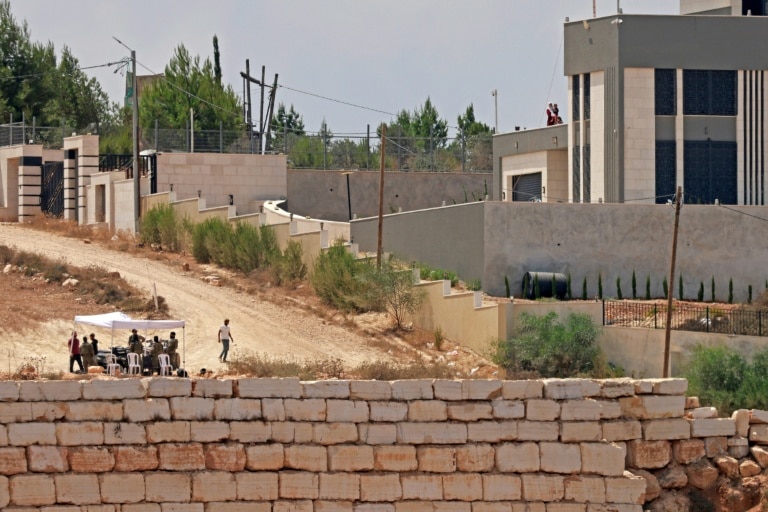
Widely regarded as the most formidable military force in the Middle East, capable of launching precision strikes deep into hostile territory, the Israeli military has found itself unable to dislodge a small group of extremist settlers from a occupied site in the West Bank village of Qusra for more than a week. The ongoing stalemate has thrown into sharp relief long-documented patterns of inertia when it comes to reining in settler violence against Palestinian residents, a failure experts trace directly to the current Israeli government’s ideological and political backing for illegal settlement expansion, alongside growing settler influence within military ranks.
The standoff began over a week ago, when a small cohort of settlers established a presence outside Qusra, near the northern West Bank city of Nablus, and blockaded Palestinian residents inside their homes, cutting off access to food, water and other essential supplies. The siege drew widespread condemnation from both the international community and domestic Israeli observers, with the United States calling for urgent action after it emerged one of the trapped Palestinians holds American citizenship.
Despite multiple deployments of Israeli troops to the site, tangible action to remove the settlers has been minimal. Beyond public statements of condemnation, the detention of a single settler, and the dismantling of temporary settler tents, no force has been used to end the blockade. Footage from the scene even showed some of the first arriving soldiers praying alongside the extremist settlers, prompting the military to promise disciplinary action that has yet to materialize. Videos obtained by AFP from a besieged Palestinian resident show settlers returning to the site by Monday, riding quadbikes and casually chatting and shaking hands with deployed Israeli forces.
Analysts and former Israeli officials say this paralysis is not an anomaly, but the direct result of government policy that puts the military in an untenable position. “The government’s support for extremist settlers puts the military in an impossible situation,” explained Nimrod Novik, a senior advisor and former special envoy to late Israeli prime minister Shimon Peres. Novik noted that the military is forced to choose between upholding its professional mandate to crack down on violent settler activity, or aligning with a government agenda that provides ideological and material backing to extremist settlers. “The result is paralysis with rare exceptions due either to the severity of the crimes or US intervention,” he added.
Since seizing control of the West Bank in the 1967 Six-Day War, Israel has allowed more than 500,000 Israeli settlers to move into the territory, where settlements are widely recognized as illegal under international law. The territory remains home to roughly 3 million Palestinians, who are denied the full citizenship rights granted to settlers. Under the current right-wing government led by Prime Minister Benjamin Netanyahu, settlement construction has reached all-time highs, with multiple cabinet members publicly supporting the establishment of outposts that are even illegal under Israeli domestic law, and openly calling for the full annexation of the West Bank.
Settler violence against Palestinians has been a persistent issue for decades, with the vast majority of perpetrators never facing legal consequences. But experts say attacks have spiked dramatically in recent months, driven by the government’s pro-settler agenda and shifting dynamics within the military. Nadav Weiman, a former Israeli sniper who now leads Breaking the Silence, an advocacy organization made up of Israeli military veterans, says the entire infrastructure of occupation is structured to prioritize settlers over Palestinian residents. “The infrastructure of the occupation is built in a way that for a soldier, for us, it’s almost impossible to enforce the law on violent settlers and very easy to do whatever we want on Palestinians,” Weiman told AFP.
Weiman explained that rules of engagement for handling violent settlers are almost never clearly outlined to rank-and-file troops, who are typically told to refer civilian settler incidents to police rather than intervening directly. “In 22 years of collecting testimonies from soldiers in the West Bank, I can tell you that in the majority of the units, nothing is being told to the soldier on what they can do with settlers,” he added.
Beyond unclear guidance, lines between the military and the settler movement have become increasingly blurred in recent years. A growing share of military officers are drawn from the settler community, many of whom attend hardline ideological pre-military academies that promote expansionist settlement goals. The current commander of Israeli forces in the West Bank, Major General Avi Bluth, is himself an alumnus of the Bnei David pre-military academy based in the illegal Eli settlement.
That blurring of boundaries accelerated dramatically after the October 7, 2023 attack by Hamas on southern Israel. With the bulk of active duty Israeli troops deployed to the Gaza war and northern front against Lebanon, the military drafted thousands of settler reservists into local regional defense units tasked with securing West Bank settlements. Israeli rights group Yesh Din estimates that roughly 7,000 armed settlers were mobilized into these units in the first months of the war. Research from the group shows these settler reservists are far less likely to intervene to stop attacks on Palestinian communities, and often participate in the violence themselves. While most have now been released from active reserve duty, the military has allowed them to retain their issued firearms and uniforms, enabling a wave of unchecked violence by settlers operating with the veneer of official military authority.
When contacted by AFP for comment, an Israeli military spokesperson stated that police are the primary body responsible for enforcing the law against Israeli citizens in the West Bank, and that soldiers are only instructed to intervene to stop ongoing violence and detain suspects until police arrive. The spokesperson added that any failure to follow military orders is reviewed thoroughly, with disciplinary action taken when appropriate. But critics say this division of responsibility is just a convenient excuse for inaction, given police rarely pursue charges against settlers.
In the wake of the Qusra siege, Israeli Defense Minister Israel Katz has called for police to take over full responsibility for law enforcement related to settler activity in the West Bank, arguing it is not the military’s job to “chase” violent settlers. While observers say the policy is unlikely to be implemented in the near term, they note it would mark a major step toward Israel’s formal annexation of the occupied territory. Ahead of Israeli national elections scheduled for October 27, observers are skeptical that there is any political will within the current government to crack down on extremist settler violence, despite growing international pressure. But they warn the unchecked escalation of attacks poses severe risks for regional stability. “Should settler violence continue, it will be astonishing if a major bloody conflagration doesn’t ensue,” Novik warned.