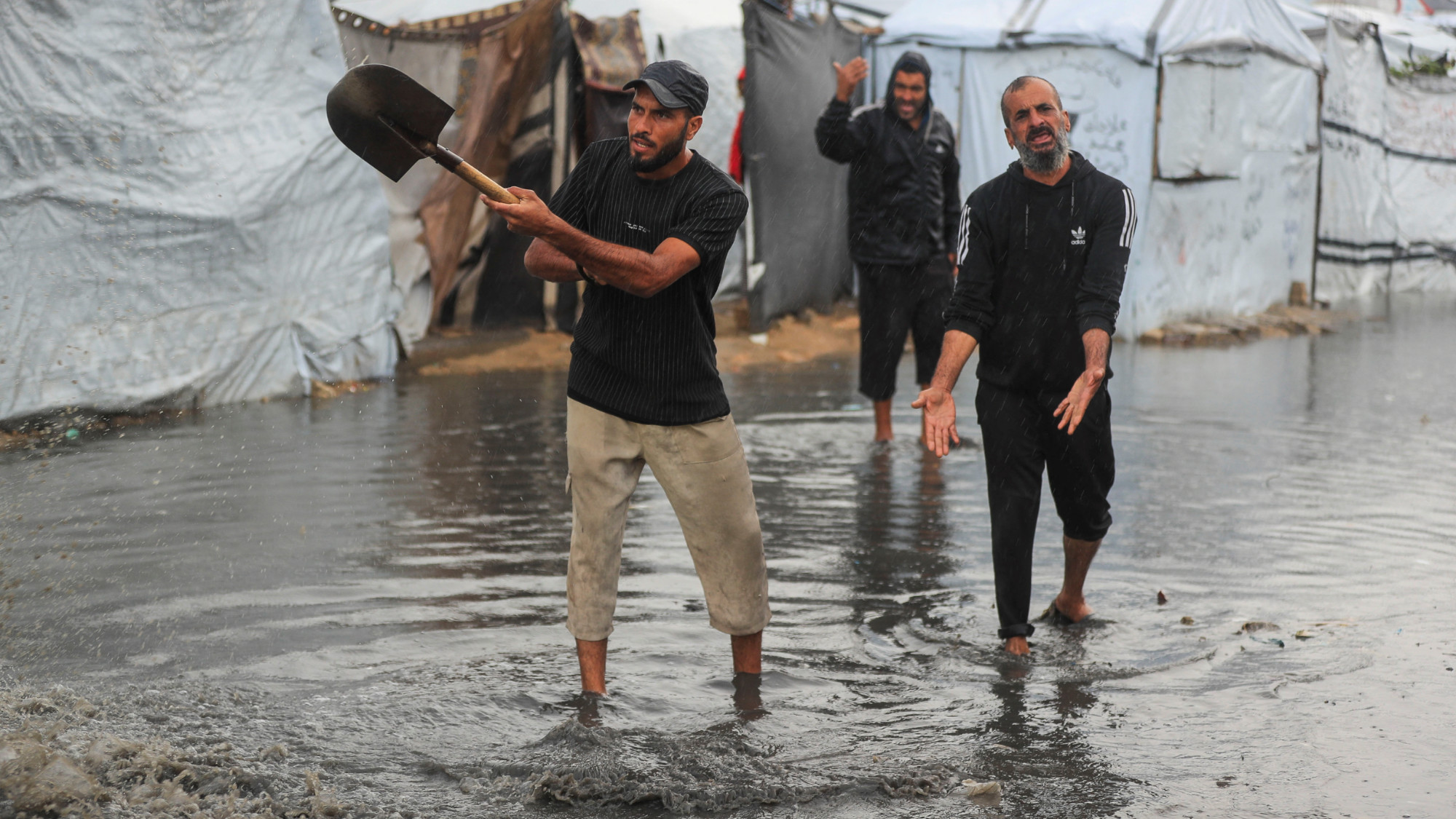
As unforgiving winter storms swept across the besieged Gaza Strip in early November 2026, tens of thousands of displaced Palestinian families already grappling with three years of devastating Israeli military operations faced a new wave of life-threatening hardship. For 48-year-old Nahla al-Majdoub and her household of eight, the latest downpour marked the total destruction of the flimsy makeshift tent they had called home for nearly two years at Gaza’s port, after their original northern Gaza residence was flattened during Israel’s ground invasion.
The family was fast asleep when the tempest struck, jolting awake to the roar of thunder and frigid rainwater gushing through gaps in their tent’s tattered tarpaulin, pooling rapidly across the muddy ground beneath them. Soaking wet and surrounded by rising water, Majdoub and her children were left screaming in helpless despair as she scrambled to bail out the incoming flood, a futile effort against the relentless downpour. When gale-force winds began tearing chunks of the tent’s covering loose, she called on neighbouring camp residents to help reinforce the structure and pile sand around its perimeter, but the damage was irreversible. As the family rushed to evacuate to a nearby neighbour’s sturdier shelter, the remaining tarpaulin ripped free entirely, and the tent collapsed with one of Majdoub’s daughters still trapped inside. Every single one of their meagre belongings – clothes, mattresses, and personal possessions – was completely waterlogged, leaving the family wearing the same damp, cold garments for four straight days after they found temporary refuge with local neighbours.
This latest disaster compounds years of unthinkable suffering for Majdoub, who sustained critical injuries in an Israeli air strike back in October 2025 while out shopping for groceries for her family. Shrapnel from the missile tore through her intestines, requiring multiple emergency surgeries that left her dependent on costly weekly medication costing 170 shekels to manage her condition, a treatment she can no longer afford amid the enclave’s economic collapse. The persistent cold of the winter storm has amplified her chronic pain, and she lives in constant fear for her seven-year-old daughter Aya, who lives with diabetes and lacks access to consistent medical care or warm, safe shelter. “Our greatest dream right now is nothing more than a strong tent that can keep the rain out and shield us from the freezing cold,” Majdoub shared, noting that her family cannot afford to replace their shelter every time a winter storm hits, and often relies on the kindness of neighbours to feed her children.
Thirty-three-year-old Sameh Doghomoush, his wife Sana, and their three young sons are another family pushed to the brink by the extreme weather. The family has been occupying their partially destroyed home in Gaza City’s al-Sabra neighbourhood since the start of the war, and after witnessing last year’s winter flooding, Doghomoush spent two days and his last remaining savings buying extra tarpaulins to patch gaping holes in his shattered roof and reinforce crumbling exterior walls, even positioning basins and pots under the largest leaks to catch rainwater. All of their careful preparation was rendered useless within hours of the first storm surge, as floodwaters poured through broken windows and the fractured roof, leaving the entire family soaked, shivering, and stranded in darkness through the night. All three of his young sons developed severe colds from exposure, and Doghomoush said his household has never received a single tent or emergency shelter supply from aid groups, despite repeated pleas for support. Before the war, the family lived comfortably in their 180-square-metre home, owned a thriving fish restaurant and a private car, and regularly took their children to amusement parks and bought them new clothes and school supplies. Today, he cannot even afford the basic food, warm clothing, or textbooks his children beg for, and lives in terror that his already structurally compromised home could collapse under the weight of the saturated soil, trapping his family inside. “We have endured death from bombardment, starvation, and helplessness for years – now we are fighting to survive the cold, too,” Doghomoush said, calling on the international community to pressure Israel to open border crossings and allow critical shelter supplies into the enclave.
Official data from the Gaza Government Media Office confirms that more than 70,000 tents housing hundreds of thousands of displaced Palestinians were fully flooded in the first 12 hours of the recent storm, with collapsing sand embankments and toppling half-damaged walls killing five people, injuring dozens more, and leaving two others unaccounted for. Initial estimates place the total financial damage from the storm at over $3 million, with officials warning that tens of thousands of buildings already weakened by years of Israeli airstrikes now face imminent collapse as rainwater saturates the ground beneath their foundations. The statement noted that Israel has systematically destroyed over 90 percent of Gaza’s core infrastructure, including sewage networks, forcing displaced populations to crowd into high-risk displacement camps that are uniquely vulnerable to catastrophic flooding. Municipal civil defence teams are working around the clock to respond to the disaster, but are crippled by critical shortages of heavy equipment, fuel, and resources, with the volume of aid permitted to enter Gaza remaining a tiny fraction of what the 2.2 million residents of the enclave require. The Gaza Government Media Office issued an urgent appeal to the international community to move beyond symbolic statements of condemnation and take tangible action to force open border crossings, calling for an immediate shipment of more than 100,000 winter-resistant tents, tens of thousands of prefabricated temporary housing units, and construction materials to repair destroyed drainage and sewage systems.
Independent Palestinian political analyst Talal Abu Rokbeh emphasized that the deliberate restriction of shelter supplies and other critical humanitarian aid by Israeli authorities is a deliberate tactic to escalate pressure on Gaza’s Palestinian population, while the international community’s prolonged silence has made it complicit in the ongoing human suffering. He noted that Israel is actively attempting to reframe the decades-long Palestinian struggle for self-determination and statehood as a purely humanitarian crisis, diverting global attention away from the political solutions required to end the conflict. Abu Rokbeh added that any meaningful shift in United States policy toward Gaza must be measured by concrete, on-the-ground milestones: the empowerment of the Palestinian technocratic committee to govern Gaza, the deployment of an international stabilization force, full Israeli withdrawal from the 70 percent of Gaza territory it has occupied in recent months, and a massive, sustained increase in allowed aid deliveries. According to the UN Office for the Coordination of Humanitarian Affairs, roughly 65 percent of Gaza’s total population – around 1.4 million people – currently reside in flimsy tents or other makeshift, unprotected shelters as the harsh winter season progresses.
‘We woke up soaking wet’: Gaza’s displaced face another winter of floods and collapsed shelters