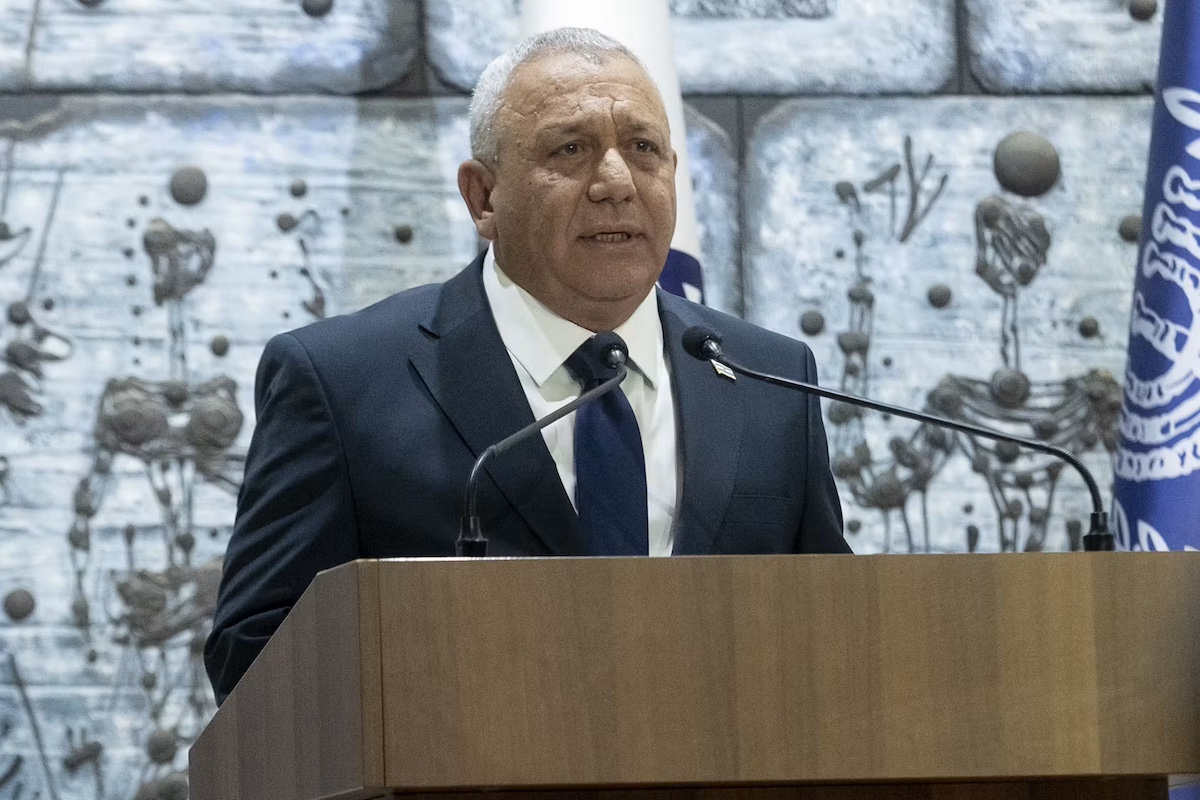
On a Sunday in early November 2026, Israeli head of state President Isaac Herzog formally nominated Gadi Eisenkot, the leading challenger to long-serving Prime Minister Benjamin Netanyahu, to undertake the high-stakes task of assembling a stable governing coalition for the country. The announcement capped 14 consecutive days of paralyzing political deadlock that followed a ballot widely framed as the most consequential national election in Israel’s 78-year history, which failed to deliver any faction a clear parliamentary majority.
Under Israel’s unique proportional representation system, which has never produced a single-party majority government across its entire history, the president holds discretion to assign coalition-forming duties to a nominee who does not lead the party that secured the most votes. In this instance, Netanyahu’s long-dominant Likud faction took the largest share of seats in the October 27, 2026 election, but fell short of the 61 seats required to command a majority in the 120-seat Knesset. Eisenkot’s collective opposition bloc also failed to hit that critical threshold, creating the unprecedented impasse. Notably, the two Arab-majority parties representing Israel’s 2 million Palestinian citizens — the Joint List and Ra’am — secured a record combined 19 Knesset seats, a historic high that has reshaped the entire political calculus of coalition building.
This election marks the first time Israeli voters have cast ballots since the catastrophic October 7, 2023, Hamas terror attack and the subsequent devastating 3-year war in Gaza, creating a uniquely fraught, high-stakes context for the political process that has left the country’s leadership void unresolved. Eisenkot, a former Israeli Defense Forces chief of staff who only entered electoral politics in 2022 and founded his centrist Yashar party just 12 months ago, now has a statutory 28-day window to negotiate a working coalition, with a possible 14-day extension available if he can demonstrate tangible progress. The task before him is uniquely daunting: to unify a deeply fragmented set of opposition factions that have long held conflicting ideological positions, many of which explicitly promised during campaigning they would never enter a governing partnership with Arab-majority parties.
To hit the 61-seat majority, Eisenkot’s proposed alliance of centrist and center-right parties — including Naftali Bennett’s B’Yachad, Yair Golan’s Democrats, and Avigdor Liberman’s Yisrael Beytenu — will almost certainly require formal or informal support from at least one of the two Arab-led factions, a compromise that runs directly counter to their pre-election public pledges. Ra’am has already publicly announced its willingness to back an Eisenkot-led government, but the 2021 precedent of a short-lived 12-month coalition that relied on Ra’am’s support collapsed under the weight of internal ideological tensions, casting doubt on the long-term viability of such a partnership. The 2018 Nation-State Law, which codifies that national self-determination in Israel is exclusive to Jewish people, creates additional structural barriers that make it legally and politically awkward for Arab parties to formally join a governing coalition.
Adding another layer of complexity is the pivotal role of the ultra-Orthodox Jewish parties Shas and United Torah Judaism, which have been core kingmakers in Netanyahu’s previous governing blocs, and whose non-negotiable demands around exemptions for ultra-Orthodox citizens from compulsory military service have long been a source of bitter national social division. Eisenkot, who has minimal national political experience and as recently as six months ago openly dismissed the idea of uniting disparate opposition factions and publicly criticized rival opposition leader Yair Lapid, faces widespread skepticism from Netanyahu’s Likud ranks, who have derided his loose collection of potential allies as a “disaster bloc.”
Even if Eisenkot manages to clear the near-impossible hurdle of cobbling together a functional coalition, the incoming government will face cascading existential domestic and international challenges. Unresolved hostilities in Gaza, where Hamas retains significant armed capabilities, spreading regional conflict that now extends to Saudi Arabia, and escalating settler violence against Palestinian communities in the West Bank all demand immediate coordinated policy action. The shifting landscape of U.S. politics, where Democratic control of both chambers of Congress during the remaining term of President Donald Trump has introduced unprecedented unpredictability to U.S.-Israel bilateral relations, adds another critical layer of external risk. Eisenkot has publicly acknowledged the scale of the task ahead, stating recently that “all of us will need to compromise” to break the deadlock, and vowing to do his utmost to be “worthy” of the historic mandate he has been granted.