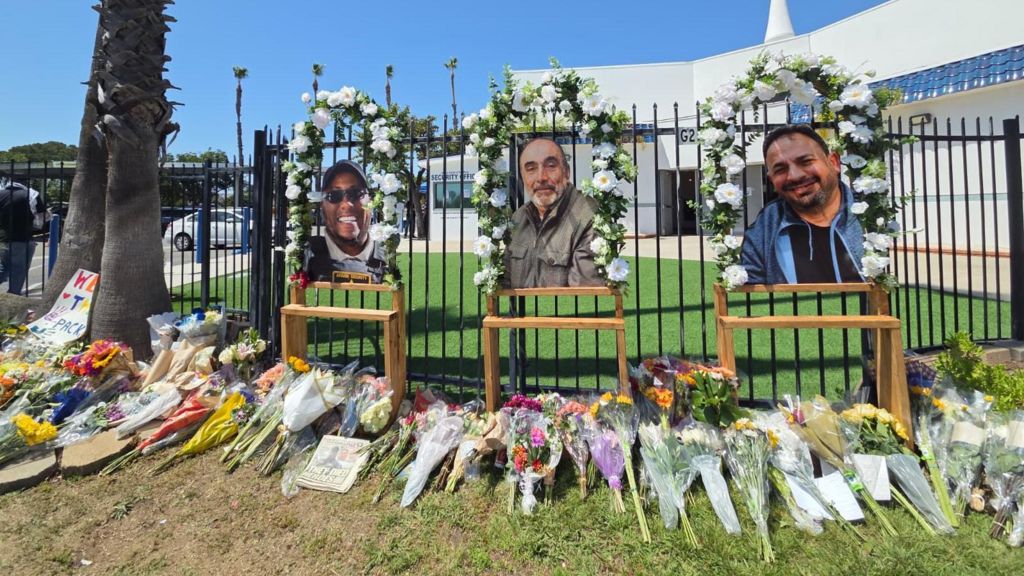
On a Monday morning in mid-May 2026, a quiet residential neighborhood in San Diego’s Clairemont area was shattered by an act of ideological violence that would ripple across the entire United States. Two teenage gunmen opened fire at the Islamic Center of San Diego – a sprawling community hub that houses the region’s second-largest mosque and a thriving primary school – leaving three people dead and sending shockwaves of grief through California’s Muslim community.
The attack unfolded just before noon local time, when parents across the area received urgent WhatsApp alerts notifying them of an active shooter on campus. For Nawal Al-Nouri, whose seven-year-old daughter was in class at the center’s school, the news felt impossible to process. “It completely didn’t hit me that it was an active shooter the way they had described it. I was definitely in a state of shock, and pretty frozen at home,” she recalled to the BBC. Her husband Omar, a vascular surgeon based in nearby La Jolla, raced to the center after getting the same alert, where he was met by a massive, coordinated law enforcement response that left him both overwhelmed and reassured.
When police closed in on the suspects’ vehicle in the residential neighborhood, the violence reached its horrific conclusion: one teen shot his accomplice before turning the gun on himself. The three victims were identified as Amin Abdullah, the center’s security guard; Nadir Awad, a beloved local shopkeeper who called 911 during the attack; and Mansour Kaziha, husband of a teacher at the on-site school. Investigators later confirmed the attack was premeditated, driven by what officials describe as “broad hatred” that radicalized the 17- and 18-year-old suspects online. A manifesto recovered from the pair contained virulently Islamophobic, anti-semitic and misogynistic rhetoric, and law enforcement seized 30 guns and a crossbow from three local residences linked to the teens. San Diego Mayor Todd Gloria confirmed the attack is being formally investigated as a white-supremacist hate crime.
Against the devastating loss, a wave of solidarity emerged from across the state and nation. Just four days after the shooting, thousands of people of all faiths and backgrounds traveled to San Diego to attend a public funeral prayer, gathering to stand in solidarity with the Muslim community and honor the lives of the three slain men. Separate burial services were held on May 21 at La Vista Memorial Park in National City, following a community vigil the night before that drew hundreds of mourners to a nearby neighborhood park.
For many parents who survived the attack, the trauma remains raw. Omar Al-Nouri, who was reunited with his daughter Maya five hours after the shooting, says he cannot shake the terrifying image of what could have happened. “I just had a vision in my mind of the shooters going into the school and encountering my child or another child, I just can’t get that vision out of my head,” he said. Dr. Muhammad Rahman, a local resident whose two children were on the playground during the shooting, called the moment devastating but credited God’s mercy with sparing the school’s students. Emergency protocols, trained staff and coordinated first responder response are credited with saving the 140 children and staff on campus during the attack.
Abdullah, the center’s security guard, has already been hailed as a hero by community members: he confronted the gunmen and initiated lockdown procedures that many believe prevented far greater loss of life. His daughter Hawaa Abdullah, speaking to reporters surrounded by her seven siblings, said her father would want the community to remain united. “He wants all of us to be better, regardless of who we are, what we identify as,” she said. “He wants us to be better, and that’s exactly what I, my family, and I hope every single other person here strives to do every single day – make this world a better place.”
Community leaders say while they are horrified by the attack, they cannot claim it came as a complete surprise. Abdullah Tahiri, president of the Muslim Leadership Council of San Diego, blamed the attack on a years-long pattern of normalized anti-Muslim rhetoric in mainstream American politics. “When figures in the highest halls of the government dehumanise Muslims, paint our institutions as threats, and treat our community with suspicion, they lay the groundwork for real-world violence we witnessed,” he told reporters. Imam Taha Hassane, director of the Islamic Center of San Diego, added that while the center had long received low-level hate messages and harassment from passersby, the scale of violence was still unimaginable. “I know what’s going on in the world. I have seen shootings taking place in houses of worship, schools, malls. But happening here? It never came through my mind,” he said.
Despite the trauma, community members across San Diego say they will not be intimidated by the hate attack. The mosque reopened for daily prayers just two days after the shooting, and leaders emphasize the center will continue its work serving people of all backgrounds across the region. “We will mourn, we will heal, and we will continue to stand strong, rooted in justice, dignity and an unwavering support and faith in our religious traditions,” Tahiri said. Dr. Saad Eldegewi, another imam at the center, added: “Hate speech leads to hate crimes. Hate speech leads to terrorism, extremism and we are here to fight all that in all legal ways. In all peaceful ways.”
Today, the center’s school semester – which was nearly complete when the attack happened – has ended early, and the administration building, playgrounds and other sections of the complex remain closed to the public as investigations continue. A makeshift memorial lined with flowers from local neighbors lines the sidewalk outside the center’s gates, and uniformed police continue to patrol the surrounding neighborhood. As the community mourns its three lost members, many are calling for national change to address the root causes of gun violence and hate-fueled extremism, clinging to solidarity as a source of strength in the wake of unthinkable tragedy.