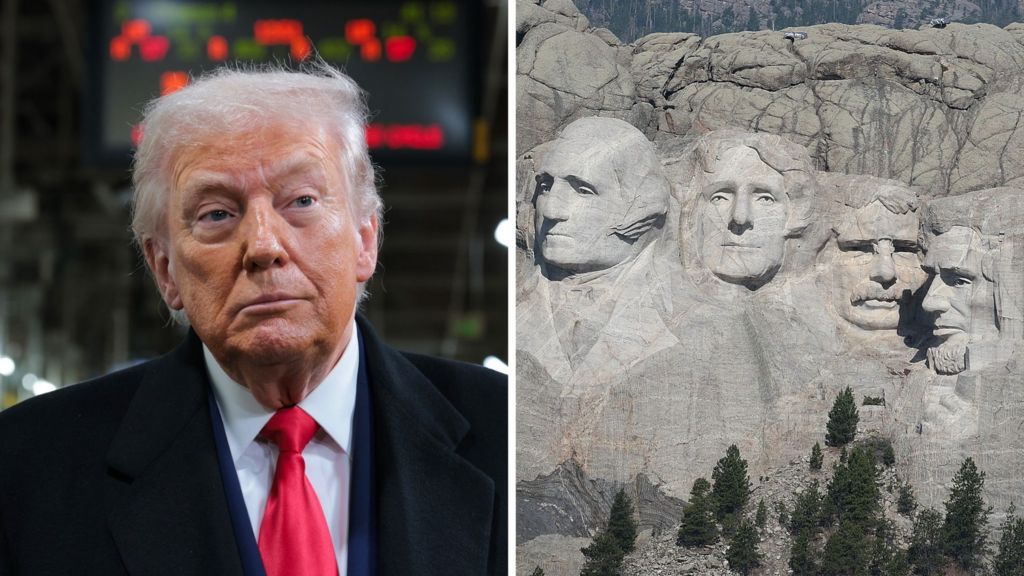
A long-simmering political conversation has bubbled back into public view surrounding former U.S. President Donald Trump’s public aspiration to see his face carved alongside the iconic presidential portraits at South Dakota’s Mount Rushmore. This proposal has sparked fierce debate across political circles and communities, touching on questions of presidential legacy, national identity, and the role of iconic historical sites in modern American discourse.
BBC North America Editor Sarah Smith traveled on-location to the granite monument in South Dakota’s Black Hills to examine the multiple layers of this proposition. What emerged from her on-site reporting is a clearer picture of how what might seem like a symbolic statement of personal ambition actually exposes deeper rifts in contemporary U.S. politics, as well as very real practical obstacles that would stand in the way of any such project moving forward.
On the political side, the proposal has laid bare stark divides over how Americans assess Trump’s presidency and what place, if any, he holds among the nation’s most transformative leaders. Mount Rushmore, which features the carved faces of George Washington, Thomas Jefferson, Theodore Roosevelt, and Abraham Lincoln, is already a site of ongoing debate over Indigenous land rights and historical commemoration—adding another layer of complexity to Trump’s request. Critics argue that the monument already stands on land seized from the Lakota Sioux, and any expansion to add a modern political figure would only compound existing historical injustices. Supporters of the former president, meanwhile, have framed the idea as a fitting recognition of what they frame as his transformative impact on American politics and policy.
Beyond the heated political disagreement, Smith’s reporting also highlights the steep practical challenges that any carving project would face. The granite formation that hosts the current portraits has limited remaining space, and geological experts have long noted that adding new carvings would require massive engineering work, significant environmental disruption, and hundreds of millions of dollars in funding—none of which has been secured or formally proposed to date. Furthermore, the site is managed by the U.S. National Park Service, which has no official process or mandate to approve changes to the iconic monument’s iconic design.
Ultimately, Smith’s reporting frames Trump’s public aspiration less as a concrete proposal that could actually come to fruition, and more as a revealing window into the former president’s own view of his place in American history, and the ongoing polarization that shapes how the nation remembers and commemorates its leaders.