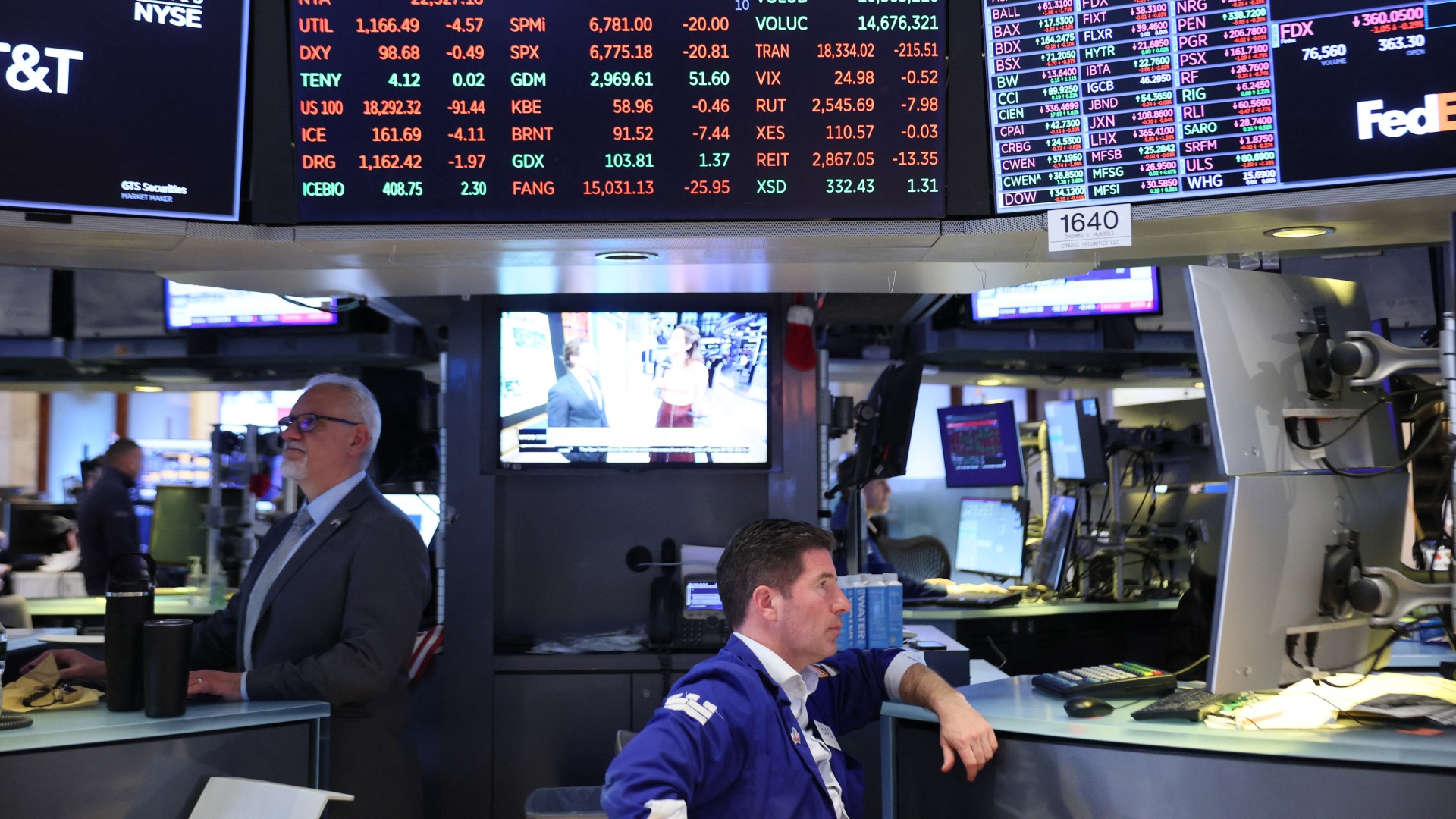
In the wake of the US and Israeli military campaign against Iran, initial market reactions have painted a misleading picture of Wall Street’s fortunes, according to senior market analysts interviewed by Middle East Eye. While immediate short-term windfalls from spiking oil prices and amplified market volatility have lifted headline earnings, these gains are masking a growing slowdown in dealmaking that threatens the foundation of the finance industry’s core operations.
Within days of the conflict’s launch, global oil prices surged dramatically, with Brent crude jumping 8.6% to roughly $72 per barrel in the first trading session after hostilities broke out. This spike lifted share values for major energy giants including ExxonMobil and Chevron, while heightened market turbulence drove a sharp uptick in trading revenues across major investment banks. Defense sector equities also rallied early on, with leading contractors Northrop Grumman, RTX Corporation and Lockheed Martin all posting immediate gains on expectations of expanded military spending. Goldman Sachs even reported a 48% jump in investment banking fees to $2.84 billion, with the bank acknowledging the conflict had given trading revenues a measurable boost.
But these early, visible gains hide deeper underlying vulnerabilities, experts warn. While first-quarter 2025 earnings appear strong on paper, the vast majority of that performance traces back to transactions that were finalized before the first strikes on Iran on February 28. The full negative impact of the conflict on global deal flow is only just beginning to emerge.
“Wall Street has done meaningfully less well out of the Iran war than might meet the eye,” explained Ilya Spivak, head of global macro at tastylive, a U.S.-based financial media and trading platform. Today, Wall Street executives are sounding the alarm that the conflict is complicating cross-border and domestic transactions, delaying planned initial public offerings (IPOs), and putting the entire pipeline of mergers, acquisitions (M&A) and new stock listings at risk.
The early upward momentum across conflict-linked sectors also proved far from sustainable. While defense stocks jumped initially, many individual firms have struggled to hold gains in subsequent weeks, leaving the broader aerospace and defense sector largely flat for the year to date. Energy equities have followed a similar trajectory, giving up all their post-conflict gains after peaking in early March. Spivak added that recent broad market rebounds are “more driven by opportunistic attempts to ‘buy the dip’ in Magnificent 7 (Mag7) stocks rather than reflecting actual war-related upside for companies.” The Mag7—Alphabet, Amazon, Apple, Meta, Microsoft, Nvidia and Tesla—are seven large-cap tech names that have driven the vast majority of U.S. market growth in recent years.
The core challenge, Spivak explained, is that trading revenue cannot fully offset a slowdown in traditional dealmaking. Trading operations require far heavier infrastructure investment and deliver significantly thinner profit margins than the advisory and underwriting work that forms the core of investment banking profitability. “Increased volatility can help offset a slowdown in dealmaking, but its thinner margins—of 25 to 45 percent, compared with those for investment banking of 45 to 65 percent—mean that you need about $1.50 in trading revenue to make up $1 of dealmaking revenue,” Spivak said.
That gap is already showing up in hard data. As of early March, the number of announced U.S. mergers had fallen roughly 23% year-over-year to 1,795, a drop that reflects both pre-existing market weakness and new uncertainty fueled by the conflict. Goldman Sachs CEO David Solomon has openly acknowledged that IPO activity slowed sharply in March, with seven of the 10 largest U.S. listings from the first quarter trading below their offer price within a month of launch.
“The disruption runs deeper than Wall Street’s earnings headlines suggest,” said Javed Hassan, a former investment banker who previously worked in London and Hong Kong for Swiss Re’s investment banking division. Hassan noted that major global banks with large trade finance portfolios—including Citigroup, HSBC and Standard Chartered—have already flagged rising counterparty risks in commodity-linked transactions. “The difficulty is not just energy prices, it is that no one can write a contract with confidence when the baseline keeps shifting,” Hassan said. “That uncertainty is the supply chain dimension Wall Street’s earnings headlines are not yet capturing.”
Geopolitical conflict disrupting global financial markets is not a new phenomenon. Previous major conflicts, from the 2003 Iraq War to Russia’s 2022 full-scale invasion of Ukraine, all triggered equity market pullbacks, widening credit spreads and sharp slowdowns in IPO activity. But Mir Mohammad Ali Khan, founder and former chairman of KMS Investment Bank at 110 Wall Street, argues the Iran conflict is unique due to its direct and lasting impact on global energy flows through the Strait of Hormuz.
“Previous conflicts, including the wars in Afghanistan and Iraq, did not have the long-term direct impact on US financial markets,” Khan told Middle East Eye. “Letting this conflict drag on is not in Wall Street’s interest.”
Industry executives now agree that the second quarter of 2025 will be the first full test of the conflict’s impact, as it will be the first period entirely exposed to war-related disruptions. “Looking ahead, planning, engagement and pipelines remain healthy, but of course, developments in the Middle East could have an impact on deal execution and timing,” JPMorgan CFO Jeremy Barnum said. Citigroup CFO Gonzalo Luchetti echoed that warning, noting a prolonged conflict could introduce “risk of deferrals” for planned deals later in the year.
Those warnings are grounded in the scale of the energy disruption. Before the conflict began, roughly a quarter of all global seaborne oil and 20% of global liquefied natural gas traded through the Strait of Hormuz—a key shipping lane that has been effectively closed since early March. The Federal Reserve Bank of Dallas has already labeled the conflict the largest geopolitical oil supply shock on record, estimating that removing nearly one-fifth of global oil supply could cut global GDP growth by 2.9 percentage points in a single quarter.
More than two months into the conflict, the economic fallout is already showing up in broader U.S. economic data. Energy costs rose 10.9% in March alone, pushing average U.S. gasoline prices above $4 per gallon and lifting overall inflation to 3.3%—far above the Federal Reserve’s 2% target. “This is a one-quarter blip where the effects of it really weren’t being felt, but I don’t really see how this is sustainable,” said William D. Cohan, a former senior Wall Street M&A investment banker with experience at Lazard Frères & Co, Merrill Lynch and JPMorganChase. When corporate profitability falls, he explained, it directly reduces companies’ willingness to pursue new deals or take on borrowed capital. “People like to say Wall Street is not Main Street, [but] Wall Street is highly correlated to Main Street,” Cohan added.
Rising energy and consumer costs have already rippled through to broader borrowing conditions. U.S. Treasury yields and 30-year mortgage rates have climbed steadily, pushing up borrowing costs across the economy and eliminating room for the Federal Reserve to cut interest rates as markets previously expected.
“The single most important factor determining the trajectory of stock prices is the central bank’s monetary policy,” said Alex Krainer, a Europe-based market analyst, commodities expert and former hedge fund manager. “Stock markets are going higher not because the economy is growing… but because the Federal Reserve is flooding the financial system with liquidity.” If the conflict continues to fuel persistent inflation, Krainer warned, the dollar’s purchasing power will erode, meaning the nominal market gains investors see on paper will not translate into actual, inflation-adjusted wealth.
The International Monetary Fund has already downgraded its 2025 global growth forecasts and warned that a prolonged conflict could push the global economy to the brink of recession. For Wall Street, which relies on steady economic growth and cheap borrowing costs to support deal activity, that outcome poses an existential threat to its core revenue model. “Look, Wall Street is a confidence game,” said Cohan. “It’s a hard thing to bet against, but at some point investors, corporations, CEOs are going to have enough of this, and they are going to pull back.”
Despite the clear short-term risks to profitability, not all analysts agree that Wall Street has an incentive to push for a rapid ceasefire. “Wall Street’s interest is in the war continuing, not stopping. I don’t think they will exert meaningful pressure on the administration for a ceasefire – probably quite the contrary,” Krainer said. Drawing on his conversations with financial and policy industry contacts, Krainer argued that control over Iran’s vast natural resources, rather than regional security, is the core strategic driver for many leading financial players.
“Wall Street’s objective is primarily to take down the regime in Tehran,” he said. “Iran is the fifth richest nation in the world in terms of natural resources, estimated at $30 trillion. If they were able to install their own puppet in Tehran, all that wealth could become their collateral.” For Wall Street, Krainer argues, the long-term potential strategic prize far outweighs any short-term hits to industry balance sheets from the current conflict-induced deal slowdown.