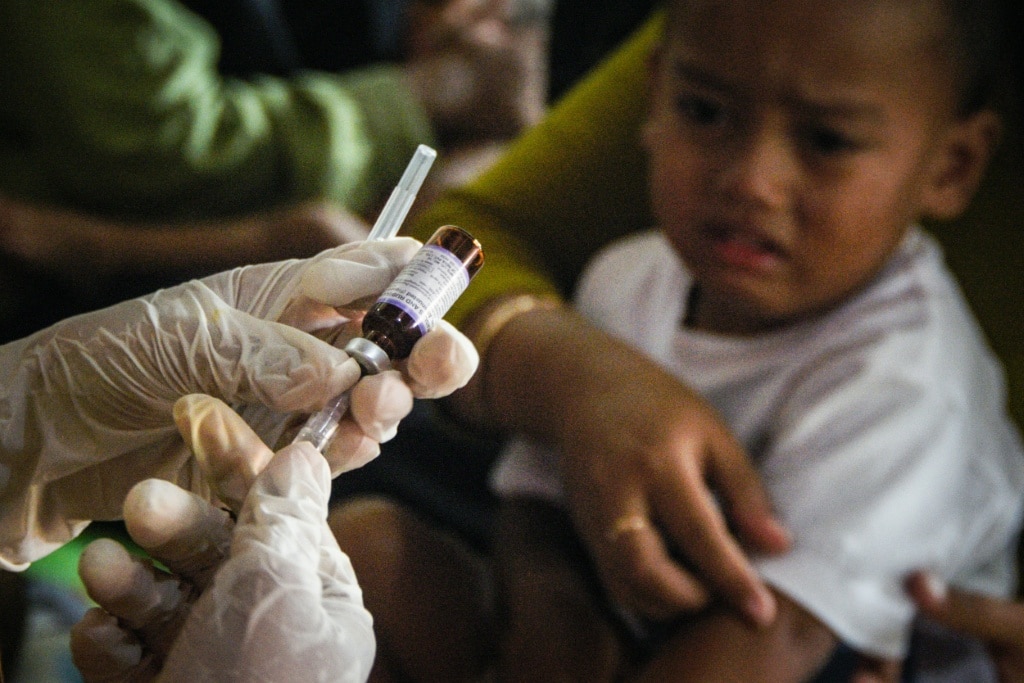
Indonesia is grappling with one of the world’s worst measles outbreaks in recent years, a public health crisis fueled by plummeting childhood vaccination rates that have dropped sharply since the COVID-19 pandemic and deep-rooted misinformation spreading across social media platforms.
For many parents like Fitri Fransiskha, a 40-year-old stay-at-home mother of four based in Banten province on the western tip of Java, fear of vaccines took root after her first child developed a mild fever following an infant tuberculosis shot. That initial anxiety was amplified by viral falsehoods circulating online that claim routine vaccines cause paralysis, developmental behavioral disorders, and even death. Instead of immunizing her children against the highly contagious, potentially fatal measles virus, Fitri relies on nutrient-dense diets and vitamin supplements to keep her family healthy. Even the ongoing surge in cases has not changed her mind.
Fitri is far from alone. As the world’s fourth most populous nation, Indonesia has seen a steady rise in vaccine refusal among parents, even as public health officials race to contain the growing outbreak. Data from the Indonesian Paediatrics Association confirms the country now has the second-highest number of measles cases globally, outranked only by conflict-ravaged Yemen.
Official health data underscores the severity of the crisis: in the first three months of 2026 alone, authorities recorded more than 8,000 suspected measles cases and 10 confirmed deaths. From 2024 to 2025, annual cases more than doubled to over 63,000, resulting in 69 fatalities. A January research paper published in the *Indonesian Journal of Internal Medicine* noted that measles, once on the brink of global elimination, has re-emerged as a major public health danger across Indonesia.
Public health experts trace the crisis to widespread vaccine misinformation amplified by vocal anti-vaccine activists across popular Indonesian social platforms. A recent study from local data analytics firm Drone Emprit found anti-vaccine content on nearly all of the country’s largest social media networks, reaching a very large share of the population. Ismail Fahmi, founder of Drone Emprit, explained that while anti-vaccine advocates make up a smaller share of users, they are far more vocal and active online than pro-vaccine communities. Many popular influencers, he added, use their platforms to push unproven herbal alternatives to routine vaccination, amplifying distrust in immunization. In March, AFP’s fact-checking team debunked a widespread viral falsehood claiming that natural infection with measles provides stronger protection than approved vaccines.
Religious concerns have also deepened vaccine hesitancy in the Muslim-majority nation, where pork products are forbidden under Islamic law. Some parents refuse vaccines because certain products contain gelatine derived from pigs, which they argue violates halal dietary rules. Yusran, a 46-year-old entrepreneur based in Makassar, South Sulawesi, has refused to vaccinate any of his five children over halal concerns, saying his children remain healthy without immunization. Even so, Indonesia’s highest Islamic authority, the Indonesian Ulema Council, issued a 2018 fatwa ruling that vaccines are permissible for protecting public health even when they contain porcine gelatine, a clarification that has failed to reach all hesitant communities.
The combination of misinformation and religious hesitancy has done severe damage to the country’s herd immunity, the threshold of vaccination required to stop measles from spreading easily through communities. “Our herd immunity has been compromised,” explained Riris Andono Ahmad, an epidemiologist at Gadjah Mada University in Yogyakarta. Currently, only around 76% of Indonesian children receive both required doses of the measles-rubella (MR) vaccine, far below the 95% coverage needed to hit herd immunity and eradicate the virus.
The Indonesian government has made urgent moves to reverse the trend: with a goal of eradicating measles and rubella by the end of 2026, authorities launched an emergency mass vaccination campaign in March across more than 100 regencies and cities, including MR booster shots for over 220,000 frontline health workers. The government has also partnered with leading religious organizations to spread accurate information and encourage parents to vaccinate their children. Indri Yogyaswari, the country’s director of immunization, told reporters that the campaign has already helped reduce measles transmission significantly. Even so, official health ministry data shows that infant first-dose MR vaccination coverage dropped 10 percentage points between 2024 and 2025, leaving the 2026 eradication goal well out of reach at current coverage levels.