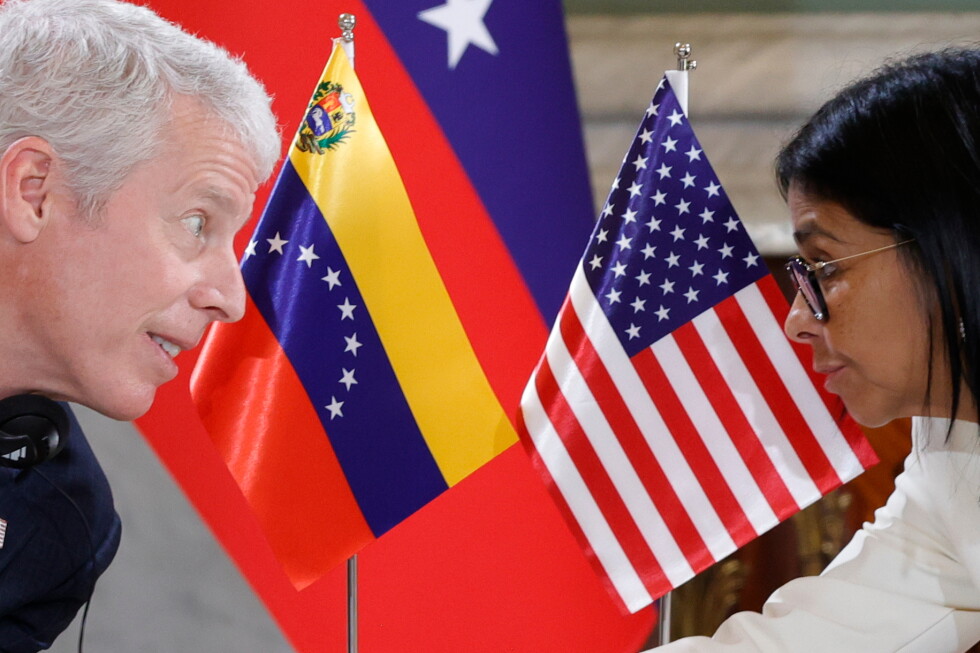
For more than a century, oil has been the foundational thread weaving together every aspect of modern Venezuelan identity. Rooted in the national consciousness is the deeply held belief that the country’s unmatched reserves of crude – the largest on the planet – belong not to political leaders or private corporations, but to every Venezuelan citizen. That long-held conviction, and the collective pride of a nation that has weathered decades of turmoil, suffered a major blow last week when acting Venezuelan President Delcy Rodríguez signed an agreement granting U.S.-backed entities control over roughly one-fifth of the country’s total proven oil reserves.
While the deal holds the long-term potential to unlock billions of dollars in investment for an oil sector and broader national economy crippled by decades of mismanagement and international sanctions, it has been widely decried by ordinary Venezuelans as an unprecedented surrender of national sovereignty. Many have linked the agreement to the January U.S. military operation that targeted former President Nicolás Maduro, arguing that seizing control of Venezuela’s vast energy wealth was the unstated core goal of the intervention that left Rodríguez in power.
“For ordinary citizens like us, there is nothing we can do to stop this – it is not just worrying, it is outrageous,” said Lisandro Castro, an architect based in the capital Caracas. “Across the country right now, there is real, widespread anxiety about what is unfolding before our eyes.”
Oil has shaped every corner of Venezuelan life since commercial deposits were first discovered in the country’s northwest in the 1920s. What began as a new energy sector transformed a poor, largely agrarian nation into an urbanized regional economic power almost overnight. American energy workers who relocated to Venezuela introduced and popularized baseball, constructing fields across oil-producing regions that turned the sport into a national pastime for working-class communities before it spread across the entire country.
The boom created unprecedented economic opportunity that drew waves of European migrants fleeing post-World War II hardship. Portuguese immigrants opened neighborhood bakeries that remain community staples today, while Italian architects designed iconic buildings that still define Venezuelan cityscapes. As a young democracy, Venezuela came to rely almost entirely on oil export revenues rather than domestic taxes on citizens and businesses, creating a dynamic where politicians used oil wealth to secure public support, explained Ronal Rodríguez, a researcher at the Venezuela Observatory at Colombia’s Universidad del Rosario.
Venezuela went on to become a founding member of OPEC, and by the 1970s, when the country boasted the highest per capita income in Latin America, the government nationalized the entire oil sector with the creation of the state-owned Petróleos de Venezuela S.A., known universally as PDVSA. Under the nationalized model, foreign firms were only permitted to operate as minority partners in joint ventures, and PDVSA’s revenues funded an extensive network of public benefits: heavily subsidized gasoline for all citizens, scholarships for international study, free healthcare and countless other social programs.
“Every single Venezuelan grows up understanding that oil is a collective right that every one of us can claim,” researcher Ronal Rodríguez noted.
Over the decades, Venezuela’s history has been defined by the repeated cycle of oil booms and crippling busts. When global crude prices plummeted in the 1980s, the economy collapsed, forcing the government to secure a bailout from the International Monetary Fund and eliminate core public subsidies. The resulting social unrest paved the way for the rise of Hugo Chávez, a young military officer who first gained national attention for a failed coup attempt.
After being elected president in 1998, Chávez expanded the country’s social safety net dramatically – including expanded access to public health, affordable housing and free education – fueled by a resurgence in global oil prices that generated an estimated $981 billion in revenue for PDVSA between 1999 and 2011. The government distributed everything from new homes to household appliances to free medication, and millions of families secured stable, well-paid jobs across public and private sectors. Emboldened by widespread popular support, Chávez tightened state control over PDVSA, sidelining major U.S. oil firms including ExxonMobil and ConocoPhillips in the process.
But PDVSA’s fortunes declined sharply as oil prices fell again in the 2010s. Systemic corruption and decades of mismanagement eroded production capacity and profits, first under Chávez and then under his hand-picked successor, Nicolás Maduro, who took office following Chávez’s death in 2013. By that time, the country was already sliding into a catastrophic economic crisis, worsened by sweeping U.S. sanctions imposed over concerns about democratic backsliding and human rights abuses that gutted the oil sector and the broader economy.
What was once a magnet for global migrants became a source of mass emigration: severe food shortages and widespread deprivation linked to economic collapse pushed more than 7 million Venezuelans to leave the country. Even today, while grocery store shelves are fully stocked, soaring hyperinflation has left basic goods out of reach for most working people. Public sector employees now earn an average of roughly $160 per month, while private sector workers averaged around $237 per month in 2024.
“Something is better than nothing,” said Romel Abreu, a former PDVSA worker who now works as a security guard in Cabimas, the heart of Venezuela’s historic oil region in the country’s northwest. Referring to Venezuela’s current crude production of roughly 1 million barrels per day, he added: “If we had no oil production at all, we would be completely lost.” Like many residents of the oil belt, Abreu holds out hope for another boom that would bring back well-paying jobs for the next generation.
The new oil deal has deepened widespread skepticism among Venezuelans of all political stripes. After Maduro’s capture in January, many Venezuelans hoped that would end the ruling party’s 27-year hold on power. When that did not materialize – with the Trump administration backing Rodríguez over opposition leaders – many held out optimism that the easing of crippling U.S. sanctions would deliver long-overdue economic improvement. A February regulatory overhaul that opened the door to expanded private investment in the oil sector was widely seen as a sign of coming progress.
But for critics like Castro, the January intervention was always just a stepping stone to this moment. “Everything that happened on January 3 was just a strategy to get us to where we are today: full U.S. control over our energy sector for their own gain, not to benefit ordinary Venezuelans,” he said.
Under the terms of the agreement, the U.S. is entering a joint venture with North American Blue Energy Partners, Venezuela’s second-largest private oil operating company, trailing only industry giant Chevron. Rodríguez has granted the joint venture 100-year exploitation rights to 17 oil fields holding 65 billion barrels of proven reserves – roughly one-fifth of Venezuela’s total 300 billion barrel reserve base.
Industry experts warn that because Venezuela’s energy infrastructure has fallen into severe disrepair after decades of underinvestment, it will take years of large-scale capital investment before production increases significantly.
Speaking in Caracas this week, U.S. Energy Secretary Chris Wright said the Trump administration’s mission in Venezuela “is to bring peace, freedom, opportunity and prosperity to the people.” In a national address Saturday, Rodríguez defended the agreement, saying she aims to restore Venezuela’s status as a global “energy powerhouse.”
For residents of Cabimas, the deal leaves them torn between conflicting fears and hopes. “On one hand, you have to acknowledge that we are handing over control of one of our largest reserve holdings,” said Erwin Ayala, a current oil sector worker, outside his home in Cabimas. “But if this is for the good of the country and for future generations, then we can support it. What good does it do us to hold all this oil in the ground if we have no machinery, no technology, to get it out and use it to improve our lives?”