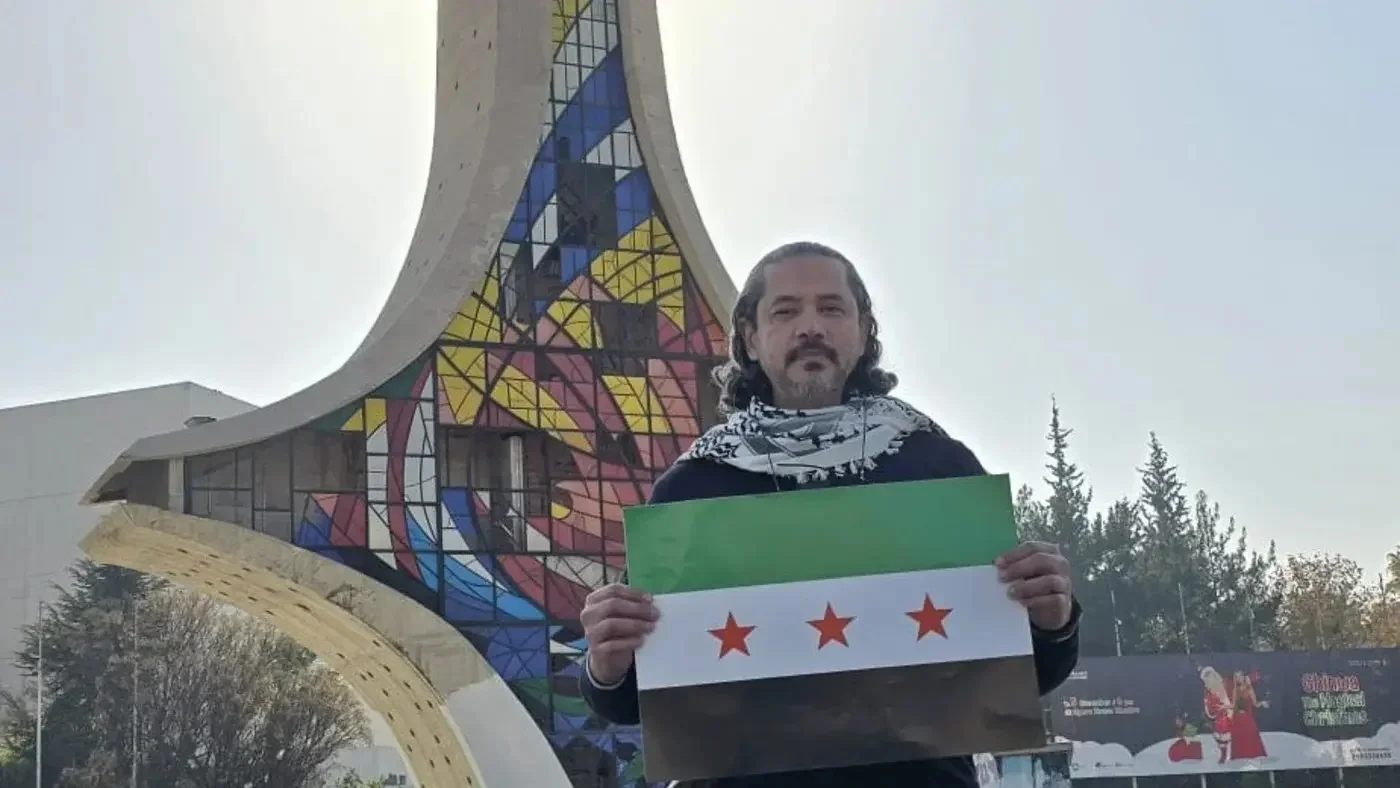
In a move that follows widespread international pressure from human rights organizations and United Nations experts, the United Arab Emirates’ president Sheikh Mohamed bin Zayed Al Nahyan has granted a pardon to Egyptian dissident poet and activist Abdul Rahman Yusuf al-Qaradawi, who had been sentenced to a decade in prison in the Gulf state, Emirati state media has confirmed.
The pardon, issued Friday, comes less than three months after Qaradawi’s conviction on August 27 by the Cybercrime Circuit of the Abu Dhabi Federal Court of Appeal, which handed down the 10-year custodial sentence alongside a fine of 200,000 Emirati dirhams (equivalent to roughly $54,450).
A dual Egyptian-Turkish national, Qaradawi was first apprehended by Lebanese security officials in January this year, before being extradited to the UAE to face charges of spreading “fake news” and “disturbing public security”. The charges stem from a social media video he recorded during a visit to Syria, in which he publicly criticized the governments of Egypt, the UAE and Saudi Arabia. Both Cairo and Abu Dhabi submitted formal extradition requests for the activist, and Lebanese authorities ultimately moved to enforce the UAE’s warrant on January 8.
In the more than 200 days that followed his extradition to the UAE, Qaradawi was held in what human rights outlet Middle East Eye described as “forced disappearance”, with no public confirmation of charges or official indictment. The unacknowledged detention sparked fierce international pushback, with leading rights groups and UN experts repeatedly calling for his immediate release.
London-based Amnesty International, one of the most vocal organizations calling for Qaradawi’s freedom, warned early in the case that his extradition represented a “flagrant violation of due process guarantees and other international human rights obligations, notably the principle of non-refoulement”. By March, a coalition of UN independent human rights experts issued a public statement raising alarm over Qaradawi’s ongoing unacknowledged detention, calling on UAE authorities to immediately disclose his location and ensure fair legal process.
The experts also raised pointed concerns over the unusual legal mechanism that enabled the extradition: an arrest warrant issued through the Arab Interior Ministers’ Council (AIMC), a relatively obscure regional security body. The coalition argued the entire process was politically motivated rather than rooted in neutral legal criteria, warning that the AIMC’s cross-border arrest framework “is being abused by some states to silence criticism, shut down dissent, and pursue activists beyond their borders”.
Amnesty International further confirmed that during Qaradawi’s initial detention in Lebanon, he was interrogated over two separate cases: a 2017 in-absentia verdict from an Egyptian court that convicted him of spreading false information in a widely condemned politically motivated case, and the separate extradition request from the UAE. The 2017 verdict added a five-year prison sentence to Qaradawi’s record in Egypt.
Reaction to the news of the pardon has been largely positive among human rights advocates, though many have called for urgent action to complete Qaradawi’s release and allow him to reunite with his family. Samar Elhussieny, executive director of the Egyptian Human Rights Forum, welcomed the pardon in comments to Middle East Eye, urging Emirati officials to speed up final administrative procedures. “I hope the procedures will be finalised as soon as possible for him to be reunited with his family,” Elhussieny said. “Then he can live his life with his daughters in peace and safety, and heal from this traumatic experience.”
Qaradawi, a well-known figure in Arab political and cultural circles, was a prominent public supporter of the 2011 Egyptian revolution that ousted long-time authoritarian president Hosni Mubarak. He also worked on the presidential campaign of former International Atomic Energy Agency head Mohammed el-Baradei, who ran for Egypt’s highest office following Mubarak’s resignation.
In the years after 2011, Qaradawi was banned from publishing work and appearing on media outlets in Egypt, and joined hundreds of other Egyptian dissidents in self-imposed exile in Turkey. His family has also faced repeated pressure from Egyptian authorities: his sister Ola has been arbitrarily detained in Egypt for four years on unsubstantiated terrorism-related charges, widely seen as retaliation for the activist’s work. Qaradawi’s father, Yusuf al-Qaradawi, one of the most prominent and widely published Islamic scholars in the modern Arab world, died in Qatar in 2022.