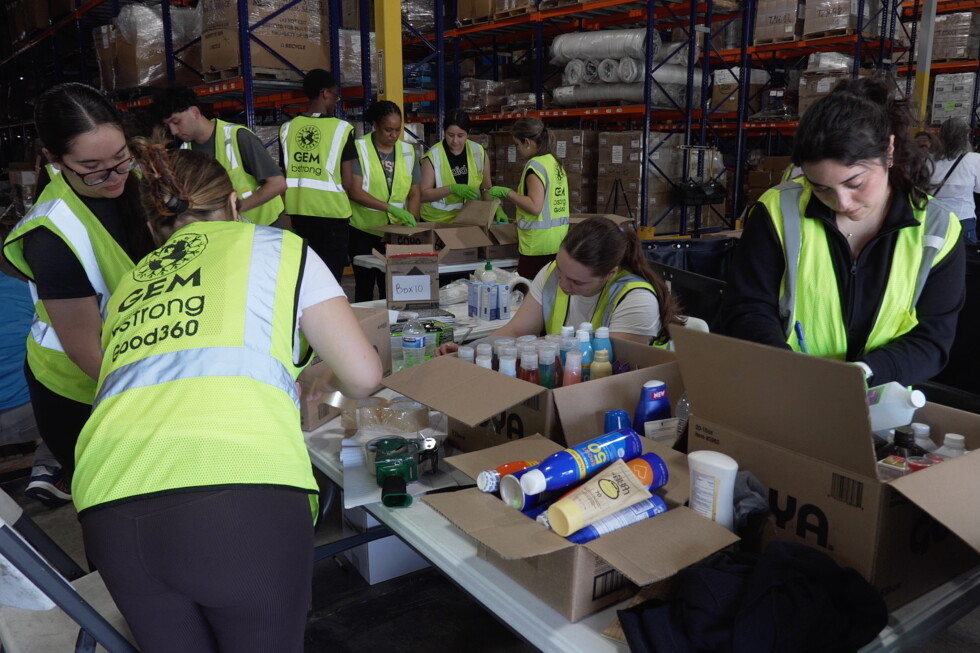
In the wake of two catastrophic back-to-back earthquakes that left at least 188 people dead and hundreds more injured across Venezuela, the large Venezuelan diaspora community across the United States has mobilized at speed to organize urgent donation drives to support relief efforts on the ground.
The 7.2 and 7.5 magnitude tremors, which struck Wednesday evening, rank among the most powerful seismic events to hit Venezuela in over 100 years. The quakes inflicted severe structural damage to Simon Bolivar International Airport, Venezuela’s primary air gateway located in the capital Caracas, a critical blow that threatens to slow the delivery of life-saving humanitarian aid to affected regions. Graphic imagery from the disaster zone shows dust-covered, bleeding injured civilians, children and animals being pulled from collapsed concrete rubble, while thousands of people remain unaccounted for — leaving relatives living in the U.S. desperate for updates on their loved ones.
More than 770,000 Venezuelan-born people currently reside in the United States, with the largest concentration settled in Doral, a suburban city just outside Miami, Florida. Oscar Torres, a 28-year U.S. resident and sales manager based in Doral, has spent nearly a full day glued to a dedicated WhatsApp group connecting Venezuelan residents with their relatives abroad, tracking updates and coordinating donations.
“Already this morning, I was looking at the Doral group and everybody’s pitching in — money, medicine, water. First, necessity items,” Torres explained. “They’re talking about making the first shipment as soon as possible.” Torres still has extended family living in Caracas and the hard-hit city of Valencia, where a number of his relatives suffered minor injuries while fleeing damaged buildings. “Their homes are destroyed and a few buildings have collapsed,” he said. “Thankfully, I don’t know anyone who passed away.” Local Doral officials and Venezuelan advocacy organizations have amplified calls for donations across social media and official press conferences, with Torres planning to contribute cash to the relief effort.
Beyond Florida, other large Venezuelan communities in Texas have also sprung into action. In the Houston metropolitan area, where the western suburb of Katy has earned the nickname “Katyzuela” for its massive Venezuelan population, residents have leveraged Facebook groups and other social platforms to advertise local drop-off points for donations. The most urgent needs identified include first aid and medical supplies: gauze, bandages, antiseptic solutions, disposable gloves, face masks, syringes, thermometers and blood pressure monitors are all high priority for aid shipments.
Daniel Arenas, a maritime industry consultant who relocated to Houston from Venezuela a decade ago, translated a Spanish donation call to English and shared it to his LinkedIn profile Thursday, urging a broader cross-section of the Houston community to contribute. “I came to this country ten years ago, built a life here, but my heart is still in Venezuela,” Arenas said. “It’s devastating what’s happening over there. They don’t have the resources to handle this.”
Arenas shared that his wife spent hours anxiously waiting for news after her aunt, a Caracas high-rise resident, sent a panicked voice note moments after the quakes hit. “She was crying and screaming and saying she was in pain but not sure from where,” Arenas recounted. “She said she lost everything. She was desperate.” The family was later able to re-establish contact with her aunt, bringing an end to the hours-long period of uncertainty.
The outpouring of organizing across U.S. Venezuelan communities comes as Venezuelan authorities assess the full scale of the disaster, with relief operations already facing logistical hurdles from damaged infrastructure.