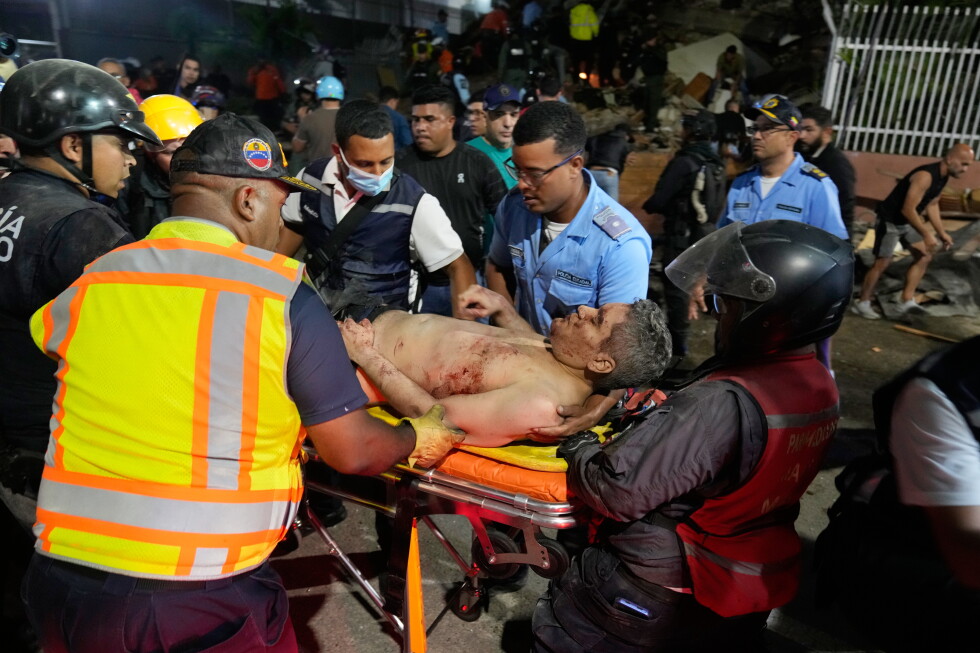
On Wednesday evening, two large-magnitude earthquakes struck northern Venezuela within one minute of each other, leaving at least 32 people dead and more than 700 injured, with widespread damage to infrastructure and communities across the South American nation, according to the country’s acting president Delcy Rodríguez. As rescue teams continue to comb through collapsed buildings and emergency crews work to reach cut-off, hard-hit areas, Rodríguez has warned the final casualty count is likely to climb. The events rank among the most powerful seismic events to hit Venezuela in more than 100 years, with shaking felt as far as 1,700 kilometers away in Brazil’s Amazon region.
Rodríguez declared a national state of emergency late Wednesday, confirming that the quakes left a trail of destruction across multiple Venezuelan states. As of early Thursday, casualty data did not include the worst-affected region: La Guaira, a coastal state roughly 30 kilometers north of the capital Caracas that Rodríguez has labeled a full disaster zone. “Dozens of buildings have collapsed there, and we are currently carrying out intensive rescue operations to save lives,” she stated in a national address.
The country’s primary international gateway, Simón Bolívar International Airport near Caracas, suffered significant damage and was forced to close immediately after the quakes. Caracas also suspended all subway operations and cut natural gas service to prevent safety hazards, while all school classes across the nation have been canceled for several days. The Ministry of Education announced that undamaged school facilities would be repurposed as emergency shelters and donation collection points to support displaced residents. Rodríguez urged all Venezuelans to report infrastructure damage via a government mobile application, called on medical professionals to report to hospitals to support care for the injured, and appealed for national calm and unity: “We urge our population to remain calm. We urge unity.”
Data from the U.S. Geological Survey (USGS) confirms the details of the back-to-back events. The agency initially recorded the first quake at magnitude 7.1, later revising its measurement to 7.2. That first seismic event originated 168 kilometers west of Caracas, off the Caribbean coast west of the town of Morón, at a depth of 22 kilometers. Just 60 seconds later, a larger 7.5 magnitude quake hit 16 kilometers southwest of Morón at a shallower depth of 10 kilometers, amplifying the damage caused by the first shock. In the northern coastal state of Falcón, Governor Víctor Clark reported 32 people hospitalized and 15 residents trapped in collapsed structures in the immediate aftermath of the quakes.
Eyewitness accounts from Caracas paint a picture of widespread chaos and fear. Residents described buildings swaying violently, forcing thousands to evacuate into the streets as walls crumbled and dust plumes rose over busy commercial neighborhoods. For hours after the quakes, many people remained gathered outside, too afraid to return to damaged structures, with some sitting on the ground clutching their pets. Collapsed structures, fallen power poles and scattered debris blocked major roads, while sections of the capital lost electricity and cellular phone service, leaving many families unable to check on loved ones—including the more than 7.7 million Venezuelans who have relocated abroad during the country’s long-running political and economic crisis. “It started off gently and then gradually grew, and in the end, we all had to leave our houses, go outside and gather together,” said Caracas resident Hector Ricci. Fellow resident Roberto Gamas added: “The building I was in really shook from side to side. Unreal. The force was incredibly strong.”
Venezuela’s Interior Minister Diosdado Cabello confirmed the quakes were felt across multiple states, and urged civilian motorists to yield the right of way to ambulances and emergency response vehicles. He reported collapsed homes and buildings in Caracas’ Altamira neighborhood, confirming injuries in the area, and noted that response teams were following established emergency protocols to accelerate rescue and aid delivery. Cabello also warned residents to stay outside of damaged structures due to the risk of additional damage from aftershocks, reminding the public to prioritize safety for vulnerable groups including children and older adults. Even in exile, Venezuelan opposition leader María Corina Machado shared a message of solidarity on social media platform X, asking for strength and unity for all Venezuelans navigating the crisis.
Seismologists note that major earthquakes are extremely rare in Venezuela. While the country sits near multiple tectonic boundaries, its position between the South American and Caribbean plates means large seismic events are far less frequent than in other Latin American nations along the Pacific Ring of Fire, the geologically active belt that produces 90% of the world’s earthquakes, per USGS data. Even so, the recent quakes were felt across a wide swathe of northern South America: buildings were evacuated in three Amazonian Brazilian cities hundreds of kilometers from the epicenter, while shaking was reported in Colombia’s Caribbean and northeastern regions with no immediate reports of damage or injury there. The U.S. Pacific Tsunami Warning Center issued brief tsunami alerts immediately after the quakes that were lifted within hours as no threat materialized.
In the wake of the disaster, dozens of nations have extended offers of international assistance to Venezuela, including countries with long-running political differences with the current administration. The United States, Argentina, Bolivia, Brazil, Chile, Ecuador, El Salvador, Mexico, Panama and Uruguay have all publicly pledged support. U.S. Undersecretary of State for Foreign Assistance Jeremy P. Lewin announced that the State Department has mobilized a dedicated disaster assistance task force to coordinate search-and-rescue teams, medical supplies, and other humanitarian resources in coordination with Venezuela’s interim government. El Salvador’s President Nayib Bukele, who has previously been openly opposed to Venezuela’s sitting government, shared a message of solidarity on X: “We send you all our solidarity and our prayers. Stay strong, Venezuela.” Ecuadorian President Daniel Noboa added that he had ordered immediate delivery of humanitarian aid, noting: “Ecuador will respond with the speed and commitment this moment demands because, despite our enormous differences, humanity must always guide the actions of a leader.” Even Bolivia, which was just days ago grappling with its own national state of emergency following widespread anti-government protests, has offered any assistance required. Brazilian authorities confirmed that no Brazilian citizens have been reported injured in the quakes.