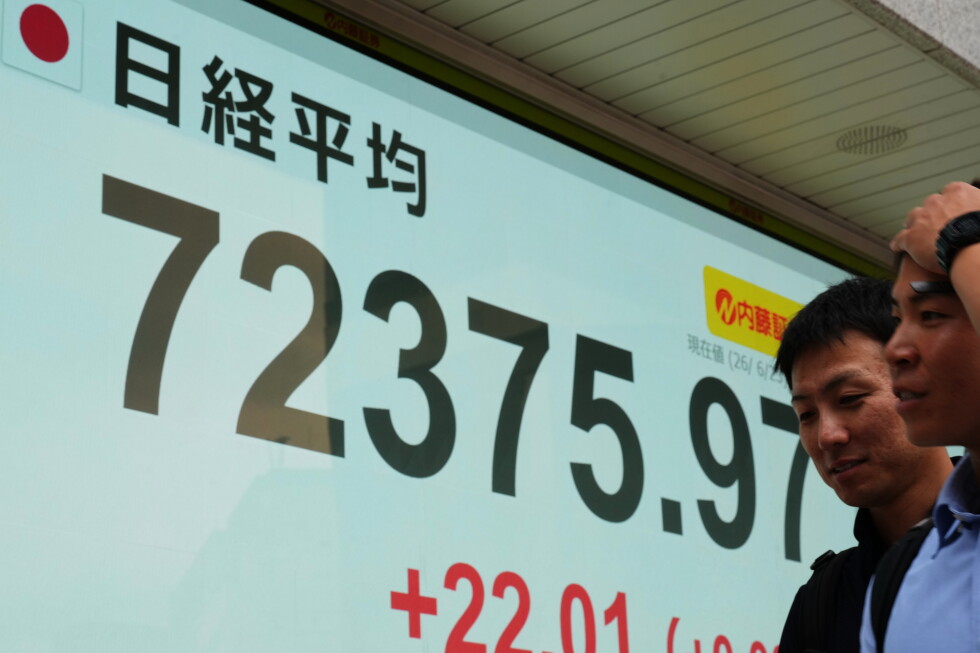
BANGKOK – Asian equity markets rallied broadly on Thursday, with technology and semiconductor stocks leading double-digit gains across Japan and South Korea. The surge came on the heels of strong earnings reports and upward guidance revisions from two major U.S. semiconductor industry leaders, Qualcomm and Micron Technology, that reignited investor confidence in the global tech sector.
Following the closing bell on Wall Street Wednesday, Qualcomm saw its share price jump 12% in after-hours trading after the firm announced a dramatic upward revision to its 2024 full-year revenue forecast, lifting the projection from an initial $22 billion to $40 billion. The company also unveiled its newest data center central processing unit, the Dragonfly C1000, which has already secured a major customer in Meta Platforms. Not to be outdone, memory chip manufacturer Micron Technology delivered its own positive update: the firm beat Wall Street analysts’ earnings and revenue estimates and raised its forward guidance, pushing its after-hours share price up nearly 16% by the end of extended trading.
These bullish U.S. chip sector results spilled over into Asian trading hours, driving sharp gains across the region’s key tech-heavy benchmark indexes. Japan’s Nikkei 225 surged 4.1% to close at 71,995.59, with semiconductor industry stocks leading the upward climb. Tokyo Electron, a leading global chip manufacturing equipment provider, gained 7.1% on the day, while Advantest, a prominent chip testing equipment manufacturer, saw its shares soar 13.4%. Across the Sea of Japan, South Korea’s benchmark Kospi index notched a new all-time closing high, jumping 5.9% to 8,968.22. Two of the country’s largest tech and chip manufacturers led gains: Samsung Electronics added 5.4% to its share price, and memory chip giant SK Hynix climbed 11.6%.
Gains were far more muted across other major Asian markets, with only small incremental increases recorded in most regional exchanges. Taiwan’s Taiex index climbed 0.8%, India’s Sensex gained 0.6%, and China’s Shanghai Composite Index edged up 0.4% to 4,125.76. Two regional bucked the upward trend: Hong Kong’s Hang Seng Index dropped 1.4% to close at 23,090.27, while Australia’s S&P/ASX 200 shed 0.5% to finish at 8,768.20.
The rally in Asian tech stocks contrasted with a mixed close for U.S. markets on Wednesday, where broader tech sector pressure capped gains for most equities. The S&P 500 slipped 0.1% to close at 7,358.22, dragged down by losses across several large-cap tech names. The Dow Jones Industrial Average, which has a far smaller weighting toward technology stocks than other major U.S. benchmarks, climbed 10.4 points to 51,848.90, while the tech-heavy Nasdaq Composite fell 0.4% to 25,476.64. Microsoft lost 2.3% of its value, Oracle slumped 4.6%, and Alphabet, Google’s parent company, slipped 0.2% ahead of its upcoming addition to the Dow Jones Industrial Average, which will take place on Monday, replacing Verizon. Alphabet will become the fifth member of the so-called “Magnificent 7” group of large U.S. tech stocks to join the Dow, joining Apple, Amazon, Microsoft, and Nvidia. Analysts have warned in recent weeks that valuations for large-cap U.S. tech stocks, which have driven the market’s record-setting rally throughout 2024, may have become stretched.
Energy markets saw significant downward movement on Wednesday as negotiations continue between the U.S. and Iran toward a potential end to their ongoing conflict, pushing global oil prices back toward levels last seen before the outbreak of the war. Brent crude, the global benchmark for oil pricing, fell 3.8% to $73.87 per barrel on Wednesday, and dropped an additional 1.3% to $72.90 in early Asian trading Thursday. U.S. West Texas Intermediate crude fell 3.9% to $70.34 per barrel on Wednesday, and lost a further 1.4% to $69.37 early Thursday. Oil prices are now edging closer to the roughly $70 per barrel trading range recorded in late February, before the Iran war began. The drop in crude pulled energy stocks lower on Wall Street, with Exxon Mobil falling 2% and Chevron losing 2.6%.
Elsewhere on Wall Street, homebuilding stocks were among the top performers Wednesday after U.S. lawmakers passed industry-friendly legislation. KB Home saw its share price surge 16.7%, while D.R. Horton jumped 6.7%.
Market focus now turns to the U.S. inflation update due later Thursday, when the U.S. Bureau of Economic Analysis will release the Personal Consumption Expenditures (PCE) price index – the Federal Reserve’s preferred measure of inflation. Economists polled by forecasters expect the report to show headline PCE inflation rose 4.1% year-over-year in May, which would mark the highest reading recorded in three years. Fed policymakers have remained concerned about persistent inflation, which has been pushed higher by tariffs that raised input costs for a wide range of goods. Inflationary pressures worsened after the outbreak of the Iran war, which pushed global energy and shipping costs higher. Analysts expect those inflationary impacts to linger even as crude oil and gasoline prices decline in recent trading.
In currency markets, the U.S. dollar edged lower against the Japanese yen early Thursday, falling to 161.75 yen from 161.75 yen in the previous session. The euro ticked slightly higher against the greenback, rising to $1.1368 from $1.1358.