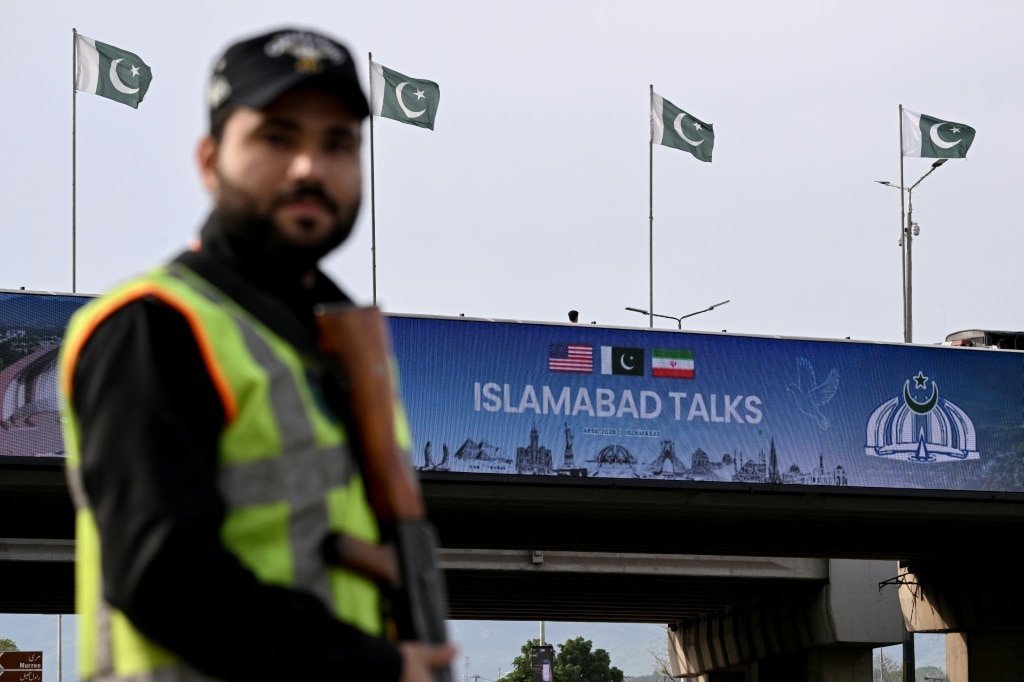
On a tightly secured Saturday in Islamabad, Pakistan, US Vice President JD Vance and a top Iranian delegation led by Parliamentary Speaker Mohammad Bagher Ghalibaf gathered for what Pakistani Prime Minister Shehbaz Sharif has framed as a “make or break” effort to end weeks of catastrophic Middle East fighting that erupted in late February.
The diplomatic gathering, months in the making through backchannel mediation, carries enormous global stakes: any lasting agreement would ease fears of a full regional war and stabilize volatile global energy markets, while a breakdown could reignite open hostilities that have already killed hundreds and destabilized the entire Middle East. But from the moment both delegations touched down, deep-seated mutual suspicion hung over the talks, with both sides openly acknowledging trust remains in short supply after decades of broken negotiating commitments.
Ghalibaf, leading a 72-member Iranian delegation that arrived overnight at Islamabad’s Nur Khan airbase, was personally greeted by Pakistan’s powerful Army Chief Asim Munir — a figure who shares established personal ties with US President Donald Trump, a detail that helped smooth the path to this week’s negotiations. Shortly after landing, Ghalibaf echoed a sentiment widely held across Iran’s political leadership, telling state media: “We have good intentions but we do not trust. Our experience in negotiating with the Americans has always been met with failure and broken promises.”
Vance, who led the US delegation that also includes senior White House envoy Steve Witkoff and Trump’s son-in-law and former senior advisor Jared Kushner, struck a similarly mixed tone before departing US soil. After a brief refueling stop in Paris en route to Pakistan, Vance said the US stood ready to negotiate in good faith: “If the Iranians are willing to negotiate in good faith, we’re certainly willing to extend the open hand. But if they’re going to try to play us, then they’re going to find the negotiating team is not that receptive.”
The current two-week ceasefire that brought both sides to the table is already teetering on collapse, underscoring the urgency of the Islamabad talks. The truce went into effect just 48 hours before Israel launched its heaviest bombardment of Lebanese territory since Hezbollah entered the war in early March, killing hundreds. Israeli strikes continued in Lebanon through Friday, with Tehran refusing to accept Israel’s position that the truce does not extend to the country. Hezbollah, the Iran-aligned militant group, responded overnight with fresh drone and rocket attacks targeting northern Israel and Israeli troops in southern Lebanon, keeping the cycle of violence active even as diplomats gathered in Pakistan.
Multiple core sticking points remain unresolved before talks can even move toward a lasting deal. Iran has demanded the ceasefire formally cover Lebanon and that billions in frozen international assets be unfrozen — two conditions that have yet to be met. For the US, Trump has made the full reopening of the Strait of Hormuz, the strategic waterway through which roughly one-fifth of the world’s global crude oil shipments pass, a non-negotiable condition for extending the ceasefire. The strait has yet to return to normal shipping operations, and Trump reiterated Friday that Washington would open it “with or without” Iran’s cooperation if no deal is reached. Beyond the strait, Trump told AFP that preventing Iran from acquiring a nuclear weapon remains Washington’s top priority, representing “99 percent” of the US agenda at the talks.
Pakistan, which pulled off last-minute mediation to bring the historic adversaries to the same capital, has already assembled a specialized team of technical experts to facilitate discussions on navigation, nuclear non-proliferation, and other core disputed issues. The country has ramped up security across Islamabad, deploying heavy police and paramilitary forces to the central diplomatic “red zone” and clearing the city’s top luxury hotel of all other guests to house the delegations. It remains unclear whether US and Iranian negotiators will meet face-to-face, or will follow the indirect format used in earlier Oman-mediated talks held before the outbreak of open war.
The talks are being closely coordinated with other major global and regional mediators, including Egypt, Turkey, and China, all of which helped lay the groundwork for negotiations. Trump confirmed to AFP that China played a key role in convincing Tehran to attend the talks, and official sources say Beijing has been floated as a potential guarantor for any final lasting agreement. It remains unclear, however, whether China will send a formal delegation to the talks or agree to take on the official guarantor role.
Public sentiment in Iran remains deeply skeptical of a breakthrough: a 30-year-old Tehran resident told AFP that most of Trump’s public statements are “pure noise and nonsense” to ordinary Iranians. Even as delegations prepared for their first formal meetings, Iran’s state media devoted only a brief segment to the talks in its first Saturday morning broadcast, with a subsequent segment focused on civilian volunteers signing up to defend the country if fighting resumes. For all the high hopes placed on Pakistan’s mediation, the coming days will test whether the two bitter adversaries can set aside decades of hostility to reach a deal that ends the current conflict before it spirals into a wider regional war.