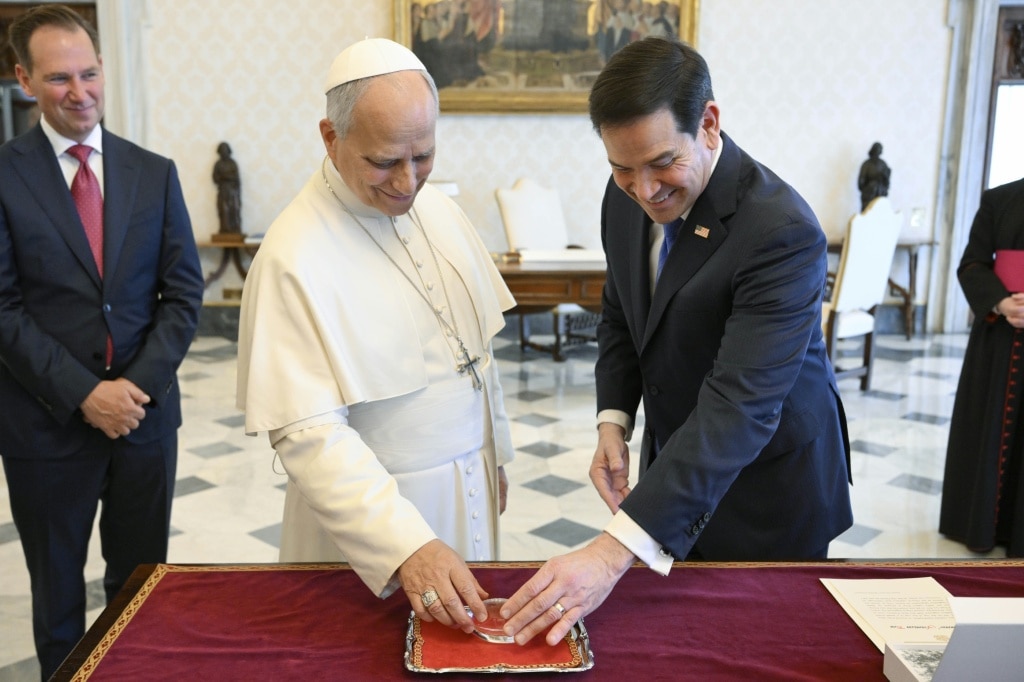
Weeks after U.S. President Donald Trump launched an unprecedented public attack on the first American-born pope in history, Secretary of State Marco Rubio held a high-stakes private audience with Pope Leo at the Vatican on Thursday, with the U.S. State Department moving quickly to underscore the enduring, robust relationship between Washington and the Holy See.
The closed-door talks between Rubio, a devout Cuban-American Catholic, and the head of the world’s 1.4 billion Catholics came amid a sharp downturn in relations that began after Pope Leo spoke out against the ongoing Middle East war backed by the U.S. and Israel. The pontiff also drew Trump’s fury when he condemned the president’s threat to destroy Iranian civilization as “truly unacceptable,” leading Trump to hit back with scathing criticism that accused the pope of being weak on crime, poor on foreign policy, and soft on Iran’s nuclear program.
Following the meeting, State Department spokesperson Tommy Pigott confirmed that the two leaders covered a range of shared priorities, including the volatile situation in the Middle East and mutual interests across the Western Hemisphere, a U.S. reference to the Latin American region. Pigott emphasized in a statement to reporters that the gathering “underscored the strong relationship between the United States and the Holy See and their shared commitment to promoting peace and human dignity.” A senior U.S. official also confirmed that the longstanding diplomatic role of the Catholic Church in Cuba was included in the discussions, a topic of particular relevance for Rubio, who has spearheaded the Trump administration’s push for major political change in the communist-governed island nation.
Rubio also held separate talks with Vatican Secretary of State Pietro Parolin, where the pair touched on issues of global religious freedom, per Pigott. Ahead of the meeting, Rubio had sought to downplay the public rift between Trump and the pope, which has dominated global headlines and sparked concerns that the friction could alienate Catholic voters ahead of upcoming elections. U.S. Ambassador to the Holy See Brian Burch had previewed the discussion as a likely “frank conversation,” while Parolin noted Wednesday that the meeting was initiated by Washington, adding simply, “we’ll listen to him.”
It has been exactly one year since Pope Leo’s historic election on May 8, 2025, a milestone the Trump administration publicly celebrated at the time. But relations between the White House and the Vatican have deteriorated rapidly in recent months, as Pope Leo — whose American citizenship gives his words unique weight in U.S. political discourse — has repeatedly broken with the administration, most notably on Trump’s hardline immigration crackdown.
In a further sign of lingering tensions, Trump renewed his criticism of the pope in an interview just this week, repeating his allegation that the pontiff tolerates Iran’s pursuit of nuclear weapons. “I think he’s endangering a lot of Catholics and a lot of people,” Trump claimed. When asked about the new comments earlier this week, Pope Francis pushed back gently, reaffirming the Catholic Church’s longstanding core mission. “If anyone wishes to criticise me for proclaiming the Gospel, let them do so truthfully,” he told reporters. “The Church has spoken out against all nuclear weapons for years, so there is no doubt about that, and I simply hope to be heard for the sake of the value of God’s word.” Parolin added Wednesday that the attacks on the pope were confounding, noting simply, “The pope is being the pope.”
Despite the underlying tensions, a U.S. source close to the delegation said the warm welcome extended to Rubio exceeded expectations. The secretary of state’s motorcade entered the Vatican through the Arch of Bells, a ceremonial honor typically reserved exclusively for heads of state, and he was formally received by the Pontifical Swiss Guard. This meeting marked the second encounter between Rubio and Pope Leo; the pair first met at the Vatican just days after last year’s election, alongside U.S. Vice President JD Vance, a convert to Catholicism.