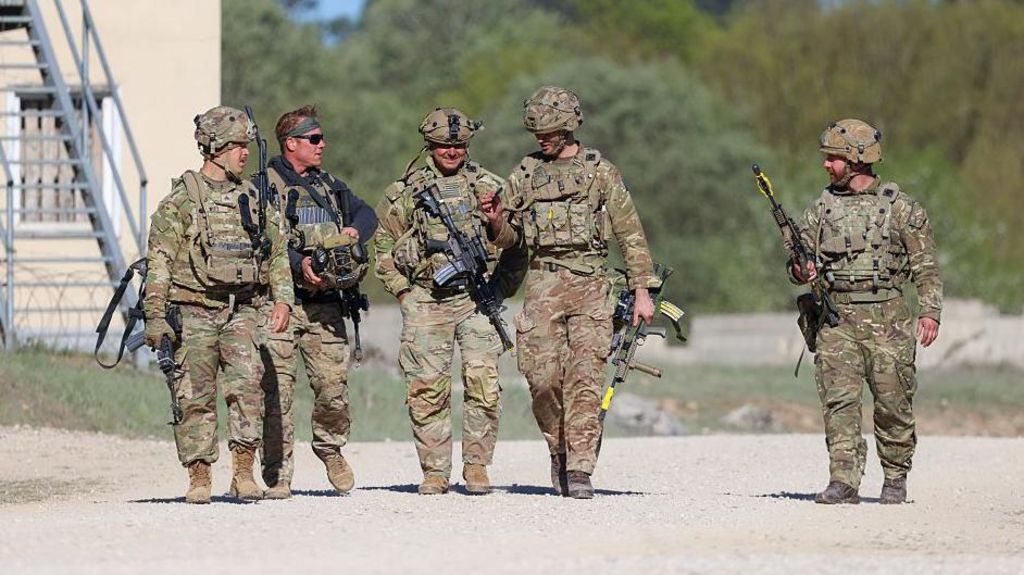
A sharp public diplomatic clash between U.S. President Donald Trump and German Chancellor Friedrich Merz over the ongoing Iran conflict has triggered a formal Pentagon plan to withdraw 5,000 American military personnel from Germany, with the drawdown scheduled to unfold over the next 6 to 12 months. The announcement of the troop withdrawal came just 24 hours after Merz delivered critical remarks that stung the White House: speaking to university students earlier this week, the German leader argued that the U.S. lacked a coherent strategy for the Iran war, claiming Iranian negotiators had effectively humiliated Washington by drawing out talks and leaving American officials empty-handed after high-profile meetings in Islamabad.
Merz’s comments quickly drew a fiery retaliation from Trump on his social platform Truth Social. The U.S. president accused Merz of supporting Iran’s nuclear ambitions, dismissed his commentary as uninformed, and lambasted Germany’s overall economic performance. Beyond his attack on the German chancellor, Trump also broadened his criticism of NATO allies who have declined to join U.S. efforts to reopen the Strait of Hormuz amid the Iran conflict, a longstanding point of friction for the president, who has been an open critic of the alliance for decades. When asked Thursday if he would also consider pulling American troops from other NATO members Italy and Spain, Trump did not rule out the move, saying “I probably will” and accusing both countries of refusing to assist the U.S. in the Iran conflict, calling their inaction unacceptable.
Pentagon spokesman Sean Parnell confirmed in an official statement that the order for the German drawdown originated with Secretary of Defence Pete Hegseth. Parnell framed the decision as the outcome of a comprehensive review of U.S. military force posture across Europe, saying the adjustment aligns with current theater requirements and on-the-ground conditions. As of last December, the U.S. maintains more than 36,000 active-duty troops deployed across bases in Germany, making it the largest American military footprint in Europe and the second-largest globally, only trailing the U.S. troop presence in Japan. Germany’s Ramstein Air Base, located outside Kaiserslautern in southwestern Germany, serves as a critical logistics and command hub for U.S. operations across the continent.
This is not the first time Trump has pushed for U.S. troop reductions in Germany. During his first term in 2020, he proposed relocating 12,000 troops out of Germany to other NATO nations or back to the U.S., but the plan was ultimately blocked by Congress and later reversed entirely by his successor, President Joe Biden. At that time, Trump justified the proposed cuts by accusing Germany of failing to meet NATO’s military spending target of 2% of GDP, calling the country delinquent in its alliance obligations. That dynamic has shifted significantly under Merz’s government: Germany is on track to hit 3.1% of GDP in total defense spending by 2027, hitting 2027 levels of €105.8 billion (£91 billion), far exceeding the alliance’s requirement. Currently, the U.S. also stations roughly 12,000 troops in Italy and 10,000 more in the United Kingdom.